






Inside This Week’s Economic Brief
This week’s Economic Brief covers the World Bank’s report on India’s poverty reduction, Maharashtra and Kerala’s investment-led growth, Europe’s affordability-driven unrest, and economic anxiety shaping the US midterm elections.
This week’s edition of The Economic Brief on DD India examined three major stories: a World Bank report on India’s sweeping poverty reduction, state-level growth momentum in Maharashtra and Kerala, and the economic pressures driving unrest across Europe and shaping the US midterm elections. The episode featured extensive analysis from Dr. Amit Kapoor, honorary chairman at the Institute of Competitiveness India.
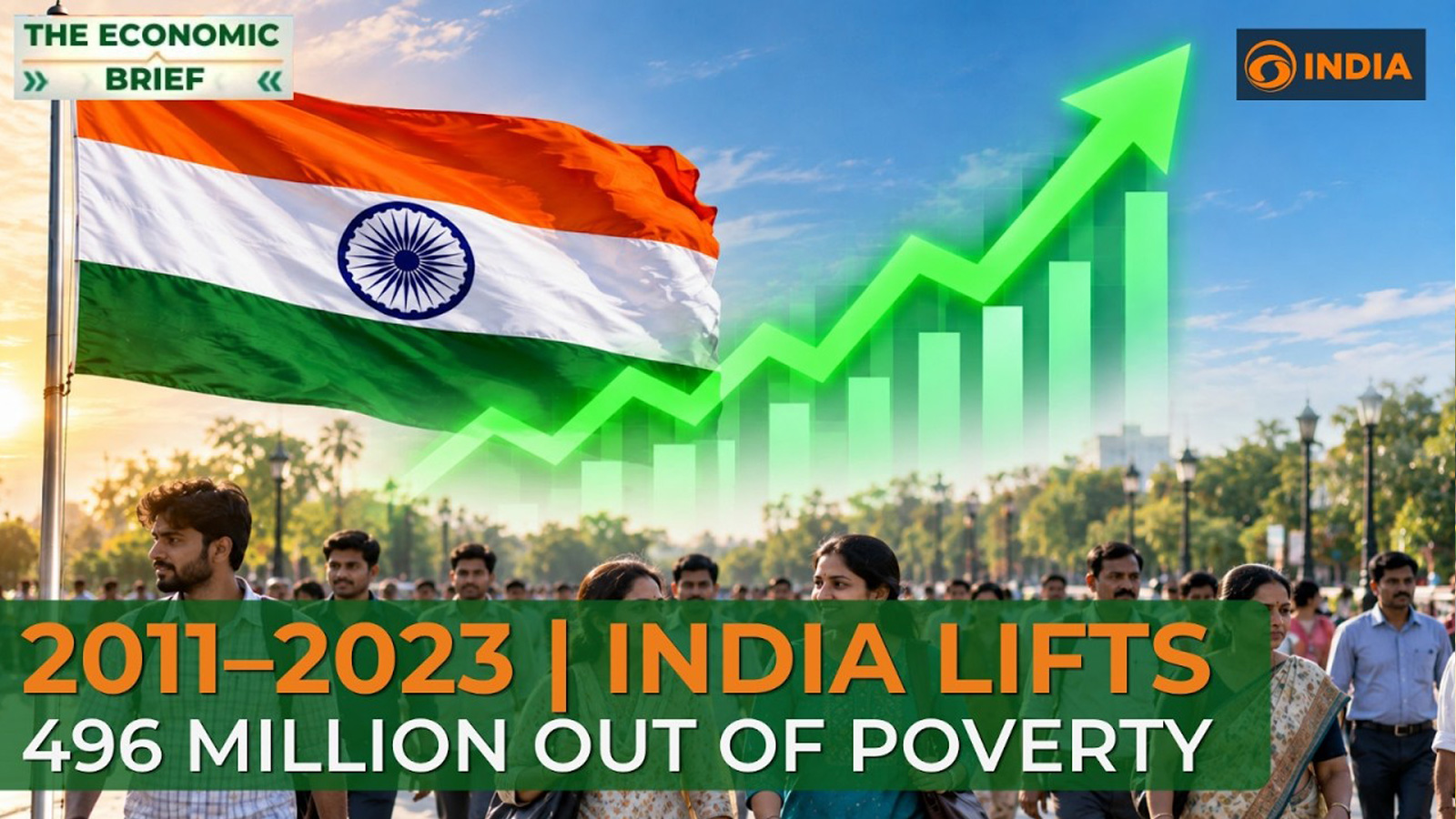
World Bank: India Lifted 496 Million Out of Poverty Between 2011 and 2023
The World Bank reported a sharp, broad-based reduction in poverty across both monetary and non-monetary dimensions — higher literacy, better nutrition and sanitation, cleaner air, more jobs, and greater social participation. Key findings include:
● 496 million people lifted out of poverty, with the poverty rate (living on less than $4.20 a day) falling from 57.7% to 16.1%, and extreme poverty (under $2.15 a day) dropping from 27.1% to just 2.6%.
● The rural-urban poverty gap has narrowed sharply, from 7.7 to 1.7 percentage points, as rural extreme poverty fell from 18.4% to 2.8% and urban extreme poverty from around 11% to 1.1%.
● Five populous states — Uttar Pradesh, Maharashtra, Bihar, West Bengal, and Madhya Pradesh — drove roughly two-thirds of the total extreme poverty reduction.
● Income inequality has eased, with the Gini coefficient falling from 28.8 to 25.1, indicating wealth is becoming less concentrated.
● Poverty is projected to decline further by 2028 given continued gains in infant mortality, literacy, housing, and social inclusion.
Dr. Amit Kapoor called the achievement significant for India’s domestic demand, noting that higher disposable incomes among the newly non-poor are fueling consumption-driven growth, visible in India’s recent 7.8% GDP print and this year’s festive season spending. He noted this demand remains largely for basic goods rather than sophisticated products, but said it still drives substantial manufacturing and services activity.
Maharashtra and Kerala Drive State-Level Growth
Maharashtra is targeting a $1 trillion economy by 2030, up from roughly $450 billion in FY22-24, under Chief Minister Devendra Fadnavis’s infrastructure-led strategy to reduce dependence on Mumbai by developing Vidarbha, Marathwada, North Maharashtra, and Konkan through logistics hubs in Nagpur, electronics in Nashik, and automobiles in Aurangabad. The state is positioning itself as a hub for electric vehicles, semiconductors, batteries, and clean technology, though funding gaps remain to be filled through bank-government partnerships.
Kerala’s investment momentum has also surged, with ₹4,646 crore recorded in the April-June 2026 quarter — nearly triple the same period last year and exceeding the cumulative receipts of the previous two years combined. Unlike manufacturing-focused states, Kerala leans on tourism, ports and logistics centered around Kochi, healthcare infrastructure, and proposed land-reform legislation to simplify approvals.
Dr. Kapoor said the right business ecosystem — industrial clusters, skilled labor, and favorable regulatory policy — is essential for states to attract investment, pointing to Aurangabad’s automotive cluster as a model. He noted Maharashtra alone contributes close to 16% of India’s GDP, calling it a challenge for other states to replicate that ecosystem at similar scale.
Affordability Crisis Fuels Unrest Across Europe
Rising living costs are reshaping politics across France, Spain, Portugal, Belgium, Greece, and the Czech Republic, even as headline inflation eases. Housing has become the central flashpoint in Spain and Portugal, while French protests over school conditions have broadened into wider concerns over purchasing power and public services. Average eurozone inflation remains near 4%, and youth unemployment and underemployment affect roughly 24% of young people, compounding a widening gap between expectations and stagnant real incomes.
Dr. Kapoor attributed the crisis to compounding shocks since COVID-19, the Ukraine war, and the ongoing US-driven trade war, all straining European energy prices and budgets. He said governments must move beyond short-term crisis management to invest in education, healthcare, and job quality, warning that Europe is losing ground to China and the US on innovation and R&D spending. On housing, he suggested converting underused commercial space and developing suburban infrastructure with low-rental government schemes as near-term fixes with broader economic multiplier effects.
Economic Anxiety Dominates US Midterm Elections
With all 435 House seats and roughly a third of the Senate at stake on November 3, surveys show the economy dominating voter concerns: 84% of registered voters call it very important to their vote, 85% cite cost of living as a top issue, and 74% disapprove of President Trump’s economic handling, according to Pew Research and AP-NORC data. Energy prices worry 74% of adults, food and consumer goods costs concern 73%, healthcare 69%, and housing 66%. Disruptions around the Strait of Hormuz pushed US gasoline from about $2.98 to over $4 a gallon and diesel from $3.76 to $6.35 since February, prompting Trump to relax Russia-related oil sanctions to ease prices.
Key Takeaways
India’s poverty reduction marks a historic, broad-based achievement now fueling consumption-led growth, while states like Maharashtra and Kerala are pursuing distinct investment strategies to capture it. Europe’s affordability crisis reflects deeper structural strain from compounding global shocks, demanding long-term reform rather than crisis management. And economic anxiety over costs and tariffs has made the economy the defining issue of the US midterm elections.


