






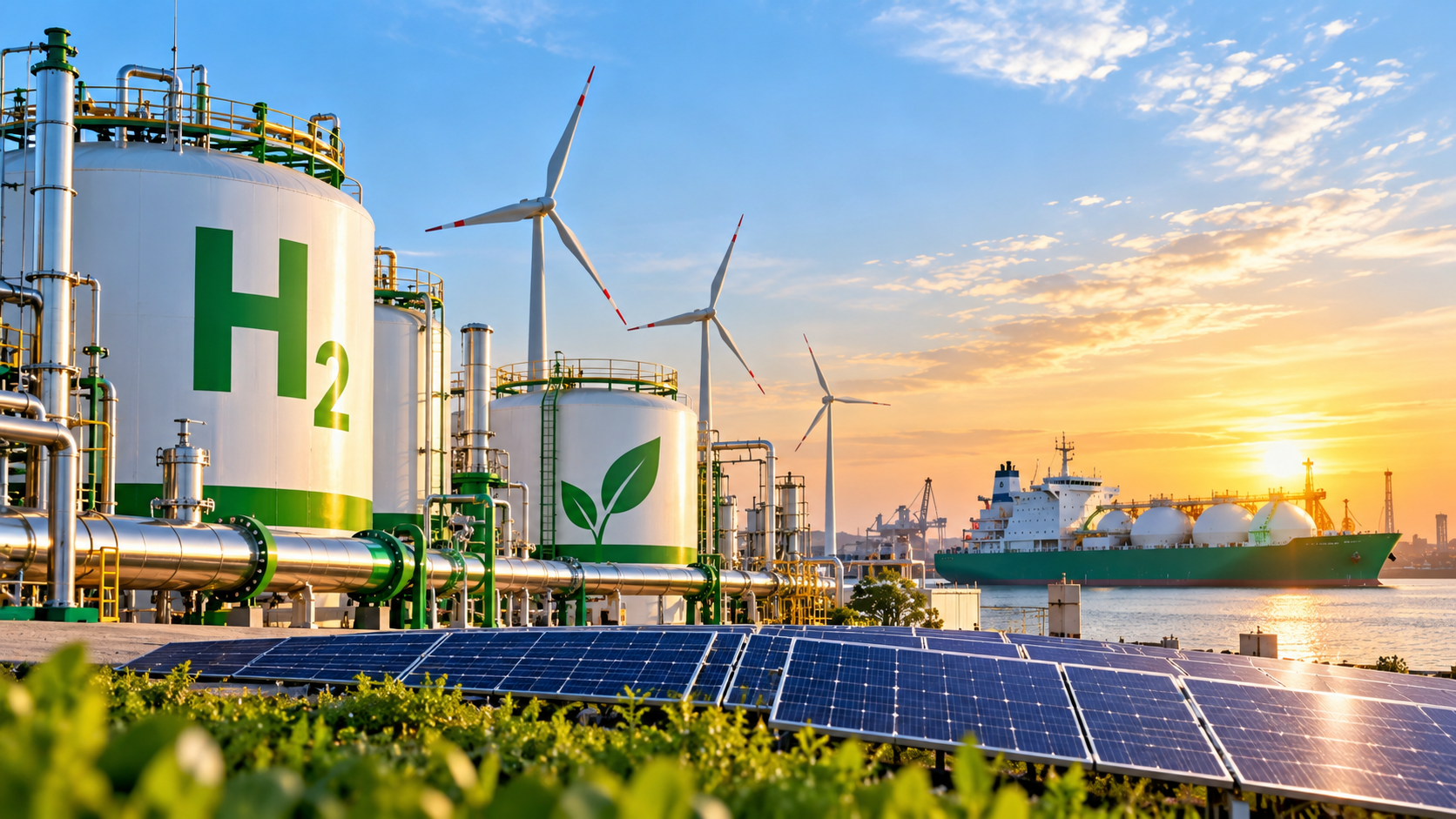
India has secured firm and signed green hydrogen offtake commitments totalling 5,55,610 metric tonnes per annum (MTPA) as of October 2026, positioning the country among the leading players in the global green hydrogen market, according to the Ministry of New and Renewable Energy.
Indian companies signed 18 new offtake agreements in 2026 for the supply of more than 4 lakh MTPA of green hydrogen equivalent. Since the launch of the National Green Hydrogen Mission in 2023, a total of 23 offtake contracts covering approximately 5.5 lakh MTPA have been signed, with more than 70 per cent of the contracted volumes earmarked for exports.
The projects are expected to attract investments of around ₹90,000 crore, equivalent to approximately 9.5 billion US dollars, reflecting growing interest in India’s emerging green hydrogen and derivatives market.
Green hydrogen derivatives, including green ammonia and green methanol, are gaining importance as cleaner alternatives in sectors such as fertiliser production, petroleum refining, shipping and power generation.
National Green Hydrogen Mission: The Roadmap
The National Green Hydrogen Mission was approved by the Union Cabinet in 2023 with an initial outlay of ₹19,744 crore up to 2029-30. The mission aims to establish India as a global hub for the production, use and export of green hydrogen.
By 2030, the mission targets annual green hydrogen production of at least 5 million metric tonnes. Its expected outcomes include the addition of 125 GW of renewable energy capacity, investments exceeding ₹8 lakh crore, the creation of more than six lakh full-time jobs and the avoidance of 50 million metric tonnes of carbon dioxide emissions annually.
The latest offtake commitments are equivalent to around 11 per cent of the mission’s production target, according to the government.
Offtake agreements are important because they establish commitments by buyers to purchase specified quantities of a product. Such agreements can provide producers with greater demand visibility, helping them plan projects, mobilise investments and develop supply chains.
Indian Companies Expand Global Partnerships
Indian companies have entered into agreements with buyers across Japan, Germany, South Korea and other markets to supply green ammonia, green methanol and related renewable fuels.
ACME Group has signed an agreement with Japan’s IHI for the supply of 4,88,000 metric tonnes of green ammonia annually. The company has also signed an agreement to supply 1,00,000 MTPA of green methanol to Mitsubishi Gas Chemical.
Larsen & Toubro and Japan’s ITOCHU have formed a special purpose vehicle for the supply of 3,00,000 tonnes of green ammonia annually, with deliveries expected to begin in December 2029.
Reliance Industries Limited has entered into a long-term supply and purchase agreement with South Korea’s Samsung C&T Corporation, valued at more than 3 billion US dollars. Deliveries under the agreement are expected to begin by 2028.
AM Green has secured a long-term purchase agreement under the H2Global auction for supplying renewable ammonia to Germany. The agreement provides for purchases worth at least 585 million euros over 10 years, with initial deliveries expected in 2029. The company has also signed a firm offtake agreement with Germany’s Uniper for 2,50,000 MTPA of green ammonia and a binding agreement with Japan’s JERA for 70,000 MTPA.
Other agreements include Agastya’s proposed supply of 2,50,000 MTPA of green methanol to Sri Lanka’s SAR and Jouno Joules’ agreement with Select Energy GmbH for 600 tonnes per day of green ammonia, equivalent to approximately 2,19,000 MTPA.
These partnerships are expected to strengthen India’s presence in international markets for low-carbon industrial fuels and support the development of export-oriented production capacity.
Why Are Green Ammonia and Green Methanol Important?
Green hydrogen is produced using renewable energy to split water through electrolysis. When produced with qualifying renewable electricity and meeting applicable emissions criteria, it can help reduce dependence on fossil fuels.
Green ammonia, produced using green hydrogen as a feedstock, can serve as a lower-emission alternative in fertiliser manufacturing. It is also being explored as a fuel for shipping and for co-firing in thermal power plants.
Green methanol is another hydrogen-derived fuel with potential applications in shipping and industrial processes.
These products can help reduce emissions in sectors where direct electrification is difficult. However, their environmental benefits depend on how they are produced, the energy sources used and the emissions associated with their transport and use.
India’s competitive production costs and access to renewable energy are among the factors that could support its position in international markets, according to the government.
Domestic Demand Gains Momentum
Alongside export commitments, the government is encouraging domestic industries to adopt green hydrogen through the Strategic Interventions for Green Hydrogen Transition (SIGHT) Programme under the National Green Hydrogen Mission.
Under the programme, agreements have been signed for the production and supply of 6,70,000 MTPA of green ammonia to 11 fertiliser units across the country.
Projects have also been awarded for the production and supply of 30,000 MTPA of green hydrogen to refineries operated by Indian Oil Corporation Limited (IOCL), Bharat Petroleum Corporation Limited (BPCL), Hindustan Petroleum Corporation Limited (HPCL) and Numaligarh Refinery Limited (NRL).
These initiatives aim to create domestic demand, encourage industrial decarbonisation and support the development of a local green hydrogen supply chain.
The Road Ahead
India’s green hydrogen sector is expanding through a combination of export-oriented offtake agreements, domestic procurement programmes and government-backed investment initiatives.
The commitments recorded so far indicate growing interest in green ammonia and green methanol as alternatives for industrial and energy applications. Their conversion into operational projects will depend on financing, renewable energy availability, production costs, infrastructure development and the timely execution of supply agreements.
As the National Green Hydrogen Mission advances towards its 2030 targets, the development of reliable production capacity and sustained domestic and international demand will be key to India’s ambition of becoming a major global supplier of green hydrogen and its derivatives.
-PIB


