






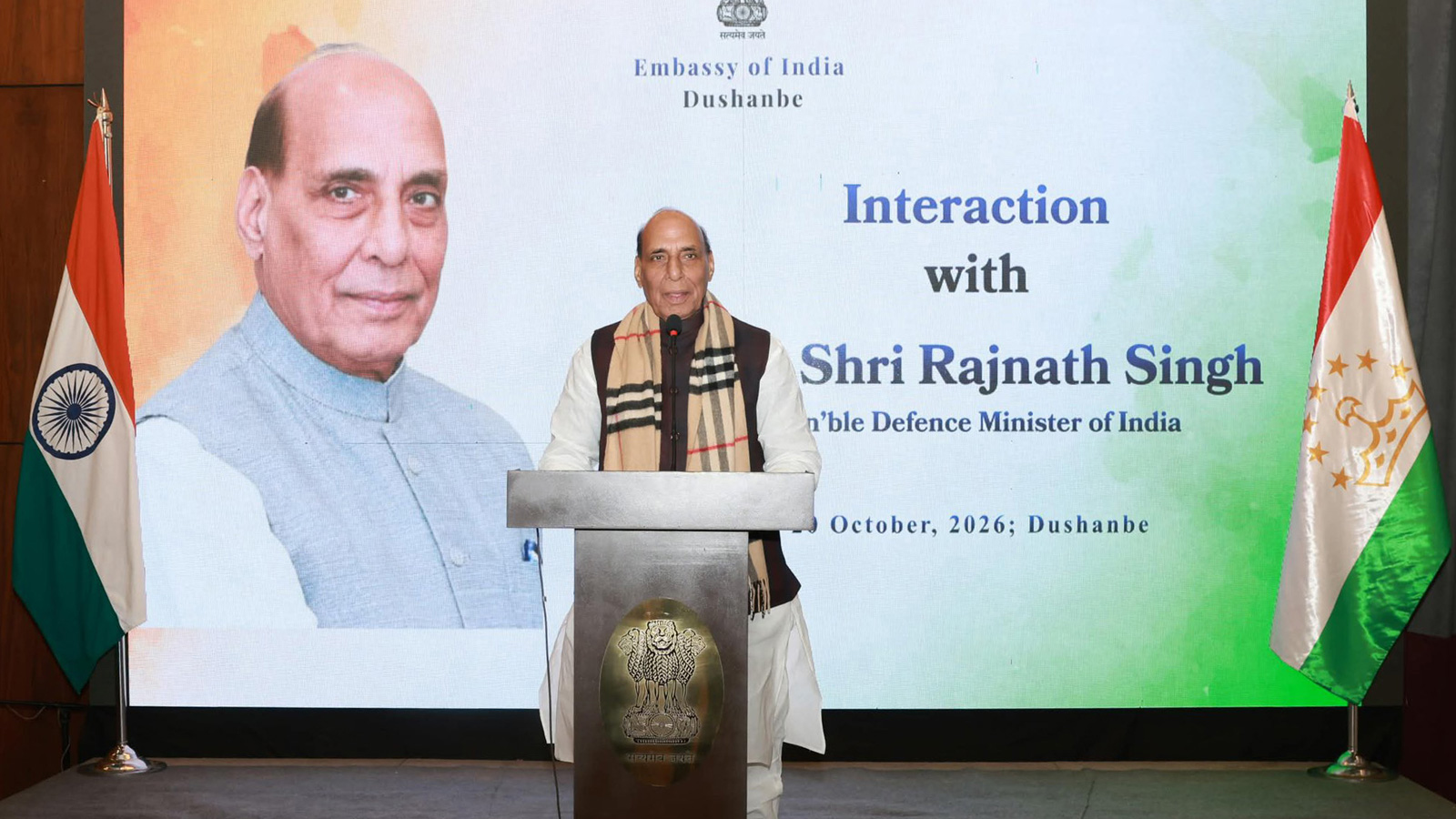
Defence Minister Rajnath Singh on Tuesday said India was working to combine economic prosperity, knowledge and strength with a commitment to global peace and human well-being, as he addressed the Indian diaspora in Dushanbe, Tajikistan.
Guided by the philosophy of Vasudhaiva Kutumbakam, or “the world is one family”, India’s development ambitions extended beyond national progress, Singh said. He credited economic reforms, technological advancement and the country’s growing international stature with supporting this vision.
Highlighting India’s economic performance, Singh said the country contributed more than 16 per cent to global economic growth and was expanding at approximately 7.8 per cent despite a slowdown in several major economies.
He said India had entered into free trade agreements with 38 countries, opening markets for manufacturers and producers. He added that the India-UK and India-EU trade agreements were expected to eliminate tariffs on 99 per cent of Indian exports to those markets.
Describing a shift in governance from “policy paralysis” to a “reform express”, Singh said: “For us, reforms are not a compulsion; they are a conviction.”
The Minister said the current account deficit had declined from more than four per cent of GDP 12–13 years ago to 0.61 per cent in the previous financial year. Foreign exchange reserves had crossed $700 billion, he added.
On defence manufacturing, Singh said exports had reached ₹38,424 crore, while production had risen to ₹1.80 lakh crore.
He also highlighted the expansion of India’s startup ecosystem to more than 2.5 lakh enterprises. Nearly half originated from smaller cities and towns, while more than 45 per cent had at least one woman director or partner, he said.
Singh credited affordable mobile data and wider connectivity with expanding access to opportunities. He said the value of UPI transactions had increased from ₹7,000 crore in 2016–17 to ₹314 lakh crore in 2025–26.
Around 25 crore people had been lifted out of poverty over the past decade, he said, highlighting the role of the Jan Dhan-Aadhaar-Mobile framework and Direct Benefit Transfer in improving the delivery of government assistance.
The minister also outlined progress in renewable energy, semiconductor manufacturing, transport infrastructure and space technology. Referring to efforts under the Semicon India programme and India Semiconductor Mission, he said, “We’re moving towards manufacturing both ships and chips, strengthening our position in strategic sectors.”
Singh praised the Indian diaspora as cultural ambassadors who preserved India’s traditions while contributing to their host countries. He said India and Tajikistan shared longstanding friendly relations, reinforced by the popularity of Indian music, literature and cinema among Tajik people.
During the event, he felicitated Indologist Prof. Habibullo Rajabov, Tajikistan’s first Padma Shri recipient, for his contributions to Hindi literature, education and philology. Indian and Tajik artists also presented cultural performances.


