






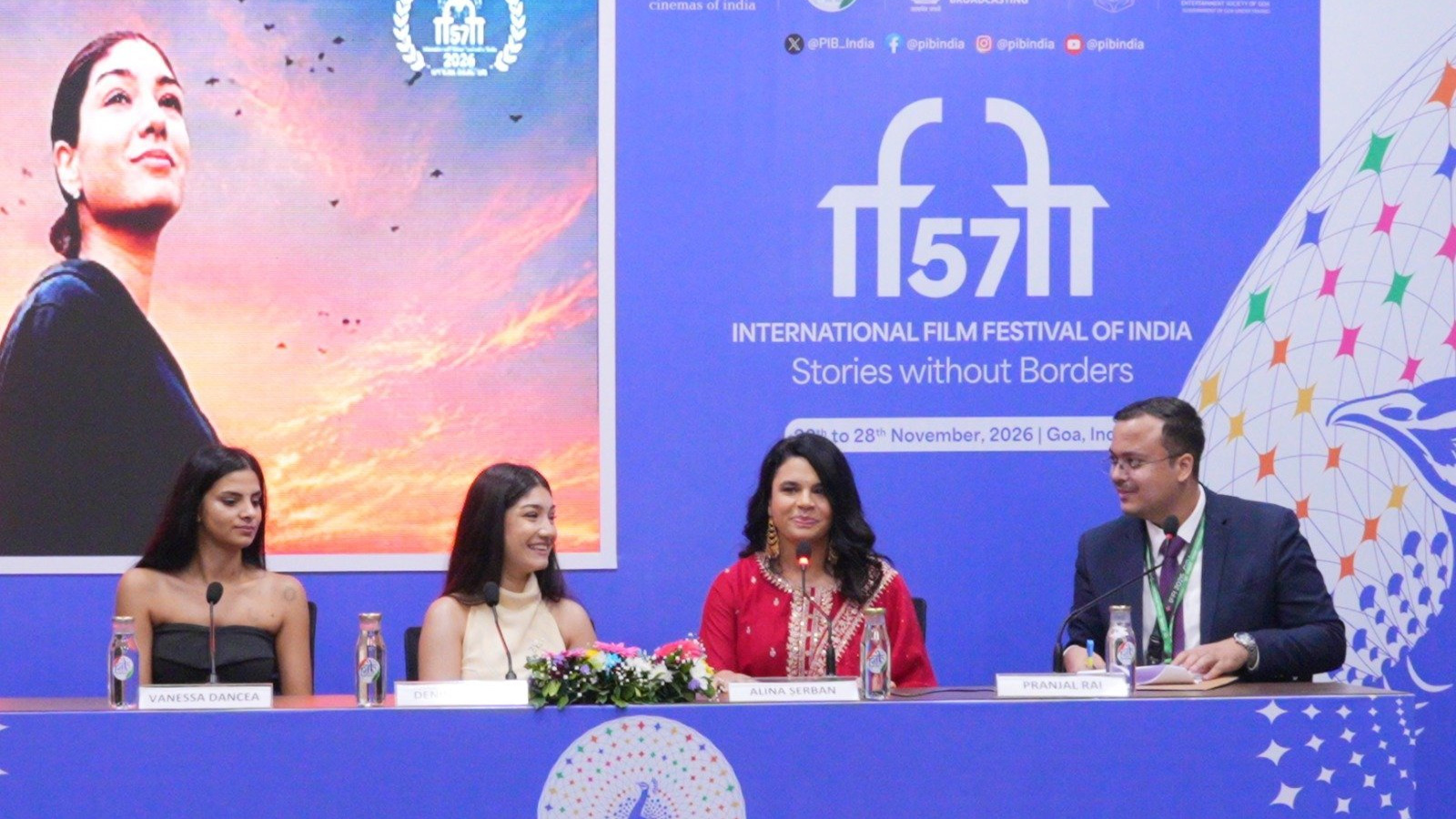
Romanian-Roma filmmaker Alina Șerban has called for greater visibility of the Roma community through cinema, saying many of its stories remain untold despite the community’s significant cultural influence. Her film I Matter (Eu Contez), the Mid-Fest selection at the 57th International Film Festival of India (IFFI) in Goa, explores identity, family, belonging and the possibility of building a future beyond one’s past.
Speaking at a media interaction organised by the Press Information Bureau (PIB) on the sidelines of IFFI on Tuesday, Șerban discussed the inspiration behind the film, its portrayal of the Roma community and the need to challenge stereotypes through storytelling. Lead actresses Denisa Farcaș and Vanessa Dancea also participated in the interaction.
The multilingual drama, featuring dialogues in Romanian and Romani, had its Indian premiere at IFFI. A co-production of Romania, Germany and Belgium, the film follows Rebeca, a young Roma woman preparing to leave the orphanage she has considered home. Hoping to reunite with her father, who is about to be released from prison, she dreams of building the family she has always longed for. Her admission to university to study acting offers her an opportunity to begin a new chapter in life.
Challenging Stereotypes Through Cinema
Explaining the film’s approach to representation, Șerban said she wanted to explore different dimensions of humanity rather than present a one-dimensional portrayal of the Roma community.
“The film asks questions about who deserves to be a human. I want to portray different layers of humanity,” she said.
She noted that the Roma community continues to face social marginalisation despite its influence on global culture. Citing flamenco as an example of its cultural contribution, she said, “Our culture, like flamenco, has impacted universal culture. But we are still at the margins of society. We live so close to other people, but they still don’t know us.”
Șerban said the film was also conceived as a message of encouragement, particularly for young people from disadvantaged backgrounds. She wanted them to see possibilities beyond the circumstances into which they were born and recognise that they, too, have a place in the world.
“I wanted to tell a story that would empower, first and foremost, young people from disadvantaged groups. I wanted to tell them what I also needed to hear: that I will manage, that there is maybe a small place for each of us in the world,” she said.
The filmmaker also expressed happiness at presenting the film at IFFI, describing her visit to India as a homecoming.
Portraying Rebeca Becomes a Journey of Self-Acceptance
Lead actress Denisa Farcaș, who plays Rebeca, described the film as a deeply personal experience that changed her relationship with her own identity.
Recounting her initial hesitation about acknowledging her Roma ethnicity, Farcaș said the experience of portraying the character helped her see her community in a more positive light. “For the first time, I saw Roma people in a positive light,” she said.
She added that working on the role helped her overcome the shame she had associated with her identity and embrace her heritage with pride. “I am proud to be Roma,” she said, expressing happiness that the experiences and stories of the community, particularly its children, were receiving attention.
The interaction, moderated by Pranjal Rai, highlighted cinema’s potential to challenge social prejudices, bring marginalised voices into the mainstream and encourage audiences to look beyond stereotypes.
(PIB)


