






Inside Tuesday’s Edition of Connecting the Dots
This edition of Connecting the Dots examines the International Court of Justice’s landmark ruling that Myanmar committed genocide against the Rohingya, and why COP31 in Antalya ended without a major political agreement on fossil fuels and climate finance.
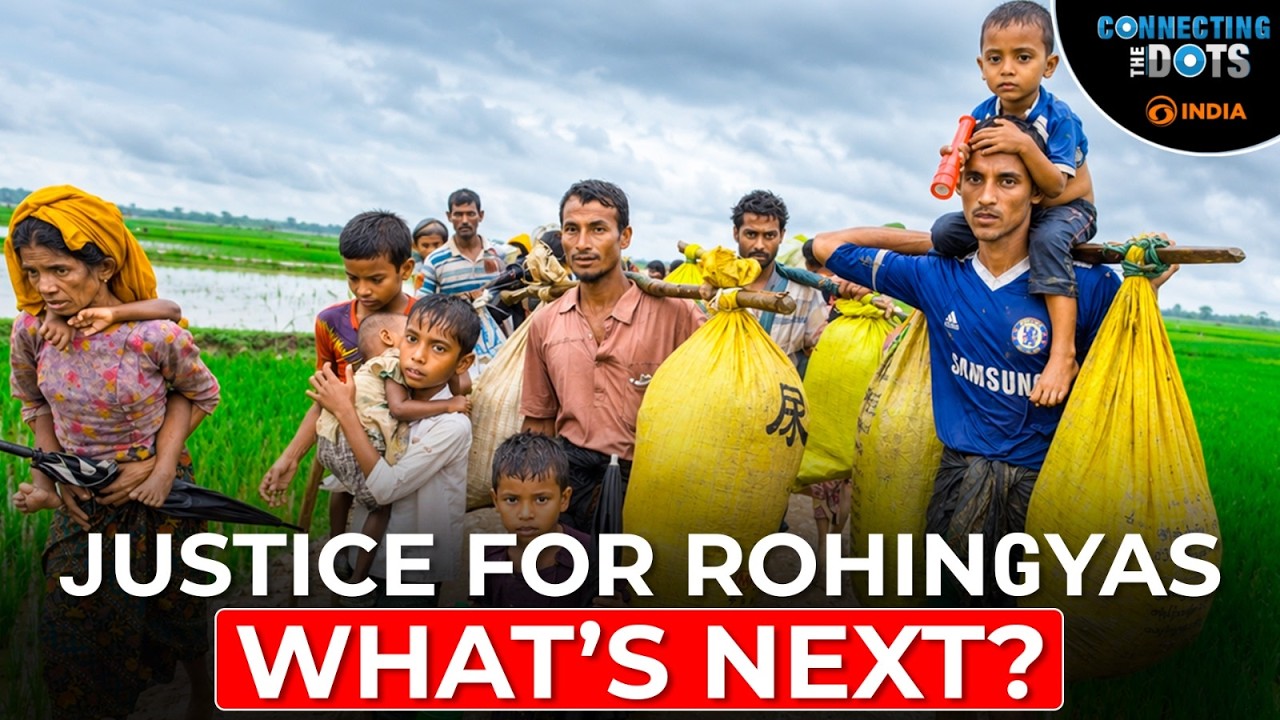
This edition of Connecting the Dots on DD India examined two major stories: the International Court of Justice’s historic ruling that Myanmar committed genocide against the Rohingya, and what it means for Bangladesh, China, India and the prospects of repatriation; and the collapse of consensus at the COP31 climate summit in Antalya, Turkey, where nearly 200 countries failed to agree on fossil fuels and climate finance.
ICJ Rules Myanmar Committed Genocide Against the Rohingya
In a judgment described as a landmark moment for international law, the International Court of Justice ruled for the first time that Myanmar committed genocide against the Rohingya during the military’s 2017 operations in Rakhine State. The court found that Myanmar’s security forces killed thousands of Rohingya civilians, carried out widespread sexual violence and acts of extreme violence against children, destroyed hundreds of Rohingya villages and attacked Rohingya as they fled in large numbers to Bangladesh. The key finding was reached by nine votes to six. The court ordered Myanmar to facilitate the safe return of displaced Rohingya, prosecute those responsible and compensate victims.
Myanmar rejects the ruling. Myanmar’s military-backed government called the judgment unfair, highlighted that the decision was not unanimous and insisted the 2017 campaign was a counterinsurgency operation against militants rather than an attempt to destroy the Rohingya community. It said it would study the judgment but gave no indication it would accept the court’s conclusions. This underscores the central challenge: the ICJ can issue judgments but has limited means of enforcing them, leaving implementation dependent on political pressure. One analyst suggested the most viable route is for states party to the Rome Statute to use universal jurisdiction to build cases against individuals directly responsible for the 2017 crimes.
A diplomatic victory for Bangladesh. Nearly a decade after the 2017 exodus, Bangladesh still hosts more than a million Rohingya refugees, most of them in the crowded camps of Cox’s Bazar. Successive Bangladeshi governments have rejected permanent resettlement elsewhere in favour of the safe, voluntary and dignified return of refugees to Myanmar, a position the ruling strengthens by explicitly calling for restitution and return. Bangladesh welcomed the decision, urged Myanmar to implement it without delay and said the judgment allows it to negotiate from a position of strength with multilateral agencies and bilateral partners, while acknowledging that return “won’t happen tomorrow.”
Repatriation, however, remains far easier to demand than to achieve. Previous attempts have failed because many refugees fear persecution and want guarantees of citizenship, security, freedom of movement and legal rights before returning, while ongoing conflict in Rakhine makes return almost impossible for now. The most tangible outcome so far, one analyst said, is recognition: the ruling strengthens the Rohingya’s claim to belong to Myanmar.
China’s role. Beijing, Myanmar’s most influential international partner, expressed concern about the ruling, warning against judicial overreach and “expansive interpretation” while saying it is willing to support dialogue and play a constructive role in repatriation. China’s priorities have traditionally been border stability, protecting its investments and preventing Myanmar’s international isolation, making it unlikely to apply public pressure in the way Western countries might. Yet without Beijing’s cooperation, there is little prospect of sustained pressure on Myanmar’s authorities. One commentator argued that, given China’s push to present itself as a champion of global governance and the UN system, the crisis offers it an opportunity to demonstrate leadership.
Resistance inside Myanmar. Many in the Buddhist-majority country do not recognise the term Rohingya, viewing the community as illegal immigrants from Bangladesh, and years of nationalist narratives have created deep resistance to granting them citizenship and equal rights.
India’s balancing act. New Delhi has balanced humanitarian concerns with security and strategic interests, including border security, insurgency and regional connectivity projects. India’s Ministry of External Affairs reiterated its support for the safe, speedy and sustainable return of displaced Rohingya, noting that India supplied relief to Rohingya camps in Bangladesh in five tranches under Operation Insaniyat and has supported the Rakhine State Development Programme in Myanmar.
The ruling creates a new diplomatic reality, delivering legal recognition of the Rohingya’s suffering. But meaningful pressure will require coordination among regional powers, especially ASEAN members, China and India; without it, Myanmar may calculate that it can absorb the criticism while making only limited concessions.
COP31 Ends in Deadlock
The world’s biggest climate negotiations ended without a major political agreement. After nearly two weeks of talks in Antalya, Turkey, almost 200 countries failed to reach consensus at COP31. Negotiations ran more than 50 hours beyond their scheduled close, making it the longest UN climate summit on record, and the first since Copenhagen in 2009 to end without an overarching political agreement.
The Conference of Parties (COP) is the annual UN climate summit at which countries negotiate how to tackle global warming. Under the 2015 Paris Agreement, nearly 200 countries pledged to keep warming well below 2°C and pursue efforts to limit it to 1.5°C. But emissions remain high, fossil fuels still dominate energy use and extreme weather is becoming more destructive. COP31 was expected to turn promises into action; instead, it exposed deep divisions over who should act, how quickly and who should pay.
• Fossil fuels. At COP26 in Glasgow, countries agreed to phase down unabated coal power, and at COP28 in Dubai to transition away from fossil fuels, but without a binding timetable. An early COP31 draft proposed a faster transition, but later versions dropped explicit references to fossil fuels. Around 130 countries, including the European Union, the UK and Australia, along with vulnerable island nations, demanded a clear roadmap. Oil producers opposed it: Saudi Arabia argued climate policy should focus on cutting emissions rather than targeting particular energy sources and backed carbon capture, while Russia warned that cutting supply faster than demand would cause shortages, price shocks and energy poverty. Carbon capture traps carbon dioxide from factories and power plants before it enters the atmosphere; critics fear it could allow continued fossil fuel use, and vulnerable nations insist it cannot replace a clean transition.
• Climate finance. The draft estimated developing countries’ climate financing needs at $5.1 to $6.8 trillion through 2030, and adaptation needs at around $305 billion a year by 2035, but set no clear baseline for how much additional money would actually be delivered.
The Marshall Islands, threatened by rising sea levels, objected to the text, saying it had been “let down on all sides.” The EU, the UK, Panama and the Marshall Islands objected to the proposed agreement because it lacked a clear fossil fuel roadmap. Because COP decisions require consensus, even a small group of countries can block an agreement. COP31 President Murat Kurum acknowledged the lack of consensus as he closed the session, and Australia’s climate minister Chris Bowen called the outcome very disappointing.
COP31 was not a complete failure. More than 90 countries backed Turkey’s electrification initiative, which aims to raise electricity’s share of final energy consumption from around 21% to 35% by 2035, and there was progress on protecting workers and communities affected by the shift to cleaner energy. Looking ahead, countries may increasingly act outside the formal COP process: the 57-nation Santa Marta initiative is already pushing for a transition away from fossil fuels, and the International Court of Justice has clarified countries’ climate obligations. COP32 will be held in November 2027 in Addis Ababa, Ethiopia.


