






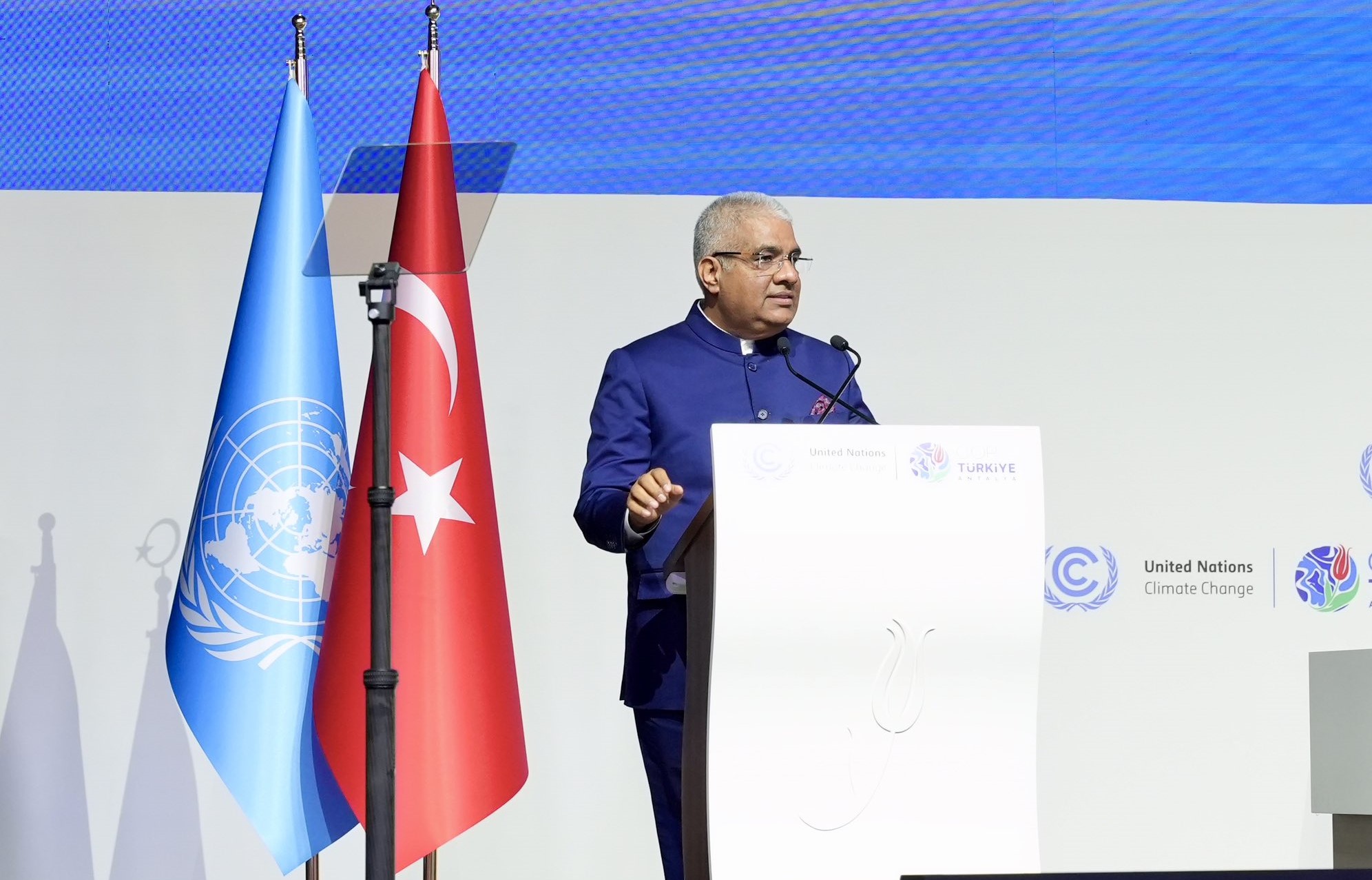
India has called for global climate action based on equity, climate justice and the principle of Common but Differentiated Responsibilities and Respective Capabilities (CBDR-RC) at the UN Climate Change Conference (COP31) in Antalya, Türkiye.
Delivering India’s National Statement, Union Environment, Forest and Climate Change Minister Bhupender Yadav said that the COP31 theme, ‘Dialogue, Consensus and Action’, must translate into honest dialogue, equity-based consensus and urgent action to address climate change.
Highlighting the historical responsibility for global warming, Yadav said the climate crisis was the result of nearly two centuries of industrialisation and economic growth in some countries, driven by unabated greenhouse gas emissions. He said it would be unjust to expect countries in the Global South to shoulder the burden of addressing the consequences of these historical emissions in the name of ‘higher ambition’.
Developing countries, he stressed, cannot be forced to choose between climate action and their legitimate right to development, decent living standards, healthcare and education. He also underlined that equitable access to the remaining global carbon budget was non-negotiable.
Yadav said decisions taken at COP conferences and their implementation must be firmly guided by equity and the CBDR-RC principle. He called for the Mitigation Work Programme (MWP) to remain facilitative and non-prescriptive, the Global Stocktake (GST) to continue serving as an instrument to inform parties, and the Just Transition Mechanism (JTM) to be firmly anchored in equity.
He also cautioned against unilateral trade measures that penalise developing countries under the pretext of climate action and urged developed nations to fulfil their climate finance obligations honestly and without delay.
Highlighting India’s climate commitments under the leadership of Prime Minister Narendra Modi, Yadav said the country’s Nationally Determined Contributions (NDCs) were aligned with the vision of achieving ‘Viksit Bharat’ by 2047 in a sustainable manner.
He emphasised that contemporary climate cooperation must take into account changing climatic and demographic conditions as well as technological advancements.
Stressing that the success of COP31 should be measured by tangible implementation, the delivery of resources to countries and communities that need them, and the scaling up of proven solutions, Yadav said dialogue must build trust, consensus must uphold equity and action must deliver climate justice.
-PIB


