






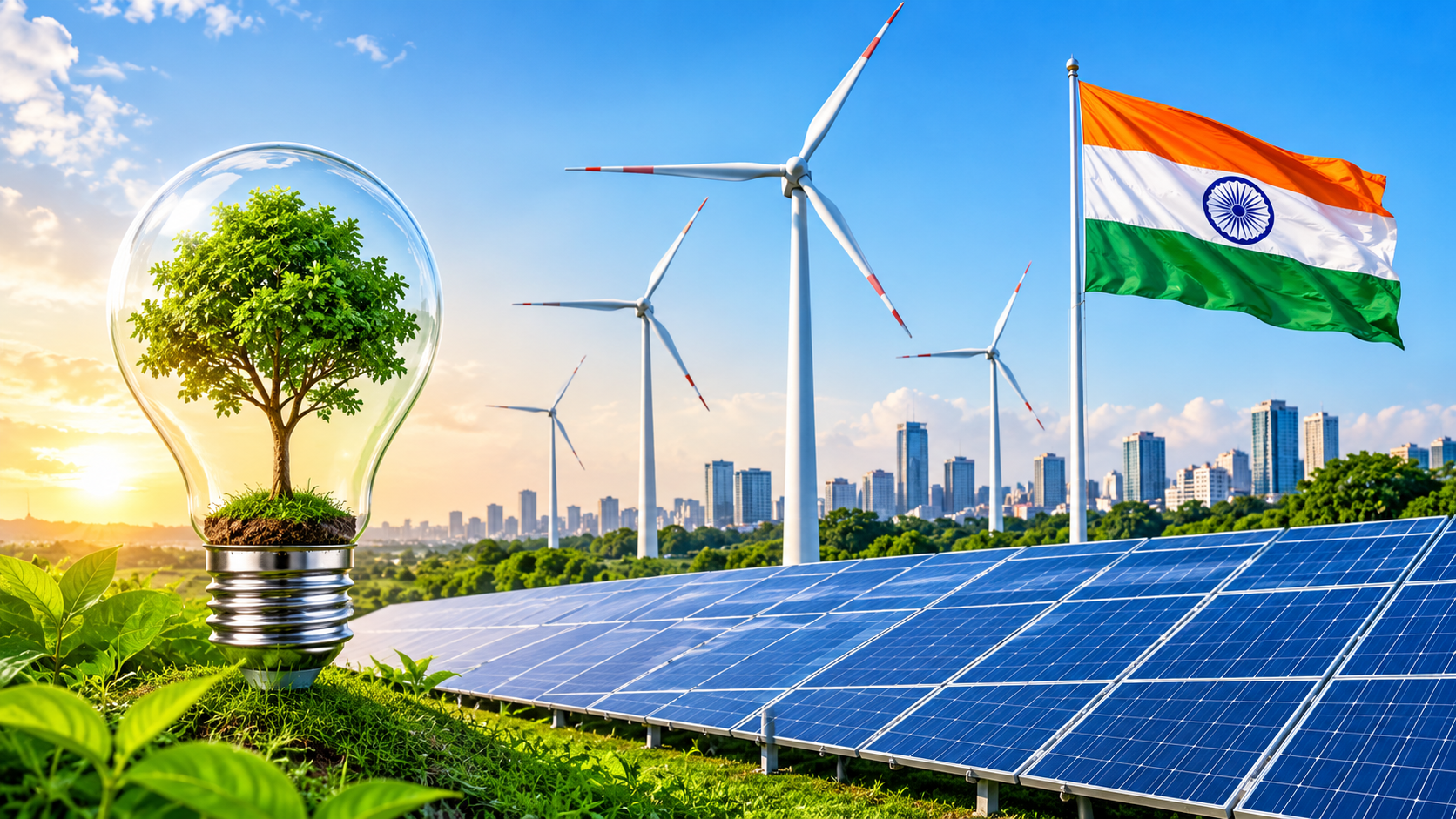
India is accelerating its transition towards renewable energy to meet rising electricity demand, strengthen energy security and achieve its clean energy goals. The country’s energy transformation spans solar, wind, hydropower, bio-energy, geothermal energy and green hydrogen, supported by policy initiatives, infrastructure development, domestic manufacturing and wider access to clean power.
From rooftop solar installations for households to large-scale wind farms, floating solar projects and energy storage systems, India is steadily increasing the share of renewable and other non-fossil sources in its energy mix.
India’s renewable energy landscape: Key figures
India’s total installed power generation capacity stood at around 560 GW in October 2026, compared with 249 GW in 2014. Non-fossil fuel-based capacity reached 308 GW as of July 31, 2026, accounting for 55 per cent of the country’s total installed capacity.
India ranks third globally in renewable energy installed capacity and invested USD 63.7 billion in the renewable energy sector between July 2024 and June 2026.
Bharat Renewable Energy Summit and Expo 2026
The Bharat Renewable Energy Summit and Expo (BRESE) 2026 was held in New Delhi from November 2 to 5 under the theme ‘Invest. Innovate. Inspire’.
The event brought together global policymakers, investors, industry leaders, manufacturers and innovators to discuss opportunities and challenges in the renewable energy sector.
Australia, Denmark, the European Union, France, Germany, the Netherlands, Norway, Sweden and the United Kingdom participated as country partners. Thirteen Indian States and Union Territories, including Gujarat, Rajasthan, Maharashtra, Uttar Pradesh and Andhra Pradesh, showcased their renewable energy potential, investment opportunities and manufacturing capabilities.
The event also featured an exhibition involving more than 400 manufacturers, technology providers, startups and research institutions. Discussions focused on renewable energy financing, clean energy manufacturing, energy storage, emerging technologies and workforce development.
Solar power: Expanding capacity and household access
Solar energy has emerged as the largest component of India’s renewable energy capacity. The country’s installed solar capacity reached around 175 GW as of October 31, 2026, compared with 2.8 GW in 2014.
India became the world’s second-largest solar growth market in 2025, adding more than 37 GW of capacity during the year, surpassing the United States, which added 34 GW.
PM-Surya Ghar: Muft Bijli Yojana
Launched in February 2024 with a total outlay of Rs 75,021 crore, the PM-Surya Ghar: Muft Bijli Yojana aims to provide rooftop solar installations to one crore households across the country.
As of November 2, 2026, the scheme had benefited 65.26 lakh households through rooftop solar installations. Around Rs 35,800 crore in subsidies had been transferred to beneficiaries, while nearly 21 lakh households had received zero electricity bills by October 2026.
Cumulatively, 19.1 GW of rooftop solar capacity has been commissioned under the scheme.
Pradhan Mantri Surya Sarovar Yojana
The government approved the Pradhan Mantri Surya Sarovar Yojana (PM-SSY) on July 31, 2026, with an outlay of Rs 5,070 crore to promote floating solar photovoltaic (PV) projects integrated with energy storage systems.
The scheme aims to develop 5,000 MW of floating solar capacity along with co-located energy storage systems having a minimum two-hour duration and a total capacity of 10,000 MWh.
Projects will be sanctioned during the period from financial year 2026-27 to 2030-31.
Wind energy: Strengthening domestic manufacturing
Wind energy remains an important pillar of India’s renewable energy expansion. The country ranks fourth globally in installed wind power capacity, with the sector witnessing higher annual additions and growing domestic manufacturing capabilities.
India’s installed wind power capacity stood at 59.20 GW as of October 29, 2026. The country added 6.05 GW during FY 2025-26, its highest-ever annual addition, representing a 46 per cent increase over FY 2024-25.
Around 28 GW of additional wind capacity is currently under implementation.
Domestic wind turbine manufacturing capacity reached approximately 24 GW in March 2026, compared with 10 GW in 2014. The sector has achieved 70-80 per cent indigenisation across key components.
To promote offshore wind energy, the Union Cabinet approved a Viability Gap Funding (VGF) scheme worth Rs 7,453 crore on June 19, 2024, to support the development of 1 GW of offshore wind projects.
Bio-energy: Converting waste into clean energy
India’s installed bio-power capacity stood at 11.75 GW as of October 29, 2026. The compressed biogas (CBG) ecosystem has also expanded, with 839 plants registered as of November 2, 2026. Of these, 210 plants had been commissioned, while 255 were under construction.
Biomass cogeneration capacity included 9,821.32 MW from bagasse-based projects and 1,047.85 MW from non-bagasse-based projects as of September 30, 2026.
Grid-connected waste-to-energy capacity stood at 324.24 MW, while off-grid plants contributed another 554.16 MW.
National Bioenergy Programme
The National Bioenergy Programme supports waste-to-energy, biomass and biogas projects through financial assistance. Its first phase covered FY 2021-22 to FY 2025-26, with an outlay of Rs 858 crore.
GOBARdhan: Promoting a circular bioeconomy
The government approved the Galvanizing Organic Bio-Agro Resources Dhan (GOBARdhan) National Circular Bioenergy Scheme on August 6, 2026, with an outlay of Rs 23,731 crore for the period FY 2026-27 to FY 2035-36.
The scheme aims to increase domestic compressed biogas production nearly tenfold and establish a national circular bioeconomy by promoting the conversion of organic waste into energy and other useful resources.
Hydropower: Supporting reliable electricity generation
Hydropower continues to play an important role in India’s renewable energy mix by providing reliable and flexible electricity generation. It also helps maintain grid stability as the share of variable sources such as solar and wind increases.
India’s cumulative hydropower capacity, including large and small hydro projects, stood at 57.49 GW as of October 29, 2026.
Small Hydro Power Development Scheme
The government approved the Small Hydro Power (SHP) Development Scheme in March 2026 for implementation during FY 2026-27 to FY 2030-31, with an outlay of Rs 2,584.60 crore.
The scheme aims to add approximately 1,500 MW of small hydropower capacity through projects ranging from 1 MW to 25 MW, with particular emphasis on supporting projects in hilly and northeastern regions.
Green hydrogen: Building a clean fuel ecosystem
Green hydrogen is emerging as an important clean fuel for hard-to-abate industrial sectors, while also offering opportunities to strengthen energy security and support industrial growth.
National Green Hydrogen Mission
Launched in 2023, the National Green Hydrogen Mission (NGHM) aims to establish a comprehensive green hydrogen ecosystem and address the opportunities and challenges associated with the sector.
Approved in January 2023 with an outlay of Rs 19,744 crore, the mission targets annual green hydrogen production of five million metric tonnes by 2030.
Since 2023, Indian companies have signed green hydrogen offtake commitments totalling 5.5 lakh metric tonnes per annum (MTPA), described as the world’s largest supply commitment. In 2026, companies signed 18 additional offtake agreements covering more than 4 lakh MTPA of green hydrogen equivalent.
More than 70 per cent of the cumulative 5.5 lakh MTPA offtake commitments since 2023 are earmarked for exports.
Green hydrogen projects are expected to attract investments of around Rs 90,000 crore (USD 9.5 billion). As of February 2026, approximately 8,000 tonnes per annum of green hydrogen production capacity had been commissioned.
In the transport sector, the government launched 12 pilot projects in July 2026 under the mission, covering 70 hydrogen-powered vehicles across 21 routes.
India’s first indigenous hydrogen fuel cell-powered train also began operations on the Jind-Sonipat section in July 2026.
Geothermal energy: Exploring untapped potential
Geothermal energy, which harnesses heat stored beneath the Earth’s surface to generate electricity or provide direct heating, offers a reliable renewable energy source that can complement variable sources such as solar and wind.
National Policy on Geothermal Energy
Notified on September 15, 2025, the National Policy on Geothermal Energy provides a framework for the exploration, development and utilisation of the country’s geothermal resources.
The Geological Survey of India (GSI) has estimated India’s geothermal energy potential at around 10,600 MW, based on exploration of 381 hot springs. Of these, 42 geothermal manifestations have been identified as promising areas.
The policy promotes technology partnerships, knowledge transfer and joint research and development. India has also established cooperation mechanisms with Australia, Iceland, Saudi Arabia and the United States in the geothermal energy sector.
Five projects were sanctioned during July-August 2025, including a pilot production plant, resource assessment projects and a solar-geothermal hybrid plant. These initiatives aim to assess the technical and economic viability of geothermal energy applications in the country.
Looking ahead: Building a sustainable energy future
India is steadily transforming its energy system through the expansion of renewable and other non-fossil energy sources. Growth in solar, wind, hydropower and bio-energy is being complemented by investments in domestic manufacturing, energy storage and emerging technologies such as green hydrogen and geothermal energy.
As electricity demand continues to rise, renewable energy is expected to play an increasingly important role in ensuring reliable power supply, strengthening energy security and reducing dependence on conventional energy sources.
Continued policy support, technological innovation, infrastructure development and domestic manufacturing will remain crucial to building a sustainable, self-reliant and future-ready energy ecosystem.
-PIB


