





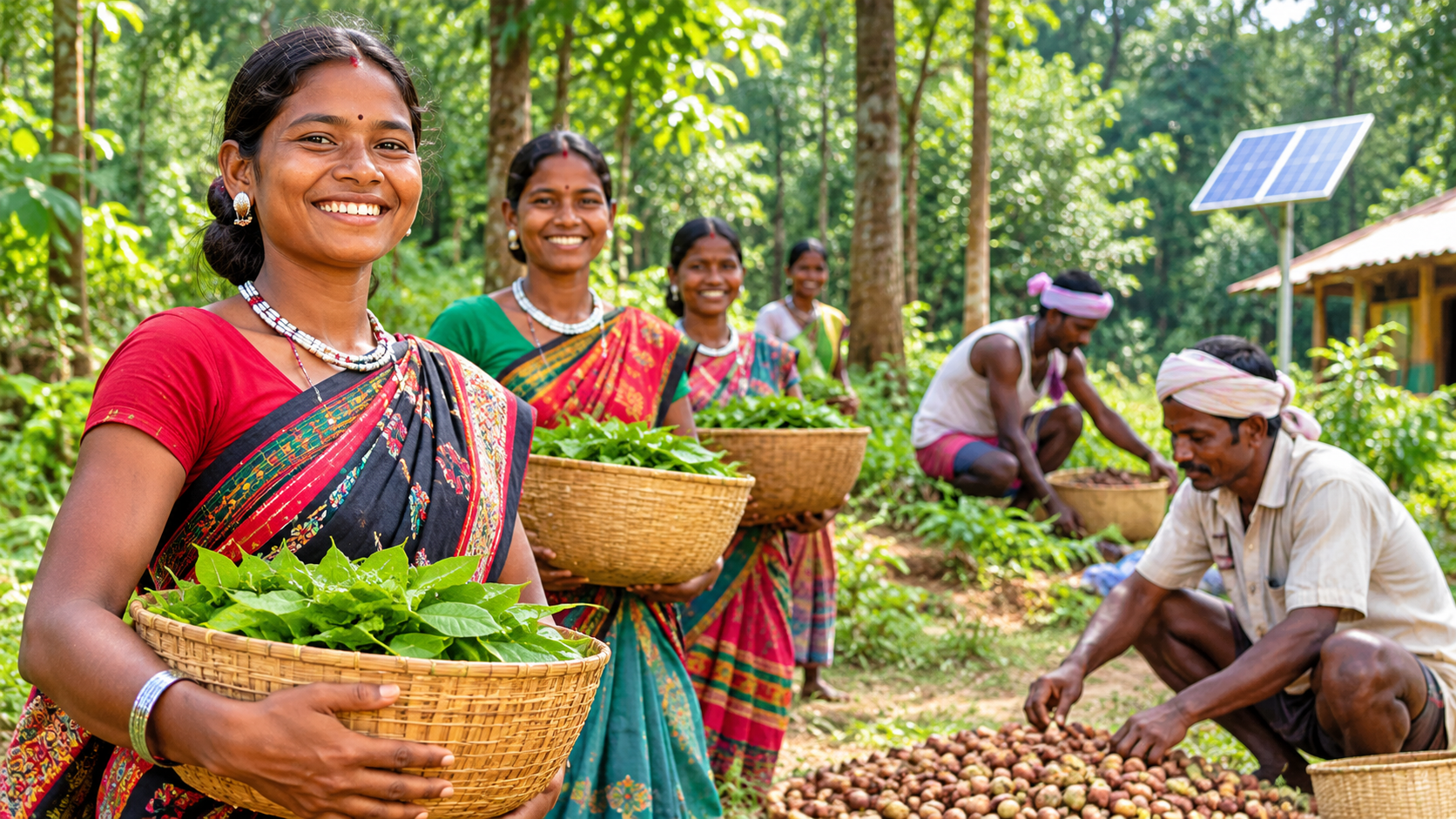
The Pradhan Mantri Janjatiya Vikas Mission (PMJVM) is aimed at strengthening the livelihoods of India’s tribal communities by improving the value of Minor Forest Produce (MFP), promoting community-owned enterprises and expanding access to domestic and digital markets.
Of India’s 10.4 crore Scheduled Tribe population, an estimated 20-40 per cent of annual income for many tribal families comes from Minor Forest Produce, including honey, tendu leaves, mahua flowers, tamarind, lac, bamboo and medicinal herbs. However, forest gatherers have traditionally received low returns by selling their produce to middlemen, often at prices below the cost of their labour.
Launched in 2021-22, PMJVM seeks to address this disparity by organising tribal gatherers into community-owned Van Dhan Vikas Kendras (VDVKs), providing them with training, technology, infrastructure and financial assistance to process raw forest produce and market value-added products.
As of March 2026, 4,172 VDVKs had been sanctioned, covering 12.48 lakh beneficiaries. According to data as of July 31, 2026, 2,911 of these centres were functional, with reported sales of around Rs. 168 crore.
The Mission also facilitates the procurement of MFP at government-notified Minimum Support Prices (MSP), helping tribal communities secure better returns and reduce their dependence on intermediaries.
Janjatiya Gaurav Pakhwada: Focus on tribal welfare and development
The Ministry of Tribal Affairs is observing Janjatiya Gaurav Pakhwada across the country from November 1 to 15, 2026, culminating in Janjatiya Gaurav Diwas on November 15, the birth anniversary of tribal freedom fighter Dharti Aaba Bhagwan Birsa Munda.
The Government of India designated November 15 as Janjatiya Gaurav Diwas in 2021. The fortnight-long initiative aims to accelerate the implementation of flagship tribal welfare programmes and ensure that their benefits reach tribal communities at the grassroots level.
More than 300 projects for tribal communities across states are scheduled to be taken up on the occasion, including 228 projects ready for inauguration and 74 for foundation stone laying.
Two national digital initiatives, the Jan-HIT Portal and the National FRA Digital Platform, will also be launched. Meanwhile, Tribal Research Institutes have planned more than 160 activities across 19 states and Union Territories.
Protecting tribal forest economies through MSP
Minor Forest Produce constitutes an important source of income for millions of forest-dependent tribal families. Despite their role in collecting and supplying these products, many gatherers have historically received only a small share of their market value due to dependence on intermediaries.
The Scheduled Tribes and Other Traditional Forest Dwellers (Recognition of Forest Rights) Act, 2006, commonly known as the Forest Rights Act, recognises the rights of forest-dwelling communities over forest resources.
The Act defines minor forest produce as non-timber forest produce of plant origin, including bamboo, brushwood, stumps, cane, tussar cocoons, honey, wax, lac, tendu or kendu leaves, medicinal plants, herbs, roots and tubers.
It also recognises the rights of tribal communities to collect and sell non-timber forest produce. Separately, the Provisions of the Panchayats (Extension to the Scheduled Areas) Act, 1996, grants Gram Panchayats in Scheduled Areas ownership rights over minor forest produce.
Under PMJVM, the government has notified Minimum Support Prices for 87 MFP items. The Tribal Cooperative Marketing Development Federation of India (TRIFED), which is responsible for the marketing and development of tribal products, facilitates procurement at predetermined MSP rates, irrespective of prevailing market prices.
Procurement is undertaken through state implementing agencies, including tribal development cooperatives and forest development corporations.
Since 2013-14, state governments have procured 2,67,954 metric tonnes of MFP worth Rs. 693.98 crore under the scheme.
How PMJVM supports tribal communities
Beyond MSP-based procurement, the Mission provides skill development, technological assistance, financial support and marketing infrastructure to help tribal communities establish sustainable enterprises.
Organising tribal gatherers into Van Dhan Vikas Kendras
The Mission mobilises tribal forest gatherers into self-help groups (SHGs). A cluster of 15 SHGs, comprising approximately 300 tribal members, is organised into a Van Dhan Vikas Kendra. At least 60 per cent of the members of each VDVK must belong to Scheduled Tribe communities.
The Van Dhan Yojana, launched on April 14, 2018, forms the foundation of the VDVK model and is implemented as part of PMJVM.
The initiative aims to transform tribal gatherers from sellers of unprocessed forest produce into entrepreneurs involved in processing, packaging and marketing finished products.
Skill development, funding and technological assistance
The government organises training programmes for MFP gatherers at VDVKs, covering scientific harvesting methods, sustainable resource management and value addition.
The SHGs receive several forms of assistance, including:
• Infrastructure: Processing facilities can be established at beneficiaries’ homes or in government and Gram Panchayat buildings.
• Processing equipment: Tools such as cutters, sieves, decorticators, dryers and packaging equipment are provided according to locally available forest produce.
• Training: Thirty members receive training in sustainable harvesting and value addition, along with raw materials and trainee kits.
• Working capital: Financial assistance is facilitated through banks, financial institutions and the National Scheduled Tribes Finance and Development Corporation (NSTFDC).
• Storage and transportation: Facilities are provided on a rental basis to support the movement and preservation of products.
Marketing and business development
VDVKs also serve as centres for establishing market linkages, enabling tribal entrepreneurs to sell their products in local and distant markets.
The centres are generally established near local Haat Bazaars, which serve as important procurement and trading points for MFP. More than 5,000 such markets operate in tribal areas.
The government is modernising these markets in phases by providing permanent structures, storage facilities, drinking water, shaded spaces and weighing equipment.
VDVKs can also collaborate with private companies and non-profit organisations for product processing, value addition and marketing.
TRIFED provides market intelligence, including daily price information and access to e-commerce platforms, to help tribal entrepreneurs make informed business decisions.
Other support measures under PMJVM include:
• Branding, promotion and advertising of tribal products through festivals, exhibitions and artisan fairs.
• Geo-tagging of VDVKs and other scheme-related assets.
• Promotion of Geographical Indications (GI) for tribal products with distinct geographical origins and characteristics.
• Development and upgrading of information technology and e-commerce platforms.
• Research and development support to improve product quality and market competitiveness.
According to the latest available figures as of July 31, 2026, 4,172 VDVKs had been sanctioned, of which 2,911 were functional. These centres had reported sales of approximately Rs. 168 crore and connected 12.48 lakh tribal beneficiaries.
VDVKs promote economic empowerment of tribal women
Women play a significant role in the collection, processing and sale of Minor Forest Produce, making PMJVM an important instrument for promoting their financial independence and entrepreneurship.
One such example is the Nyigamane, Ho Yorbe, Medumhagdum VDVK in Arunachal Pradesh’s Leparada district. Established in October 2021, the centre comprises 300 women SHG members and farmers.
It processes locally available non-timber forest and agricultural produce into marketable products, including:
• King Chilli Pickle made from Bhut Jolokia, a speciality of northeastern India.
• Bamboo Shoot Pickle made from locally available bamboo shoots.
• Turmeric Powder and Ginger Powder produced from locally grown crops.
• Pineapple Jam and Pineapple Squash made from locally sourced pineapples.
• Orange Squash prepared from oranges.
Since 2022-23, the VDVK has sold products worth Rs. 11 lakh.
The initiative has helped participating women diversify their income sources beyond seasonal agriculture and generate earnings throughout the year. The women collectively own the enterprise and have a stake in its brand and business operations, rather than functioning solely as workers.
Towards a sustainable forest-based economy
The Pradhan Mantri Janjatiya Vikas Mission seeks to strengthen the economic position of forest-dependent tribal communities by creating a structured system for collecting, processing and marketing non-timber forest produce.
By combining traditional knowledge and locally sourced resources with modern technology, value addition and market access, the initiative aims to create a sustainable forest-based economy rooted in community ownership.
The Mission also seeks to ensure that tribal communities receive a greater share of the economic value generated from forest resources while promoting sustainable livelihoods and conservation practices.
Through its focus on entrepreneurship, financial inclusion and market integration, PMJVM contributes to the government’s broader vision of inclusive development under the principle of Sabka Saath, Sabka Vikas and the goal of achieving Viksit Bharat@2047.
PIB


