





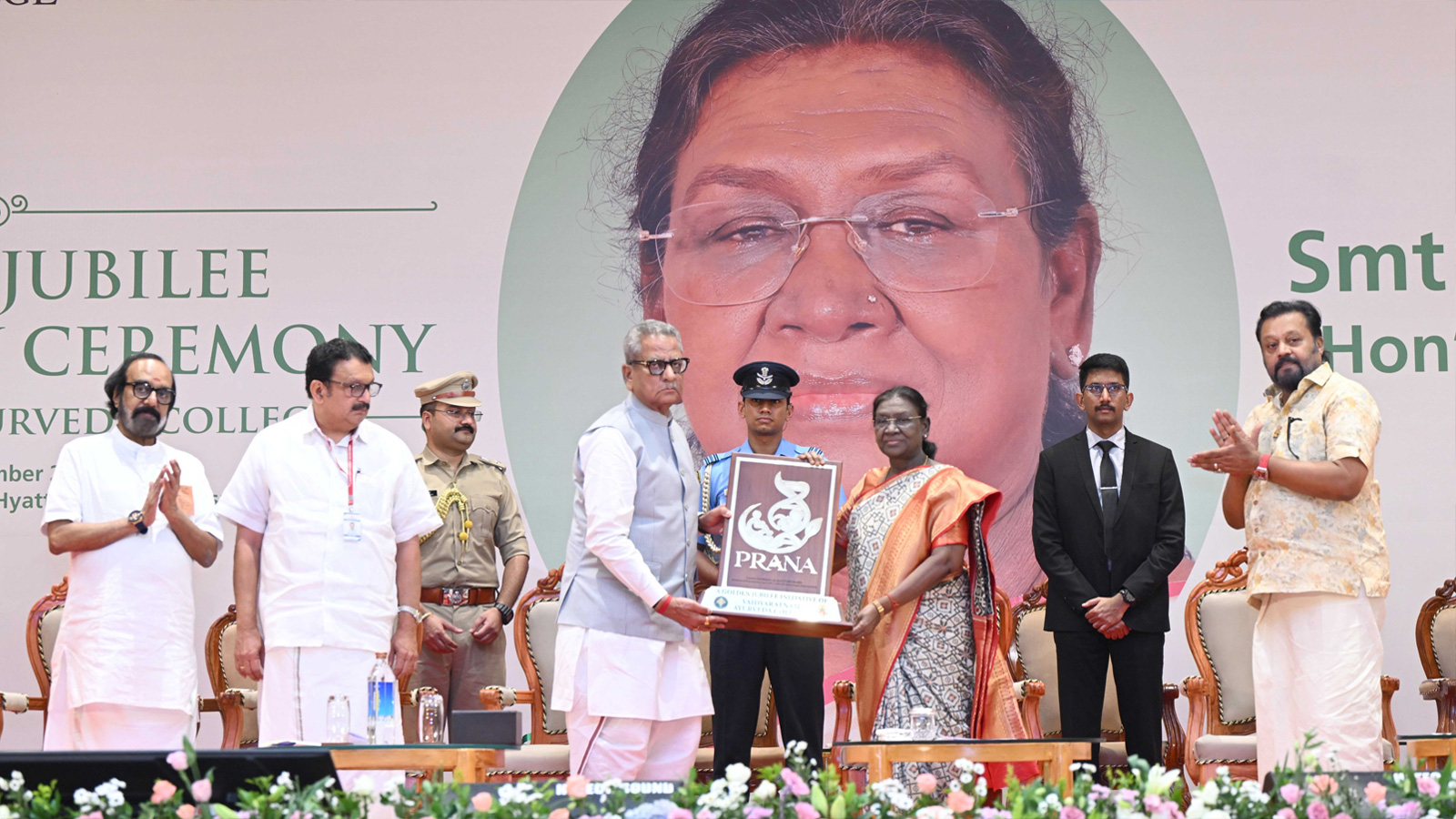
President Droupadi Murmu on Friday called on Ayurvedic colleges to serve communities through authentic and effective Ayurveda, impart relevant education and develop skilled practitioners and researchers capable of addressing the health challenges of present and future generations.
Addressing the valedictory ceremony of the Golden Jubilee celebrations of Vaidyaratnam Ayurveda College in Thrissur, Keralam, the President said Ayurvedic institutions have an important role in achieving the goal of a healthy and developed India by 2047.
She noted that Keralam’s contribution to Ayurveda extends beyond enhancing its international reputation. The state has nurtured a rich and living tradition of classical Ayurvedic learning, enriched medical knowledge passed down through generations of Vaidya families and sustained the preparation of authentic Ayurvedic medicines.
Highlighting the distinctive character of Keralam’s Ayurvedic tradition, President Murmu said its authentic literature has never been limited to Sanskrit. Several original works and commentaries have also been produced in Malayalam and Manipravalam. She cited works such as Chikitsa-Manjari, Aalattur Mani-pravalam and Sahasra-Yogam as contributions of learned Vaidyas from the state.
The President congratulated those associated with Vaidyaratnam Ayurveda College for successfully organising its year-long Golden Jubilee celebrations. She also observed that Thrissur holds a special place in preserving India’s cultural heritage and knowledge traditions, which received international recognition when the city was included in UNESCO’s Global Network of Learning Cities in 2022.
Strengthening Research and Documentation
Emphasising the importance of scientific research in traditional medicine, the President recalled that the makers of the Constitution had recognised the need for a systematic framework for the practice and education of Ayurveda and other Indian systems of medicine, including Unani and Homoeopathy.
She referred to the debates in the Constituent Assembly, particularly the views expressed by H. V. Kamath on the need for the State to actively promote scientific research into Ayurveda. R. V. Dhulekar, Seth Govind Das and Dr. B. Pattabhi Sitaramayya had also shared their views on related issues.
President Murmu said these discussions reflected the foresight of the Constitution’s makers, as similar questions concerning traditional medicine continue to feature in national and international debates.
She underlined the national importance of systematically documenting the texts, manuscripts, treatment methods and practical knowledge preserved by the Ashtavaidya families of Keralam. These families have developed a rich tradition of studying, interpreting and practising the teachings of Ashtanga Hridayam and classical Ayurveda.
The President also highlighted the region’s preserved expertise in Agada-Tantra (toxicology), Kaumara-bhritya (paediatrics) and Marm Chikitsa, along with the traditional use of medicinal plants by different communities.
Scientific Validation and Evidence-Based Panchakarma
The President noted that initiatives such as the Ministry of Ayush’s ‘One Herb, One Standard’ programme and the work of its research councils are aimed at providing a modern scientific foundation to India’s traditional medicine systems.
She also referred to the WHO Global Traditional Medicine Centre in Jamnagar, which is working to serve as a global knowledge hub for traditional medicine through modern science, data and technology. Ayurvedic colleges across Keralam, she said, could undertake joint research projects in collaboration with such government and reputed international institutions.
Referring to the Charaka Samhita, Sushruta Samhita and Ashtanga Hridayam, President Murmu said these classical texts describe how soil, water, seasons and geographical conditions influence the quality of medicinal plants. Collaborative studies of these factors could strengthen institutional research capabilities and help develop a comprehensive knowledge database for Ayurveda.
She further noted that an authentic study of the Ayush service sector had indicated the potential for Keralam to emerge as an international reference point for authentic and scientifically evaluated Panchakarma. The state should also strive to become a leader in evidence-based Panchakarma research, with government and private institutions, including Ayurvedic colleges, working together towards this objective.
Ayurveda, Community Service and Viksit Bharat
Stressing the responsibility of Ayurvedic colleges towards society, the President said institutions that combine authentic healthcare delivery with relevant education can produce capable Vaidyas and researchers equipped to respond to emerging health challenges.
She expressed satisfaction that the work ethos of Vaidyaratnam Ayurveda College was aligned with this approach.
Addressing students, President Murmu highlighted a distinctive feature of Keralam’s Ayurvedic tradition: the integration of professional practice with philanthropy. She urged them to carry this tradition forward in their professional lives and demonstrate that traditional knowledge-based enterprises and service to underprivileged communities can progress together.
The President also appreciated the intellectual and field activities undertaken during the college’s Golden Jubilee celebrations. She said sustaining professional excellence over five decades while continuously refining institutional practices to remain relevant to contemporary needs was commendable.
Concluding her address, she conveyed her best wishes to the college fraternity and expressed hope that Ayurveda would continue to enhance its capabilities in serving humanity, particularly the underprivileged sections of society.
(PIB)


