







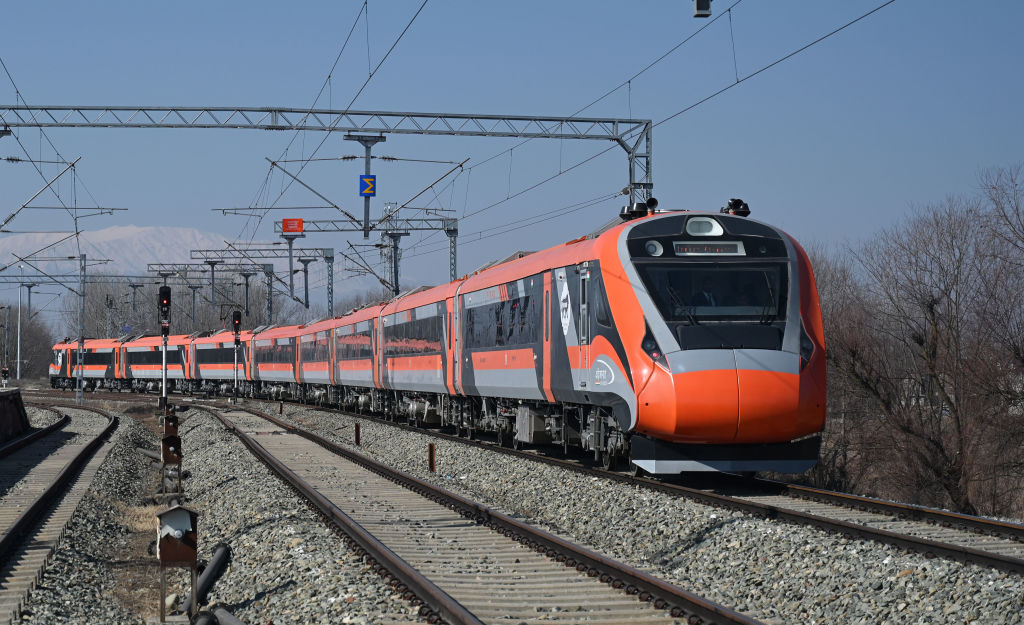
Prime Minister Narendra Modi on Thursday shared an article by Railway Minister Ashwini Vaishnaw, highlighting the significant transformation of the Indian Railways, particularly in the area of safety through sustained reforms and technological advancements.
Urging people to read the article, the Prime Minister’s Office (PMO) said in a post on X, “The Indian Railway ecosystem has undergone a fundamental shift and the results are right in front of us. Union Minister Shri Ashwini Vaishnaw writes how this sector is setting new benchmarks through sustained reforms and technology.”
In his article, Vaishnaw underlined that railway safety has emerged as a core priority over the past decade, supported by clear policy direction, consistent funding, and large-scale adoption of modern technology. He noted that with over two crore passengers travelling daily and more than 25,000 trains operating across the country, safety is not just a technical parameter but a matter of public trust.
Vaishnaw highlighted a sharp decline in consequential train accidents – from 135 in 2014-15 to just 16 in 2025-26 – marking an 89 per cent reduction. During the same period, the Consequential Accident Index dropped from 0.11 to 0.01, indicating significantly improved safety per kilometre of train operation.
The Minister also pointed to a substantial reduction in fatalities, from 292 deaths in 2014-15 to 16 in 2025-26. While noting that every loss of life is tragic, he emphasized that the decline reflects a system increasingly focused on preventing accidents rather than merely responding to them.
The transformation, Vaishnaw said, has been backed by unprecedented financial investment, with annual safety expenditure rising from ₹39,200 crore in 2013-14 to about ₹1.2 lakh crore in 2026-27. These funds have supported modernization across tracks, signalling systems, rolling stock, and other safety infrastructure.
Technological advancements have played a key role in this shift. The number of digital railway stations has increased to nearly 4,000 from fewer than 900 a decade ago, while GPS-based Fog Safety Devices have expanded from just 90 units to around 30,000. Improvements in track technology and maintenance have led to a 93 per cent reduction in weld failures and a 92 per cent drop in rail fractures.
A major milestone has been the elimination of nearly 9,000 unmanned level crossings, alongside the construction of over 14,000 road overbridges and underpasses. Passenger safety has also been enhanced through the large-scale induction of LHB coaches, designed to minimize damage during collisions.
Vaishnaw also highlighted the rollout of ‘Kavach’, India’s indigenous Automatic Train Protection system, which automatically intervenes in case of signal overshooting or speed violations. The system has already been deployed on high-density corridors such as Delhi-Mumbai and Delhi-Howrah, with further expansion underway.
The Minister stressed that alongside technology, improving working conditions for railway staff has also been a priority. Measures such as better rest facilities, regulated duty hours, and counselling support have been introduced to strengthen the human element of safety.
Vaishnaw concluded by highlighting that railway safety often goes unnoticed when it works effectively. “Trains that do not crash do not make news. Yet, this absence of headlines is precisely what truly says that individual life matters,” he said.


