







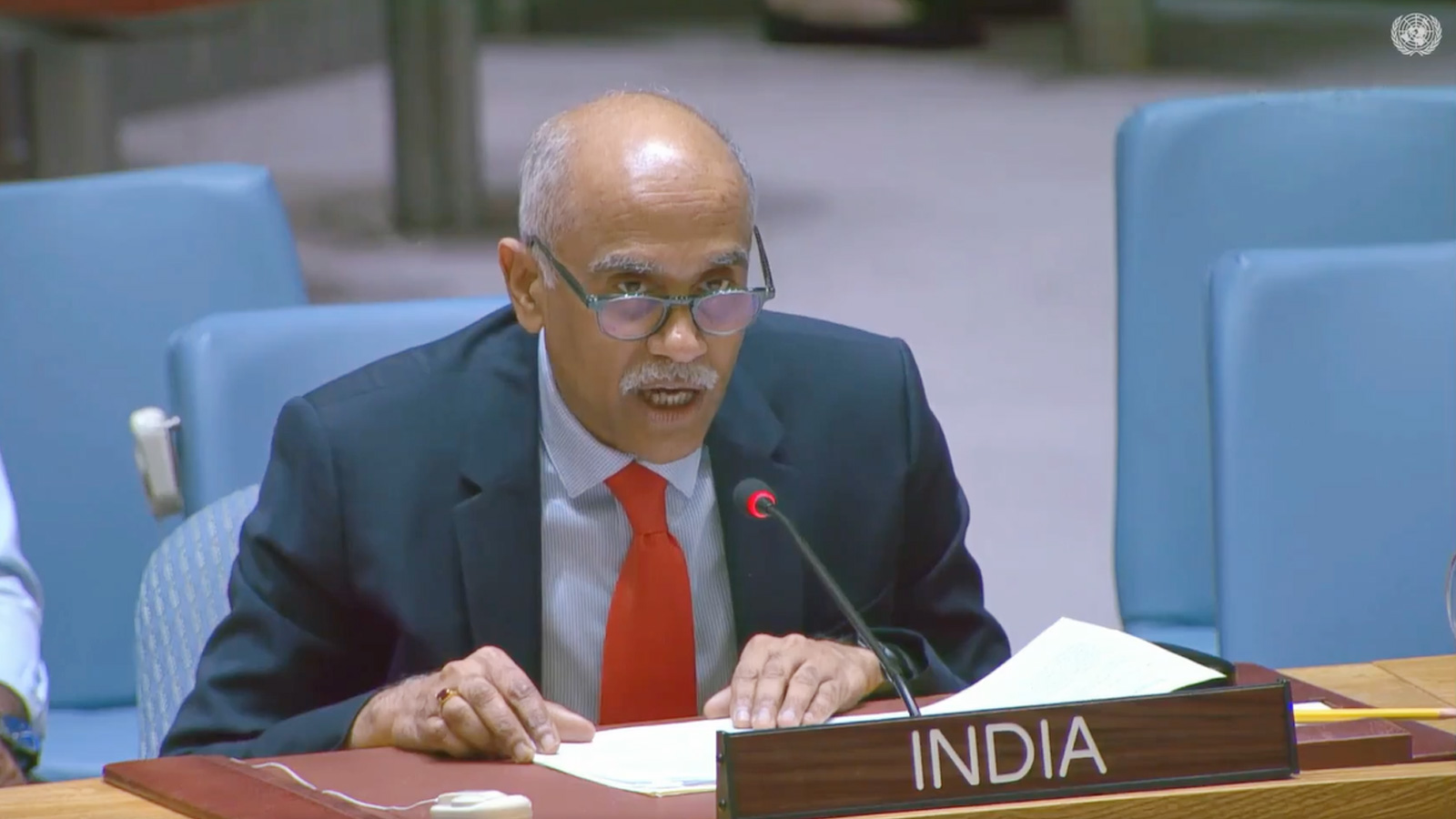
India on Tuesday pointed out resistance to long-pending reforms of the United Nations Security Council (UNSC), warning that the global body faces a growing crisis of credibility because its structure remains rooted in the geopolitical realities of 1945.
Speaking during an open debate at the United Nations on “Upholding the Purposes and Principles of the UN Charter and Strengthening the UN-Centred International System”, India’s Permanent Representative to the UN Parvathaneni Harish said progress on reforms was being obstructed by “entrenched interests” determined to preserve the status quo.
“Lack of progress in the Inter-Governmental Negotiations on Council reforms is indicative of entrenched interests of several member states to maintain the status quo and retain the eight-decade-old UNSC architecture,” Harish said.
India has long argued for expansion of the Security Council’s permanent membership, maintaining that the present structure no longer reflects contemporary geopolitical realities. Harish stressed that meaningful reform would require expansion in the permanent category of membership, saying this alone could alter the Council’s decision-making process.
“The UN Security Council must be a living instrument, not a fossil,” he said, warning that failure to adapt would further erode the Council’s authority, legitimacy and effectiveness.
Without naming countries directly, India’s remarks were seen as aimed at the “Uniting for Consensus” group, which opposes the creation of new permanent seats and has often been accused by reform supporters of delaying negotiations through procedural tactics.
UN Secretary-General António Guterres also underlined the urgent need for reform, saying global institutions must reflect present-day realities rather than the world order that emerged after the Second World War.
“A Security Council that does not reflect the geopolitical realities of today’s world cannot fully deliver on its responsibilities,” Guterres said, adding that reform was essential for restoring the Council’s credibility and ensuring more inclusive decision-making.
He particularly highlighted the continued exclusion of Africa from permanent membership, calling it a major historical injustice.
Drawing a sharp analogy to illustrate the outdated UN framework, Harish said the organisation was attempting to operate in the modern era using systems designed in the 1940s.
“It is akin to running advanced AI technologies on the 1945 version of the computer called the Electronic Numerical Integrator and Computer (ENIAC),” he said.
He added that adaptability was central to survival and progress throughout history and argued that the UN could not remain indifferent to changing global realities.
Making India’s case for permanent membership in a reformed Security Council, Harish highlighted India’s contributions during and after the Second World War. He noted that more than 2.5 million Indian soldiers fought alongside Allied forces and over 87,000 lost their lives during the war.
“This was not our war, but we paid dearly for it. Therefore, it was natural for us to become a founding member of the UN,” he said.
Harish also cited India’s longstanding contributions to UN peacekeeping missions and international peace efforts in regions including Korea, Indochina, Congo and Gaza.
The Indian envoy further expressed concern over growing divisions within the Security Council, particularly among its veto-wielding permanent members, saying such disunity had weakened the body’s effectiveness in addressing global crises.
Guterres echoed those concerns, saying the Council too often failed to act with unity and purpose, with the consequences extending far beyond the UN chamber.
In a post on X following the debate, Harish reiterated India’s commitment to multilateralism and called for strengthening the United Nations General Assembly (UNGA) as the UN’s principal organ. He also emphasised the need for greater transparency within the Security Council and renewed calls for reforms aligned with contemporary geopolitical realities.
Harish additionally criticised Pakistan over cross-border terrorism, accusing Islamabad of using terrorism as an instrument of state policy against India.
“Pakistan will have to accept that there are consequences to its sponsorship of cross-border terrorism,” he said, asserting that India had every right to defend itself against such threats.
(With IANS inputs)


