







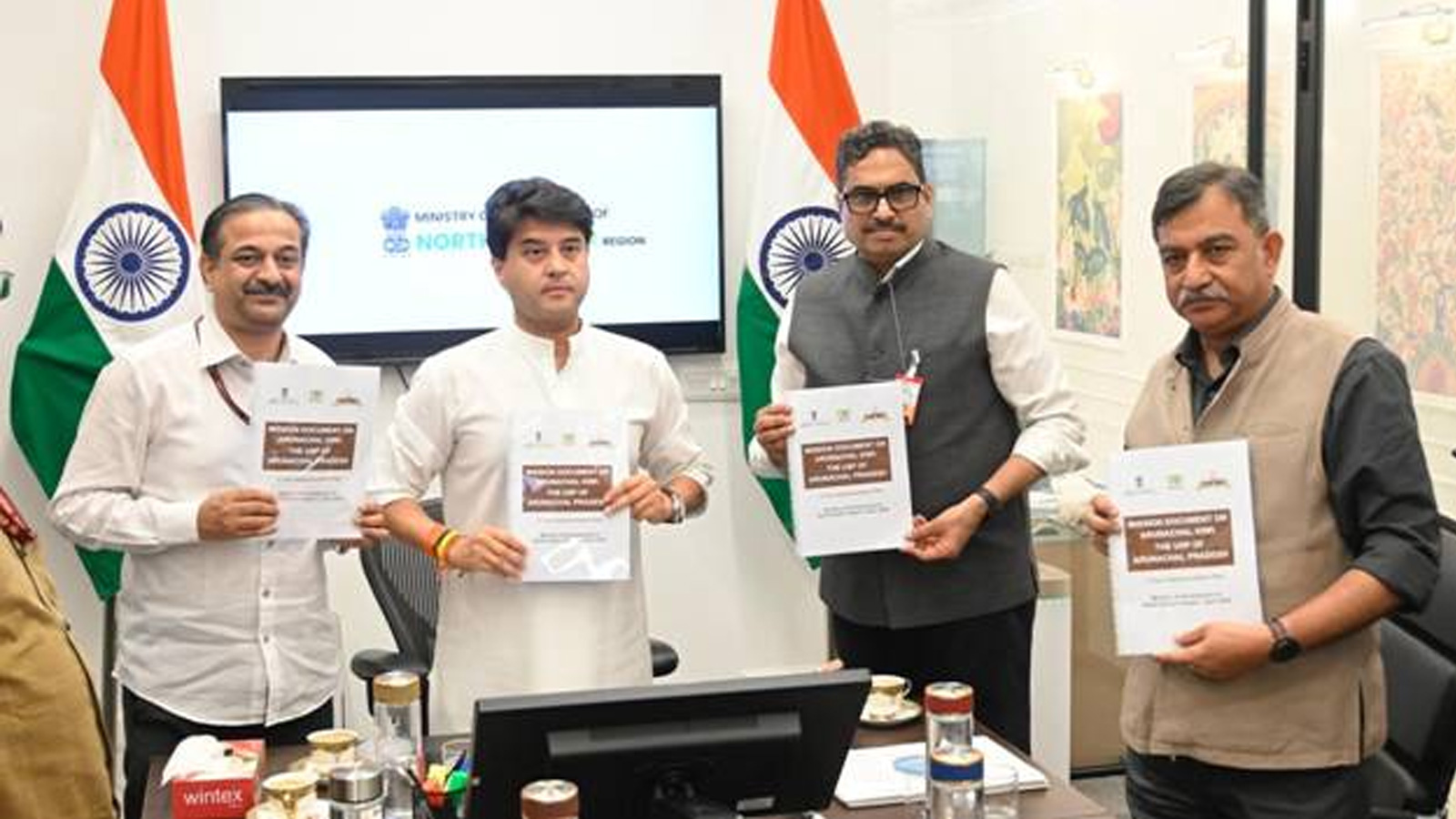
Union Minister for Development of North Eastern Region Jyotiraditya Scindia on Wednesday launched the Mission on “Arunachal Kiwi: The USP of Arunachal Pradesh,” a major cluster-based initiative aimed at transforming Arunachal Pradesh into India’s premium organic kiwi hub with strong domestic and global market presence.
The mission, launched in the presence of Pema Khandu and senior officials from the Centre and the state government, has an outlay of around ₹167 crore and seeks to strengthen the entire kiwi value chain – from cultivation and post-harvest management to branding, exports and agri-tourism.
Speaking at the launch event, Scindia said the initiative aligns with Prime Minister Narendra Modi’s vision of a “Viksit North East” and aims to ensure that farmers become stakeholders across the entire agricultural value chain “from farm to fork.”
The minister highlighted that Arunachal Pradesh currently contributes more than 50 per cent of India’s kiwi production, producing over 7,050 metric tonnes annually. However, despite its dominant position, local farmers receive significantly lower prices compared to imported kiwi sold in domestic and global markets.
“Today, with the launch of Project Kiwi in Arunachal Pradesh, we are taking another major step in building globally competitive value chains rooted in the strengths of the North East,” Scindia said.
The mission adopts a cluster-based development model covering six major post-harvest management hubs across Ziro Valley, Dirang, Kalaktang, Shi Yomi and Dibang Valley. More than 30 targeted interventions have been planned to address gaps in storage, processing, certification, branding and market access.
The Ministry of Development of North-East Region (MDoNER) said the initiative aims to restore Arunachal Pradesh’s lapsed National Programme for Organic Production (NPOP) certification, establish cold-chain infrastructure, reduce distress sales during the short 7–10-day harvest window, and improve value realisation for farmers.
The mission is being implemented through a convergence-based approach involving multiple ministries and institutions, including the Ministry of Agriculture and Farmers Welfare, Ministry of Food Processing Industries, NABARD, ICAR-CITH, APEDA and NERAMAC, along with private sector investors.
Scindia said the programme is built around four strategic pillars — convergence, value addition, branding and market integration — with key targets including the creation of 2,000 metric tonnes of cold storage capacity, promotion of kiwi-based startups, improvement in processing facilities and expansion into export markets by 2028.
The minister also unveiled plans to position “Arunachal Organic Kiwi” as part of the broader “Brand North East” initiative, alongside products such as Lakadong Turmeric, Mizoram ginger, Nagaland coffee and Tripura’s Queen pineapple.
Highlighting export opportunities, Scindia noted that Arunachal Pradesh’s kiwi harvest season from November to January coincides with New Zealand’s off-season, creating a unique opening in Southeast Asian, Middle Eastern and European markets.
The mission also aims to promote kiwi orchard tourism and farm-stay experiences in areas such as Ziro Valley and Dirang, combining horticulture with experiential tourism.
Chief Minister Pema Khandu described the initiative as a “defining moment” in Arunachal Pradesh’s agricultural and economic development. He said kiwi cultivation has emerged as a sustainable alternative to traditional jhum cultivation in high-altitude regions and reaffirmed the state government’s commitment to implementing the mission in coordination with the state’s own Arunachal Pradesh Kiwi Mission 2025–35.
Sanjay Jaju, Secretary, MDoNER, said Arunachal Pradesh’s high-altitude climate and organic farming conditions are ideal for premium kiwi cultivation, especially Hayward and Allison varieties. He noted that kiwi farming has already expanded across 13 districts, covering more than 3,582 hectares and supporting over 1,500 farmers.
MDoNER said the mission is expected to reduce post-harvest losses, improve farm-gate earnings, generate rural employment opportunities and encourage greater participation of youth and farmer producer organisations in the kiwi economy.


