







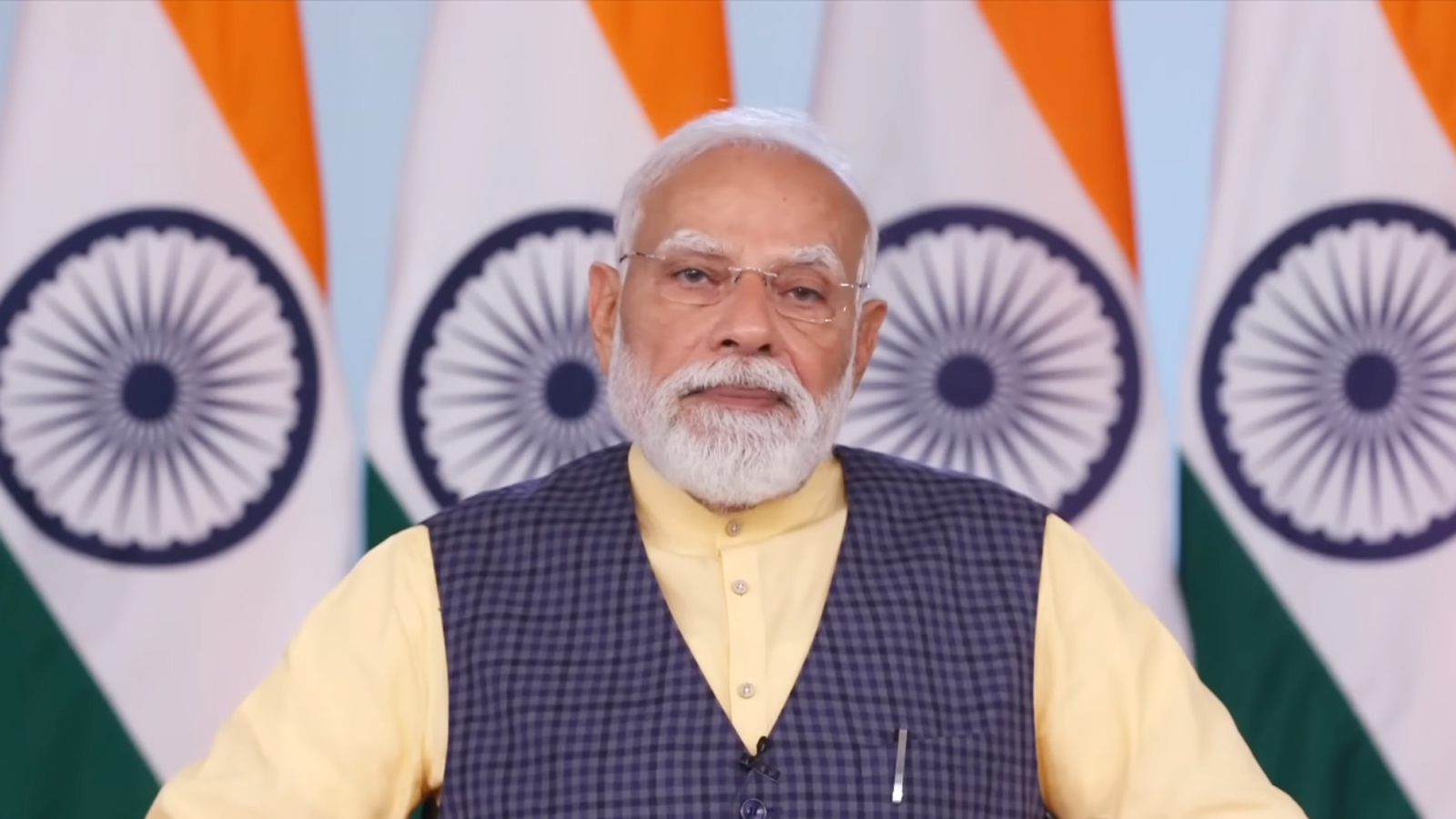
Prime Minister Narendra Modi on Monday invited Norwegian companies to expand investments in India’s clean energy and maritime sectors as he addressed the India-Norway Business and Research Summit in Oslo alongside Norwegian Prime Minister Jonas Gahr Støre and Crown Prince Haakon.
“At the Oslo City Hall, Prime Minister Jonas Gahr Støre and I took part in the Business and Research Summit. It was good to interact with those active in the world of business and research. Our nations can collaborate extensively in areas like food security, fertilisers, fisheries and energy. I invited Norway to invest in India’s clean energy initiatives. Also talked about India’s reform trajectory. An area like shipbuilding too presents unlimited possibilities,” PM Modi said in a post on X.
The summit, attended by CEOs of over 50 companies and more than 250 participants from Indian and Norwegian business and research communities, marked a major step in strengthening bilateral economic cooperation following the implementation of the India-EFTA Trade and Economic Partnership Agreement (TEPA).
Addressing the gathering, PM Modi highlighted India’s rapid economic growth, demographic advantage, investor-friendly policies and competitive federalism, while urging businesses from both countries to deepen collaboration in emerging sectors.
“Trade is key to the India-Norway friendship. The recently signed India-EU Free Trade Agreement offers immense opportunities to boost economic and investment linkages,” PM Modi said.
The Prime Minister stressed that India and Norway could significantly expand cooperation in areas such as clean energy, shipbuilding, blue economy, renewable energy, health-tech, critical minerals, food security, fisheries and start-ups.
PM Modi also underlined India’s ambitious green transition programme, pointing to the country’s growing renewable energy capacity, expansion of grid infrastructure, push for green hydrogen and commitment to climate goals. He appreciated Norway’s leadership in clean energy investments, maritime decarbonisation, ocean sustainability and climate finance.
During the summit, both leaders emphasized the need to achieve the investment target of USD 100 billion under TEPA and create one million jobs in India over the next 15 years.
MEA spokesperson Randhir Jaiswal said the summit opened “a new chapter of shared progress and prosperity” and highlighted the strong foundation of India-Norway ties in food, fuel and fertiliser sectors.
“A new chapter of shared progress and prosperity! Prime Minister Narendra Modi and Prime Minister Jonas Gahr Støre addressed the India-Norway Business & Research Summit in Oslo,” Jaiswal said in a post on X.
He added that PM Modi highlighted opportunities for expanding trade, technology partnerships and investments following the implementation of TEPA, particularly the commitment to invest USD 100 billion in India over the next 15 years.
Ahead of the summit, four sector-specific roundtable discussions were organised in Oslo focusing on healthcare innovation, maritime cooperation, battery and energy storage systems, digitalisation, electrification and wind energy.
Several business agreements between Indian and Norwegian companies were also signed during the summit.
Earlier in the day, PM Modi held bilateral talks with Norwegian Prime Minister Jonas Gahr Støre, during which the two countries elevated ties to a “Green Strategic Partnership.” The partnership aims to strengthen cooperation in clean energy, sustainable growth, green shipping, blue economy, innovation, research, education, healthcare and digital technologies.
“Held fruitful talks with PM Jonas Gahr Støre in Oslo. One of the key highlights was the upgrading of our bilateral partnership to a Green Strategic Partnership, which will deepen synergy in clean energy, sustainable growth, the blue economy, green shipping and more,” PM Modi said.
He added that Norway joining the Indo-Pacific Oceans Initiative would further strengthen maritime cooperation between the two countries.
PM Modi said the outcomes of his Norway visit would “add new strength to a partnership rooted in trust, sustainability and shared aspirations,” with deeper cooperation expected in areas including space, digital technologies, health and capacity building.


