







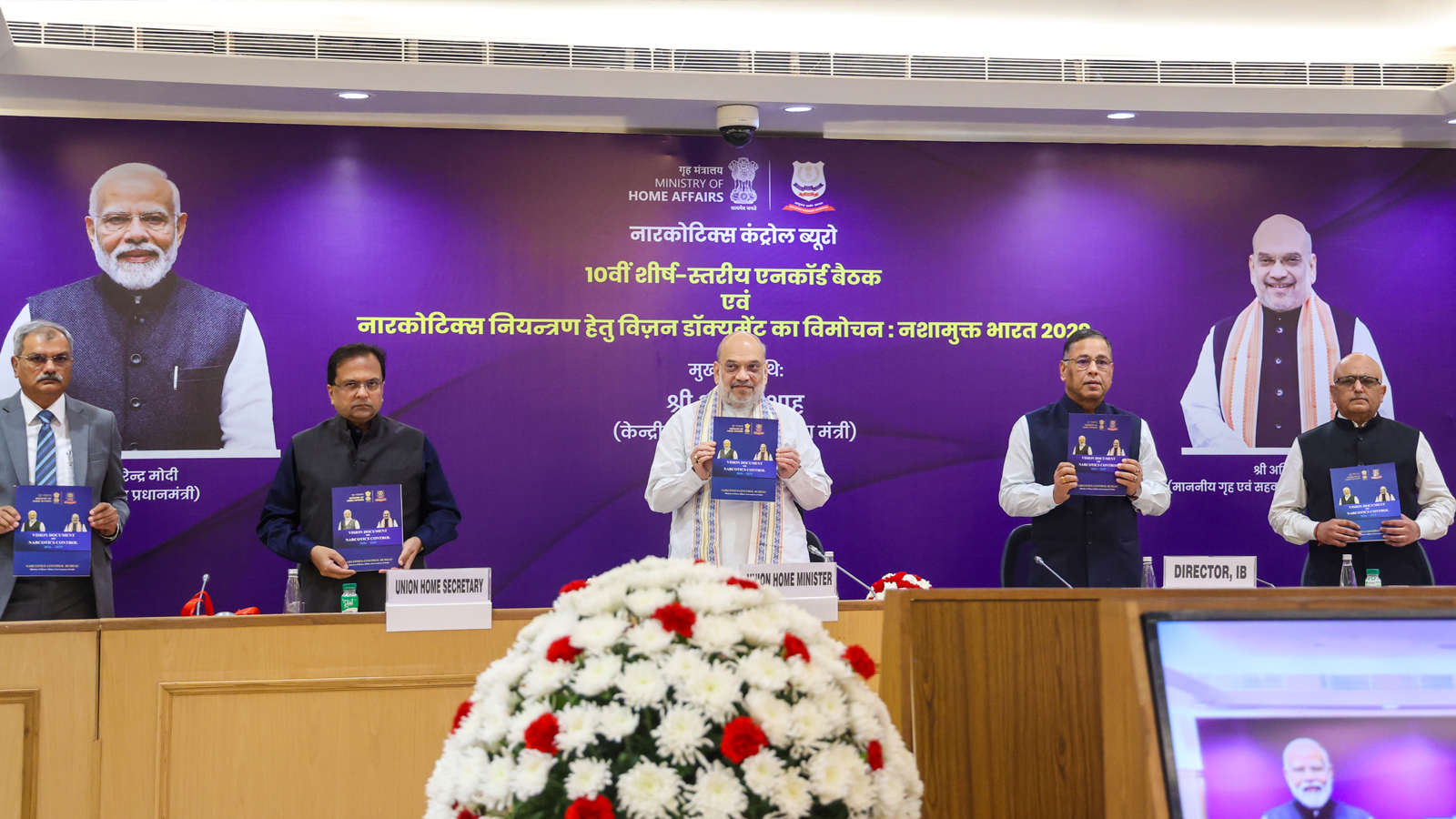
Union Home Minister Amit Shah on Friday unveiled the ‘Vision Document on Drug Control (2026-2029)’, outlining a comprehensive national roadmap to strengthen India’s fight against narcotics. Chairing the 10th Apex Level Meeting of the Narco-Coordination Centre (NCORD) in New Delhi, HM Shah also launched the ‘Online Drugs Disposal Fortnight Campaign’, under which narcotic substances worth more than ₹6,000 crore, weighing over 2.09 lakh kilograms, will be destroyed.
The Home Minister also released the NCB Annual Report 2025 and virtually inaugurated the Narcotics Control Bureau (NCB) zonal offices in Jammu and Guwahati, reaffirming the government’s zero-tolerance approach towards drug trafficking and organised crime.
Addressing the meeting, HM Shah described the next three years as a decisive period in India’s campaign against narcotics, stating that the country must ensure that drug cartels are dismantled so comprehensively that they cannot recover for decades.
He said the government’s strategy would be guided by the principles of “Detect, Disrupt and Destroy”, combining human intelligence, technological intelligence and community policing to target every link in the narcotics supply chain – from production and trafficking networks to financiers and kingpins.
HM Shah stressed that while drug traffickers must face the strictest legal action, young people affected by addiction should be treated with compassion and supported through rehabilitation and de-addiction programmes.
Highlighting the evolving nature of drug-related crime, the Home Minister said narcotics trafficking has become closely linked with organised crime, narco-terror financing and cross-border terrorist networks. He warned that smugglers are increasingly using advanced technologies such as drones, darknet platforms, cryptocurrency payments, parcel networks and maritime routes, requiring an equally technology-driven and intelligence-led response from enforcement agencies.
The Vision Document outlines a roadmap based on four key pillars – Enforcement, Intelligence and Operations; Precursor and Synthetic Drug Control; Demand Reduction and Rehabilitation; and Capacity Building and Coordination. The strategy seeks to strengthen institutional capacity, particularly in tackling synthetic drugs, darknet networks, cross-border trafficking and emerging narcotics threats.
HM Shah directed states to convert their Anti-Narcotics Task Forces (ANTFs) into dedicated, full-time and well-equipped units and called for greater coordination among central and state agencies. He also emphasised the need for mandatory financial investigations in major NDPS cases to identify, freeze and seize proceeds of crime, saying dismantling the financial backbone of drug cartels is essential to eliminating the narcotics ecosystem.
Calling for stronger legal action, the Home Minister said the Ministry of Home Affairs is working towards establishing exclusive NDPS courts to ensure faster trials and convictions. He urged states to pursue the creation of dedicated NDPS courts and appoint special public prosecutors to strengthen prosecution in narcotics cases.
HM Shah also called on states to intensify efforts to bring back drug smugglers and gang leaders hiding abroad by using mechanisms such as Red Corner Notices, extradition proceedings and coordination with the Central Bureau of Investigation (CBI).
On the demand reduction front, the government plans to establish drug-free zones and expand awareness campaigns involving parents, teachers, educational institutions, youth organisations and community groups. The Ministries of Social Justice, Health and Education have been assigned specific responsibilities to strengthen de-addiction services, monitor pharmaceutical diversion and promote drug-free campuses.
Reviewing the government’s performance, HM Shah said narcotics seizures have increased substantially under the Narendra Modi government. Between 2014 and 2026, authorities seized drugs worth ₹1.84 lakh crore, compared to ₹40,000 crore between 2004 and 2014. During the same period, drugs worth ₹89,896 crore were destroyed, significantly higher than the ₹8,000 crore destroyed in the previous decade.
He also noted that illegal opium cultivation has been aggressively targeted, with over 42,000 acres destroyed in 2025 compared to around 10,000 acres in 2020. Narcotics-related enforcement has also intensified, with 8.75 lakh cases registered and over 10.97 lakh arrests made since 2014.
Concluding his address, HM Shah expressed confidence that the coordinated efforts of the Centre, states, law enforcement agencies and society would significantly weaken India’s narcotics networks over the next three years and move the country closer to the goal of a “Nasha Mukt Bharat” as envisioned by Prime Minister Narendra Modi.


