







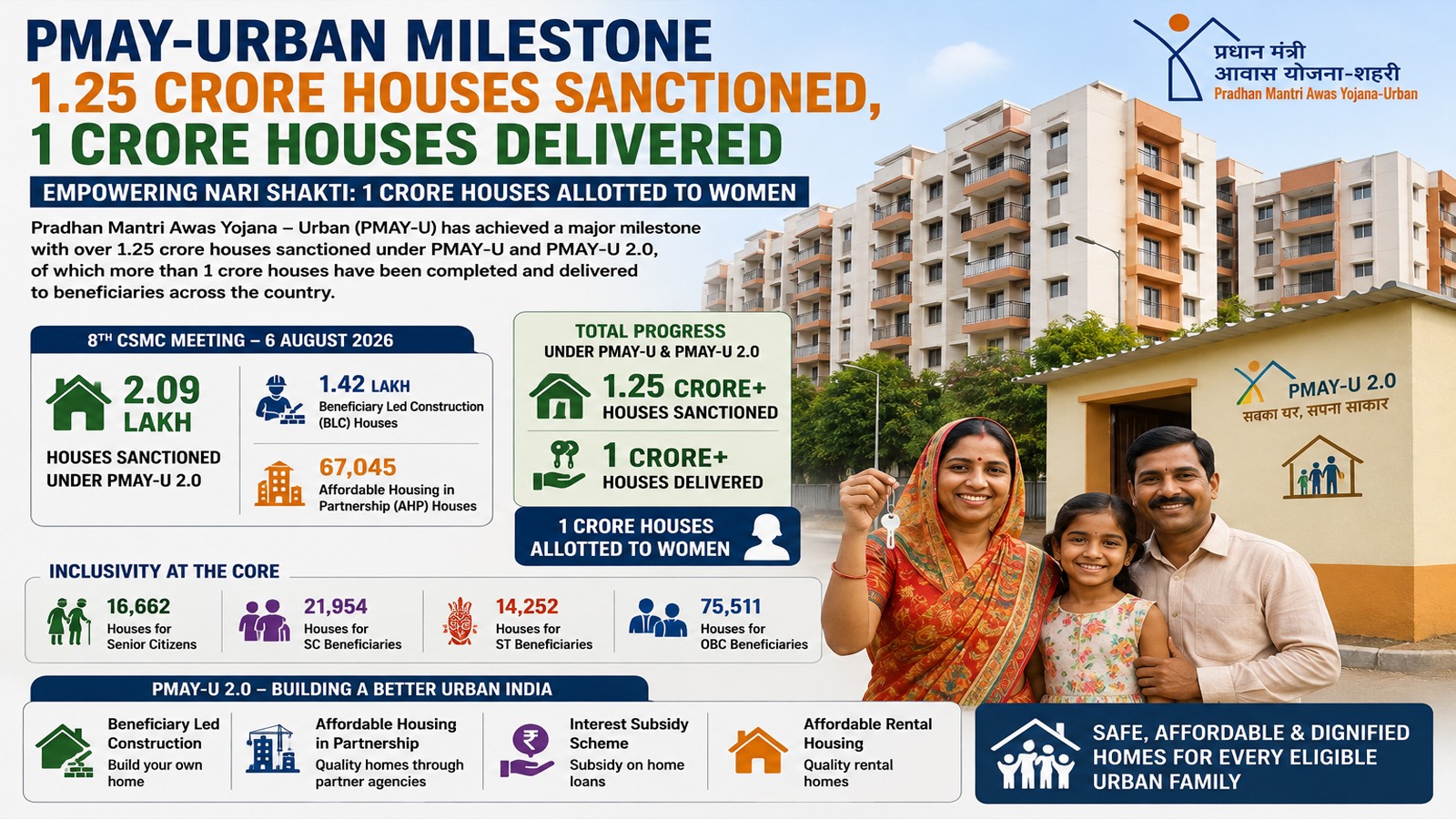
The Pradhan Mantri Awas Yojana-Urban (PMAY-U) has crossed a major milestone with more than 1.25 crore houses sanctioned under PMAY-U and PMAY-U 2.0, of which over 1 crore houses have been completed and delivered to beneficiaries across the country, the Ministry of Housing and Urban Affairs (MoHUA) said on Sunday.
MoHUA said the housing programme has also emerged as a major instrument of women’s empowerment, with 1 crore of the sanctioned houses allotted in the name of women, either as female heads of households or through joint ownership.
The latest progress was reviewed at the eighth meeting of the Central Sanctioning and Monitoring Committee (CSMC) under PMAY-U 2.0, held on August 6 in New Delhi under the chairmanship of Satendra Singh, Secretary, Department of Urban Development, MoHUA.
The committee approved more than 2.09 lakh additional houses under PMAY-U 2.0 for economically weaker section (EWS) families across 16 States and Union Territories, including Andhra Pradesh, Bihar, Gujarat, Jammu and Kashmir, Madhya Pradesh, Maharashtra, Odisha, Rajasthan, Tamil Nadu, Telangana, Uttar Pradesh and Uttarakhand.
Of the newly sanctioned houses, around 1.42 lakh fall under the Beneficiary Led Construction (BLC) component, which provides financial assistance of up to Rs 2.5 lakh to eligible beneficiaries to construct pucca houses on their own land. Another 67,045 houses were sanctioned under the Affordable Housing in Partnership (AHP) component, under which public and private agencies develop affordable housing projects in partnership with States and Union Territories.
With the latest approvals, the total number of houses sanctioned under PMAY-U 2.0 has crossed 18.38 lakh. These include 14.40 lakh houses under BLC, 2.48 lakh under AHP, 1.36 lakh under the Interest Subsidy Scheme (ISS) and 13,046 under Affordable Rental Housing (ARH).
During the meeting, the Ministry reviewed the implementation of the scheme across States and Union Territories, including the pace of construction, timely completion of sanctioned houses, geo-tagging, utilisation of funds, beneficiary verification and occupancy status.
MoHUA also highlighted the strong focus on women’s ownership under the scheme. Of the 2.09 lakh houses approved during the latest CSMC meeting, around 2.03 lakh have been allotted to women.
The latest sanctions also include 16,662 houses for senior citizens, 21,954 for Scheduled Caste beneficiaries, 14,252 for Scheduled Tribe beneficiaries and 75,511 for Other Backward Classes beneficiaries.
Overall, of the more than 1.25 crore houses sanctioned under PMAY-U and PMAY-U 2.0, 1 crore have been allotted to women. The government said prioritising women’s ownership has helped strengthen their financial security, social status and participation in household decision-making.
The housing programme also focuses on vulnerable and marginalised sections, including eligible SC, ST and OBC communities, minorities, senior citizens, persons with disabilities, transgender persons and other underprivileged groups.
Singh stressed the need for faster implementation, timely release of funds, effective monitoring and closer coordination among government agencies, beneficiaries and other stakeholders to ensure that eligible urban families receive the benefits of the scheme without delay.
The committee is expected to meet regularly to monitor progress, facilitate approvals and address implementation challenges.
PMAY-U was launched in June 2015 with the objective of achieving ‘Housing for All’ in urban areas. PMAY-U 2.0 builds on the programme by seeking to address the housing requirements of an additional 1 crore eligible economically weaker section, low-income group and middle-income group families in urban India with annual household income of up to Rs 9 lakh.
The second phase provides support through multiple components, including assistance for beneficiaries constructing their own homes, affordable housing projects, interest subsidies on home loans and affordable rental housing, aiming to meet the diverse housing needs of urban families.


