







For decades, India’s poorest and most marginalised communities remained on the periphery of development. Tribal families living in remote forests, Scheduled Castes struggling for educational access, nomadic communities lacking formal identity, and sanitation workers facing hazardous working conditions often found themselves excluded from the benefits of economic growth.
Over the past twelve years, however, the Government has sought to redefine welfare delivery through the principle of Antyodaya – the upliftment of the last person in society. Moving beyond fragmented welfare schemes, policymakers have increasingly focused on saturation-based development aimed at ensuring that benefits reach every eligible household.
As a result of these targeted interventions, the development landscape has been completely reshaped. From tribal villages and remote hamlets to Scheduled Caste-majority settlements and nomadic communities, this decade of sustained effort has brought millions of families closer to education, sustainable livelihoods, dignity, and opportunity.
The transformation is visible not only in statistics but also in stories emerging from some of the country’s most underserved regions.
Turning Gandhian Ideals into Governance
Mahatma Gandhi’s vision of measuring governance by its impact on the weakest and poorest citizens has long served as a moral compass in Indian public policy. In recent years, that principle has evolved into a governance framework centred on last-mile delivery.
The approach has involved coordinated action across ministries to improve infrastructure, education, healthcare, livelihoods and social dignity among historically deprived communities.
Remote tribal habitations, aspirational districts and difficult-to-access villages have increasingly become focal points of development planning. Rather than isolated interventions, multiple schemes are being implemented simultaneously to address interconnected challenges.
Tribal Communities at the Heart of Development
Among the most significant shifts has been the focus on India’s tribal population, particularly communities living in geographically isolated areas.
Historically, many tribal villages lacked basic infrastructure such as all-weather roads, electricity, piped water, healthcare facilities and quality schools. Bridging these gaps has become a central component of development planning.
PM JANMAN Targets the Most Vulnerable
A major initiative in this direction is the Pradhan Mantri Janjati Adivasi Nyaya Maha Abhiyan (PM JANMAN), launched in November 2023 to address the needs of Particularly Vulnerable Tribal Groups (PVTGs).
With a budgetary allocation exceeding ₹24,000 crore, the programme covers 75 PVTG communities across 18 states and one Union Territory through 11 targeted interventions ranging from housing and road connectivity to healthcare, education and skill development.
The programme is implemented through coordinated efforts involving nine ministries and aims to bring essential services to some of India’s most isolated populations.
Traditional Knowledge Becomes Modern Enterprise
In tribal regions, the impact of such interventions is increasingly reflected in livelihood generation.
Women belonging to the Kamar PVTG community in Chhattisgarh have transformed generations-old knowledge of medicinal herbs into a commercial enterprise through the Van Dhan Vikas Kendra initiative.
Once dependent on selling raw forest produce at low prices, these women now manufacture AYUSH-certified herbal products under the “Chhattisgarh Herbals” brand. Entrepreneurship training, digital literacy programmes and market access have enabled them to manage production, packaging and marketing independently.
The initiative has generated sales exceeding ₹1.59 crore, illustrating how traditional knowledge can be integrated into modern economic opportunities.
Van Dhan Kendras Expand Rural Livelihoods
Van Dhan Vikas Kendras have emerged as a key pillar of tribal livelihood support under PM JANMAN.
As of April 2026, 491 such centres had become operational against a target of 500. More than 38,000 members of PVTG communities have undergone entrepreneurship development training, creating new avenues for income generation based on forest resources.
PM-JUGA: Mission-Mode Tribal Development
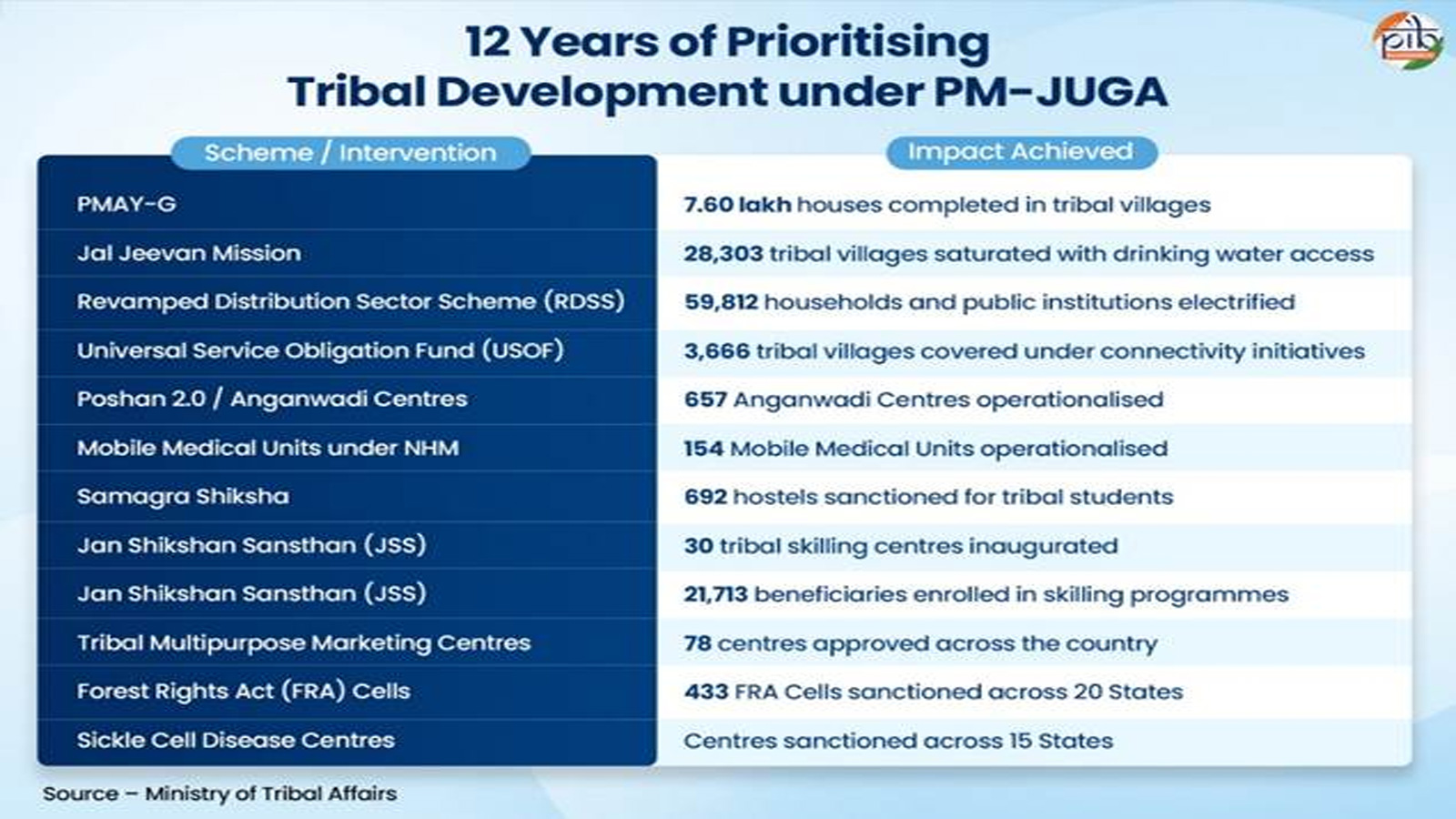
Launched in October 2024 as the Dharti Aaba Janjatiya Gram Utkarsh Abhiyan and later renamed PM-JUGA, the programme seeks to accelerate development in tribal-majority villages through the convergence of efforts across 17 ministries.
The initiative reflects a growing emphasis on coordinated implementation, ensuring that infrastructure, healthcare, education and livelihood programmes complement one another rather than functioning in isolation.
Transforming Tribal Education Through EMRS
Education has emerged as one of the most visible indicators of change.
The expansion of Eklavya Model Residential Schools (EMRS) has brought quality residential education closer to tribal students living in remote regions.
As of 2026, 499 EMRS institutions were operational, serving more than 1.56 lakh students, while another 323 schools remain under construction.
Equipped with smart classrooms, science laboratories, libraries, sports facilities and residential hostels, these schools are providing educational opportunities that were previously unavailable in many tribal districts.
From Remote Kinnaur to IIT Jodhpur
The impact of these schools is perhaps best illustrated through individual success stories.
Jatin Negi grew up in Sangla village of Himachal Pradesh’s Kinnaur district, where severe winters frequently disrupt road connectivity and electricity supply.
After joining an Eklavya Model Residential School in Class VI, he benefited from structured learning, mentorship and academic support. Despite personal hardships, including the loss of his father during Class XII, he persevered and secured an All India Rank of 421 in JEE Advanced.
Today, he is pursuing engineering at IIT Jodhpur.
His journey reflects a broader trend. During the 2024-25 academic year, 597 EMRS students successfully cleared JEE and NEET examinations, compared to just two students in 2022-23.
Preserving Tribal Heritage
Beyond infrastructure and education, efforts have also focused on preserving tribal identity and cultural heritage.
Tribal Research Institutes operating across 29 states and Union Territories are documenting indigenous languages, oral histories, traditional medicinal practices and cultural traditions.
Research projects supported under the TRI-ECE scheme involve leading institutions including IITs, IIMs and AIIMS, helping bridge traditional knowledge systems with academic research.
Simultaneously, eleven Tribal Freedom Fighter Museums have been sanctioned across the country to commemorate tribal leaders who resisted colonial rule. Four museums have already been inaugurated, while seven others remain under development.
The annual observance of Janjatiya Gaurav Divas on November 15, marking the birth anniversary of Bhagwan Birsa Munda, has further strengthened efforts to highlight tribal contributions to India’s freedom movement.
Expanding Opportunities for Scheduled Castes
Scheduled Castes have also been the focus of extensive development initiatives aimed at improving education, livelihoods and social mobility.
PM-AJAY and Village Transformation
The Pradhan Mantri Anusuchit Jaati Abhyuday Yojana (PM-AJAY), launched in 2021, focuses on the integrated development of Scheduled Caste-majority villages.
Covering more than 47,000 villages across 597 districts, the programme reaches over four crore citizens and more than 83 lakh households.
Village-level infrastructure assessments have helped identify gaps in roads, water supply, sanitation, education and connectivity, enabling more targeted interventions.
Dedicated Budgeting Through DAPSC
The Development Action Plan for Scheduled Castes (DAPSC) has strengthened funding mechanisms by ensuring dedicated allocations for SC welfare across government departments.
Today, 38 ministries implement 239 schemes under the framework, covering sectors ranging from housing and education to healthcare and livelihood generation.
Education as a Tool for Social Mobility
A range of scholarship programmes has expanded educational opportunities for disadvantaged students.
The SHREYAS programme supports higher education, research, overseas studies and competitive examination preparation for SC, OBC and economically backward students.
During 2025-26 alone, more than 4,000 SC students received support under the Top Class Education component, enabling admission to premier institutions such as IITs, IIMs, AIIMS and NITs.
Meanwhile, fellowship programmes supported thousands of research scholars pursuing advanced studies.
SHRESHTA Creates New Pathways
The SHRESHTA scheme has focused on providing quality residential education for Scheduled Caste students from economically weaker backgrounds.
Its impact is reflected in stories like those of Doli from Himachal Pradesh and Urmila from Rajasthan.
Doli, the daughter of a daily-wage labourer, received support under SHRESHTA and eventually secured admission to IIT Delhi, where she now studies Civil Engineering.
Urmila, supported through the scheme’s residential education component, topped Rajasthan in her Class XII examinations with a score of 99.6 percent.
Their journeys highlight how targeted educational interventions can help talented students overcome economic barriers.
Rising Educational Participation
Recent years have also seen measurable improvements in educational indicators among Scheduled Castes.
Scheduled Caste enrolment in higher education reached 66.23 lakh in 2021-22, representing a 44 percent increase since 2014-15.
Female enrolment rose by 51 percent during the same period, while the Gross Enrolment Ratio for SC students increased from 18.9 percent to 25.9 percent.
These improvements indicate growing access to higher education among communities that historically faced significant barriers.
Supporting OBCs, DNTs and Nomadic Communities
Development efforts have also increasingly targeted Other Backward Classes, Economically Backward Classes, and Denotified and Nomadic Tribes.
PM-YASASVI Expands Educational Access
Launched in 2021-22, PM-YASASVI provides scholarships and hostel facilities for students from OBC, EBC and DNT communities.
The scheme covers education from school level through higher education, with all benefits transferred directly into Aadhaar-linked bank accounts.
Skill Development Through PM-DAKSH
The PM-DAKSH programme has trained more than 2.08 lakh beneficiaries since its launch in 2020-21.
The scheme offers free certified skill training linked to employment and self-employment opportunities for SCs, OBCs, EBCs, DNTs and sanitation workers.
SEED Scheme Strengthens Inclusion
The Scheme for Economic Empowerment of DNTs (SEED) addresses longstanding challenges faced by denotified and nomadic tribes through coaching support, health insurance, livelihood assistance and housing aid.
In 2025-26 alone, thousands of beneficiaries received educational support, livelihood funding and Ayushman Bharat health cards.
Minority Empowerment Through PM VIKAS
The Government has also consolidated several minority welfare initiatives under PM VIKAS, launched in 2025.
The scheme combines skill development, entrepreneurship, leadership training and cultural preservation under a single framework.
Training programmes have covered diverse sectors ranging from aviation and healthcare to digital technology and traditional crafts.
More than 73,000 candidates have enrolled under the programme so far.
Dignity for Sanitation Workers
One of the most significant reforms has been the NAMASTE scheme, aimed at eliminating hazardous manual cleaning practices.
Launched in 2023-24, the programme seeks to replace manual sewer and septic tank cleaning with mechanised systems while expanding livelihood opportunities and social protection for sanitation workers.
Since 2024, waste pickers have also been included under the scheme, broadening its reach and impact.
Aspirational Districts Drive Grassroots Change
The Aspirational Districts Programme, launched in 2018, represents another major pillar of inclusive governance.
Covering 112 underdeveloped districts, the initiative focuses on health, education, nutrition, agriculture and financial inclusion through data-driven monitoring and competition.
The programme was expanded in 2023 through the Aspirational Blocks Programme, which now covers 500 blocks across 329 districts.
Local Solutions, Measurable Results
In Assam’s flood-prone Lakhipur district, mobile medical units and boat clinics achieved complete screening coverage for diabetes and hypertension among the target population.
In Tamil Nadu’s Virudhunagar district, a digital maternal healthcare platform helped reduce maternal mortality to zero between April 2023 and March 2024.
These examples demonstrate how local innovation combined with administrative accountability can produce measurable improvements in service delivery.
The Road Ahead
India’s development narrative over the past decade has increasingly centred on inclusion. Rather than treating marginalised communities as passive beneficiaries, many of the newer initiatives seek to position them as active participants in economic growth and social transformation.
The results are becoming visible across the country – in tribal students entering IITs, Scheduled Caste scholars pursuing advanced research, women-led enterprises emerging from remote forests, sanitation workers gaining safer livelihoods, and aspirational districts improving key social indicators.
Challenges remain, and disparities have not disappeared. Yet the shift in policy focus is unmistakable. Communities once viewed as being at the margins of development are increasingly becoming central to India’s vision of inclusive growth and its broader ambition of achieving Viksit Bharat by 2047.


