







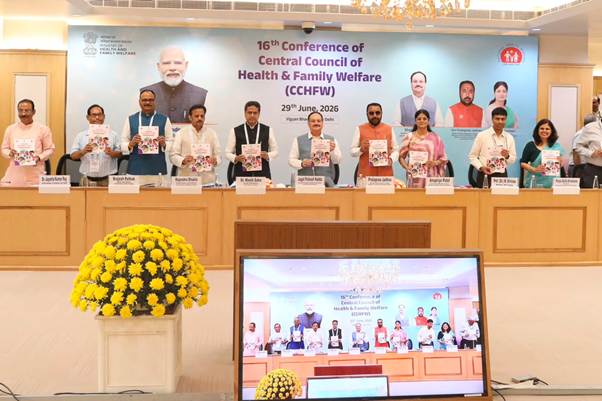
Union Health Minister Jagat Prakash Nadda on Monday launched the SUMAN Roadmap 2030, a strategic framework aimed at strengthening maternal and newborn healthcare and accelerating India’s progress towards achieving the Sustainable Development Goals (SDGs) by 2030.
The roadmap was unveiled during the 16th Conference of the Central Council of Health and Family Welfare (CCHFW) in the presence of Union Ministers of State for Health and Family Welfare Anupriya Patel and Prataprao Jadhav, Health Ministers from States and Union Territories, and senior officials of the Ministry of Health and Family Welfare.
Developed under the Reproductive, Maternal, Newborn, Child and Adolescent Health plus Nutrition (RMNCHA+N) framework, the roadmap adopts a life-cycle approach covering pre-pregnancy, pregnancy, childbirth and the postnatal period. It integrates maternal and newborn care with child health, adolescent health, family planning and nutrition programmes to ensure continuity of care.
The strategy places special emphasis on the identification and management of high-risk pregnancies through all stages of pregnancy and childbirth. It also addresses challenges related to emergency obstetric care, referral transport, healthcare access in tribal and remote areas, community participation and the impact of climate change on maternal and newborn health.
To accelerate progress in areas with a high burden of maternal and newborn mortality, the roadmap proposes targeted interventions across 130 districts in 13 high-focus States—Assam, Bihar, Chhattisgarh, Haryana, Jharkhand, Karnataka, Madhya Pradesh, Odisha, Punjab, Rajasthan, Uttar Pradesh, Uttarakhand and West Bengal.
The roadmap includes a dedicated SUMAN Package for Pregnant Women, promoting early pregnancy registration, comprehensive antenatal care, institutional deliveries and postnatal follow-up. Other measures include bi-weekly home visits by ASHA workers during the final months of pregnancy, financial assistance for caregivers during the postnatal period, strengthened referral transport, and the establishment of Birth Waiting Homes, Maternal and Child Health Wings, Obstetric High Dependency Units and Intensive Care Units in underserved areas.
For all States and Union Territories, the strategy outlines measures such as pre-pregnancy care through folic acid supplementation, expanded nutrition interventions to address maternal anaemia, strengthened surveillance of high-risk pregnancies, community initiatives including SUMAN Panchayats, wider deployment of Non-Pneumatic Anti-Shock Garments (NASG) for managing obstetric haemorrhage, AI-enabled labour rooms, digital monitoring through the JANANI Portal, and climate-responsive planning for pregnant women and newborns.
The roadmap also envisages establishing Centres of Excellence for maternal and newborn healthcare, a centralised SUMAN Call Centre for grievance redressal, stronger referral linkages and enhanced digital monitoring systems to improve service delivery.
According to the Ministry of Health and Family Welfare, the roadmap aims to reduce the Maternal Mortality Ratio (MMR) to below 70 per 100,000 live births by 2030, further reduce the Neonatal Mortality Rate (NMR) and Infant Mortality Rate (IMR), achieve universal coverage of quality maternal and newborn healthcare services, and move towards the goal of eliminating preventable maternal and newborn deaths.


