







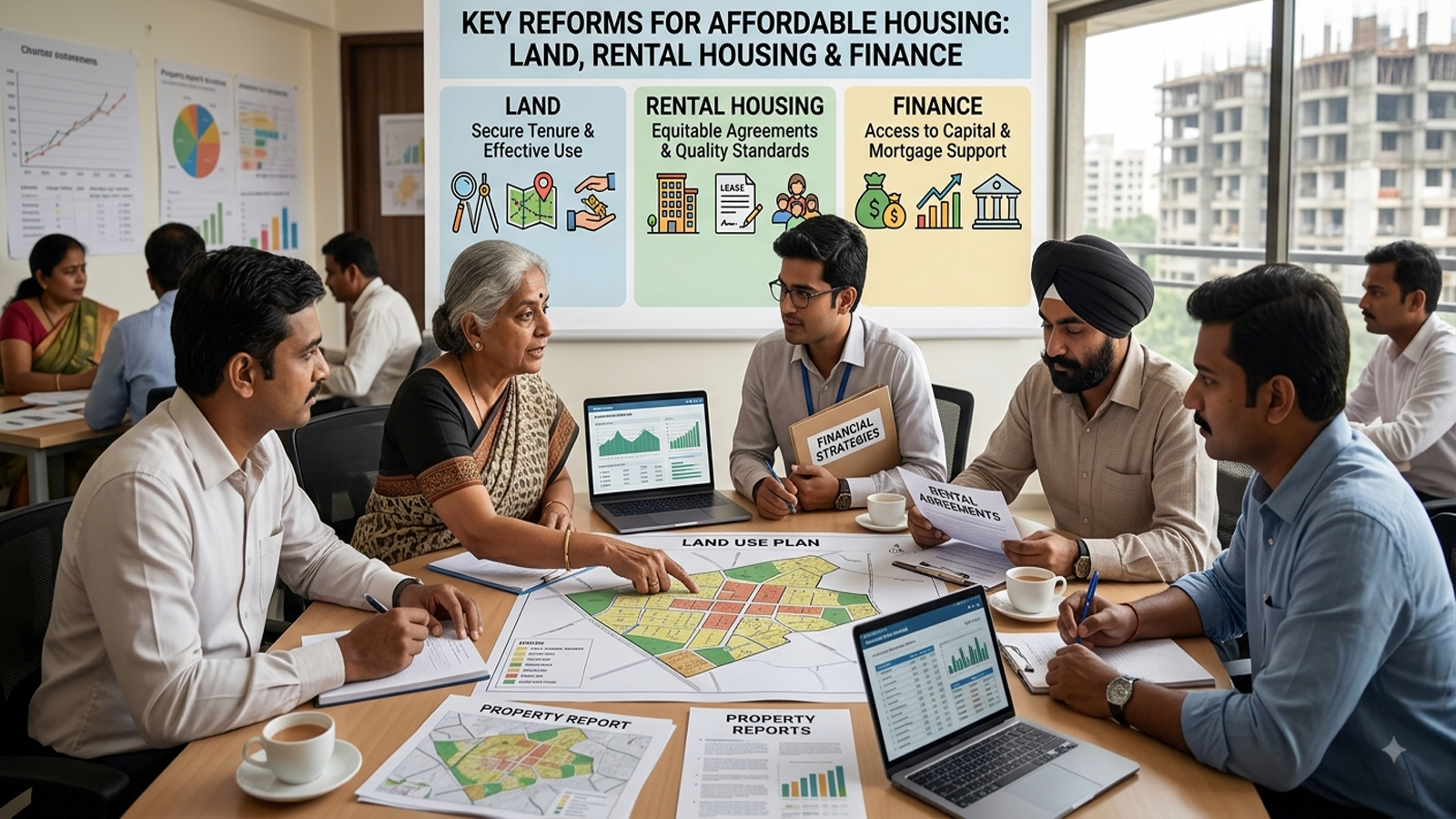
Land availability, urban planning reforms, rental housing and access to finance must remain at the centre of efforts to expand affordable housing in Indian cities, Member of NITI Aayog Rajiv Gauba said on Tuesday.
Addressing the National Conference on Affordable Housing Reforms, titled “Reimagining Affordable Housing: From Scheme to Sustainable Ecosystem”, organised by the Ministry of Housing and Urban Affairs (MoHUA) at Vigyan Bhawan in New Delhi, Gauba called for a shift from a scheme-based approach to the creation of a sustainable and enabling affordable housing ecosystem.
The conference brought together senior policymakers, experts, representatives of States and Union Territories and financial institutions to discuss reforms and innovative approaches to strengthen affordable housing.
Gauba emphasised that land is the most critical constraint in the housing sector and called for reforms to increase the availability of land for affordable housing projects. He suggested considering the waiver of land-use change charges for land dedicated to affordable housing and exemption of affordable housing units from stamp duty to improve project viability and reduce costs for beneficiaries.
“Land is the most binding constraint in the housing sector and therefore, it has to be at the centre of the reform agenda,” Gauba said.
More land for affordable housing
Referring to the NITI Aayog-MoHUA report “A Comprehensive Framework to Promote Affordable Housing”, Gauba said most of the measures proposed in the report would require implementation by State governments and municipal authorities.
He called for a whole-of-government approach by States to address the multiple challenges affecting housing supply.
Among the recommendations are expanding planned urban areas and reserving at least 10 per cent of residential land as affordable housing zones in master plans. The report also proposes increasing the permissible Floor Area Ratio (FAR) for such projects to around 5-6, besides promoting transit-oriented development, land pooling and transferable development rights.
Other measures include easing parking and density norms and creating land banks to improve the availability of land for affordable housing.
Focus on rental housing
Gauba also stressed the growing importance of rental housing, particularly for migrant workers, young professionals, students and industrial workers. He called for reforms in the tenancy framework to facilitate the expansion of affordable rental housing.
The conference also examined strategies to unlock vacant housing stock and improve access to rental accommodation in urban areas.
NITI Aayog Programme Director Anna Roy said affordable housing was fundamental to building inclusive, productive and resilient cities. With India’s urbanisation accelerating, she said, the policy approach must evolve from merely implementing housing schemes to creating an ecosystem that continuously supports affordable housing supply and expands housing choices for urban households.
She stressed that land, planning regulations, financing mechanisms, rental markets and institutional arrangements must work together to make affordable housing viable and sustainable over the long term.
Financial sector participation needed
Gauba called for greater participation of the financial sector and more financial innovation to increase private capital flows into affordable housing.
The conference’s discussions covered measures to improve access to capital for both housing projects and homebuyers. The National Housing Bank (NHB) and HUDCO presented initiatives relating to project finance and home loans, while the Department of Financial Services and Indian Banks’ Association discussed home loan products for people working in the informal sector.
The National Credit Guarantee Trustee Company (NCGTC) shared insights into the performance of the Credit Guarantee Scheme.
PMAY-U experience to guide future reforms
MoHUA Secretary Satendra Singh said affordable housing was not merely a social necessity but also an important driver of economic growth, employment generation and sustainable urban development.
He highlighted the transformation of the urban housing sector over the past decade through the Pradhan Mantri Awas Yojana-Urban (PMAY-U).
Since its launch in 2015, PMAY-U has supported the construction and delivery of houses for eligible urban families, while promoting women’s ownership, convergence with basic civic amenities and greater participation of States and Urban Local Bodies.
Under PMAY-U 2.0, the government aims to support one crore additional eligible urban families through a demand-driven approach. The programme focuses on diverse housing solutions, technology-enabled implementation, access to finance and stronger institutional partnerships.
Singh said the recommendations emerging from the conference should serve as a roadmap for strengthening affordable housing policies and accelerating India’s transition towards sustainable and inclusive urbanisation.
States share reform initiatives
The one-day conference featured three technical sessions focusing on major dimensions of affordable housing reforms.
The first session examined land and urban planning reforms, with presentations from Gujarat, Maharashtra, Telangana, Tamil Nadu and Delhi. The discussions covered town planning models, affordable housing zones, cluster development policies and the Delhi Transit-Oriented Development Policy 2026.
The second session focused on rental housing and vacancy unlocking, including regulatory reforms, rental housing exchanges and initiatives undertaken by Tamil Nadu, Andhra Pradesh, Gujarat, Odisha, Telangana and Assam.
The third session examined access to capital and financial viability on both the demand and supply sides. Discussions focused on project finance, home loans, financing for informal-sector workers and credit guarantee mechanisms.
The conference also enabled States to showcase best practices and share implementation experiences, promoting peer learning and cooperative federalism.
The deliberations are expected to contribute to a roadmap for housing-sector reforms, including mechanisms for monitoring progress, sustained engagement and sharing of successful initiatives among States and other stakeholders.
The conference reaffirmed the need for coordinated action by the Centre, States and UTs, financial institutions, urban local bodies and other stakeholders to build an accessible, inclusive, financially viable and sustainable affordable housing ecosystem.
The discussions will also help guide the implementation of reforms under PMAY-U 2.0 and identify strategies that can be adapted and scaled across different urban contexts.


