







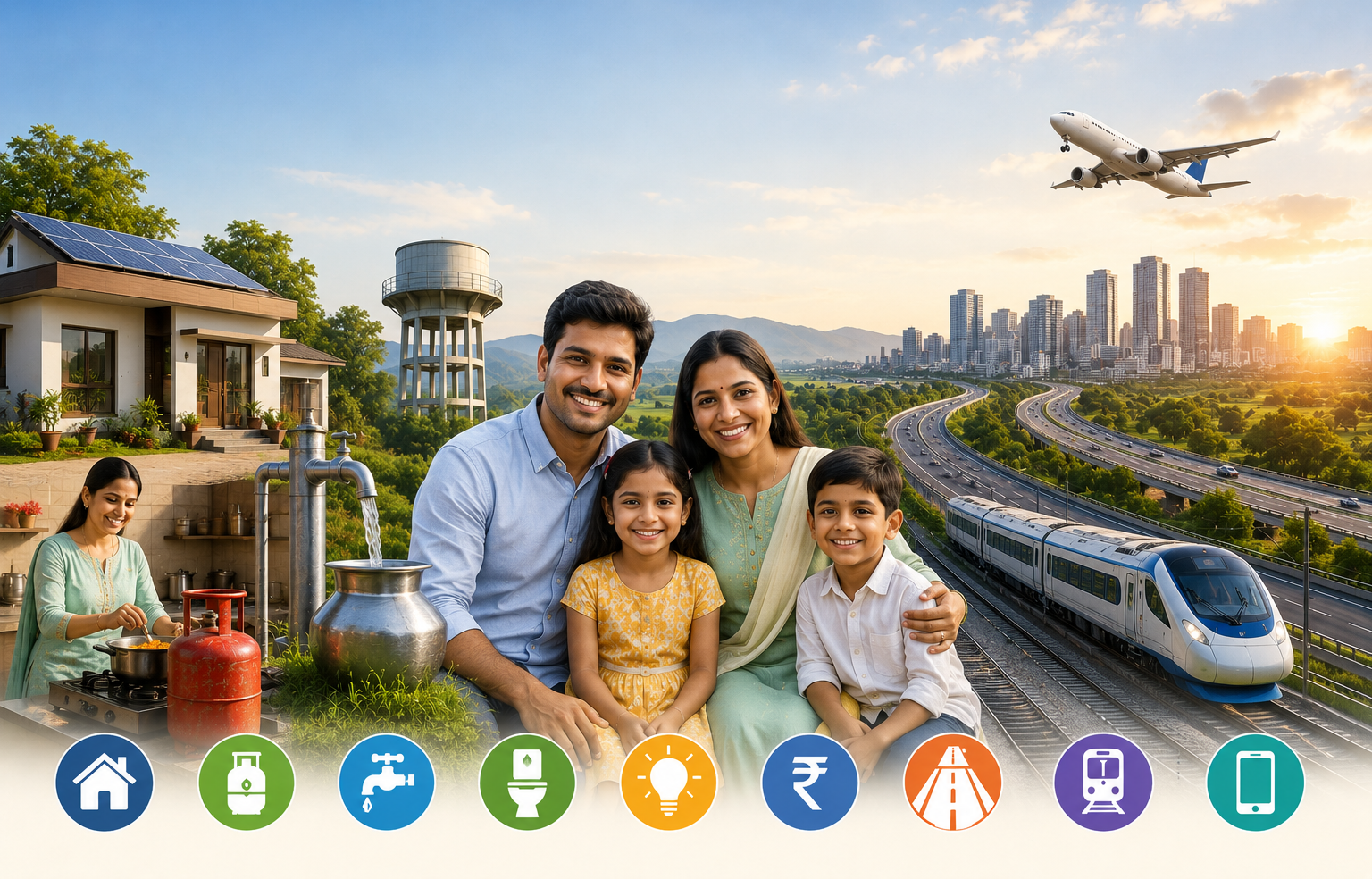
Over the past 12 years, India’s development strategy has increasingly focused on improving everyday living standards through a combination of welfare schemes, infrastructure expansion, financial inclusion and governance reforms. The changes span multiple sectors, including housing, drinking water, sanitation, electricity, banking, transport and digital governance, with programmes targeting both rural and urban populations.
The scale of these interventions is reflected in the numbers. More than 3.91 crore rural houses have been sanctioned, over 15.86 crore rural households now have tap water connections, more than 10.57 crore LPG connections have been provided under Ujjwala, and over 58 crore Jan Dhan bank accounts have been opened. India’s installed power capacity has crossed 532 GW, while the metro rail network has expanded from 248 km in five cities in 2014 to 1,155 km across 26 cities in 2026.
Housing: Over 4 crore houses sanctioned
Housing has been one of the largest components of India’s welfare push. Under Pradhan Mantri Awas Yojana-Urban (PMAY-U), launched in 2015, more than 1.25 crore houses have been sanctioned and over 98 lakh completed. PMAY-U 2.0, launched in 2024, provides financial assistance of up to ₹2.5 lakh under the Beneficiary-Led Construction vertical.
In rural India, PMAY-Gramin, launched in 2016, registered a target of 3.98 crore houses between 2016 and 2026. Of these, 3.91 crore houses have been sanctioned and 3.05 crore completed. About 75 per cent of sanctioned houses are owned by women or jointly owned by women.
Urban infrastructure spending also expanded through the Atal Mission for Rejuvenation and Urban Transformation (AMRUT). While AMRUT Phase-I covered 500 cities, AMRUT 2.0 extended coverage to all 4,800 statutory towns with an outlay of ₹2.99 lakh crore. Projects worth ₹2.79 lakh crore have been sanctioned under AMRUT and AMRUT 2.0.
Water, sanitation and clean cooking fuel
The Pradhan Mantri Ujjwala Yojana, launched in 2016, has provided more than 10.57 crore LPG connections. National LPG coverage increased from 55.9 per cent in April 2014 to 107.2 per cent in April 2026, while the number of consumers rose from 14.51 crore to 33.39 crore.
The Jal Jeevan Mission has expanded rural tap water coverage from 3.23 crore households (16.72 per cent) in 2019 to more than 15.86 crore households (81.94 per cent) by June 2026. Around 12 crore new connections have been added, backed by investments of ₹2.08 lakh crore. More than 1.81 lakh villages have been certified as Har Ghar Jal, while 11 states and Union Territories have achieved complete rural household coverage.
Under Swachh Bharat Mission-Gramin, sanitation coverage increased from 39 per cent in 2014 to 100 per cent in 2019. More than 12.14 crore household toilets and 2.76 lakh community sanitary complexes have been built. In urban areas, over 63 lakh household toilets and six lakh community toilets have been constructed. Urban waste processing increased from 16 per cent in 2014 to 82 per cent in 2026.
Power sector: Capacity doubles to 532 GW
India’s installed power generation capacity has grown from 248 GW in 2014 to more than 532 GW by March 2026. Renewable energy capacity increased from 76.38 GW to 274.69 GW during the same period. Solar capacity expanded from 2.82 GW to 150.26 GW, while wind power capacity rose from 21.04 GW to 56.09 GW.
Electricity availability has improved significantly, with average rural supply rising from 12.5 hours in 2014 to 22.6 hours in 2026. Urban areas receive an average of 23.4 hours of power daily. The national energy shortage has fallen from 4.2 per cent in 2013-14 to 0.03 per cent in 2025-26.
Financial inclusion: 58 crore Jan Dhan accounts
The Pradhan Mantri Jan Dhan Yojana has grown into the world’s largest financial inclusion programme, with more than 58 crore accounts opened by June 2026. Deposits in these accounts have crossed ₹3 lakh crore. In FY 2024-25 alone, ₹6.9 lakh crore was transferred through Direct Benefit Transfer mechanisms covering 327 schemes.
Under the MUDRA scheme, more than 57.7 crore loans worth ₹40 lakh crore have been sanctioned. Women account for 66 per cent of beneficiaries, receiving loans worth ₹16.88 lakh crore.
Transport: Highways, metros and airports expand
India’s national highway network has expanded from 91,287 km in FY14 to 1,46,572 km in March 2026. Four-lane and above highways increased from 18,371 km to 45,516 km, while 3,644 km of access-controlled expressways are operational.
Metro rail networks have expanded from 248 km in five cities in 2014 to 1,155 km across 26 cities in 2026, making India home to the world’s third-largest metro network. Daily ridership has increased from 28 lakh passengers in 2013-14 to more than 1.15 crore.
Civil aviation has also witnessed significant growth. Operational airports increased from 74 in 2014 to 165 by April 2026. Under the UDAN scheme, 665 routes have been operationalised across 95 airports, heliports and water aerodromes, serving more than 1.64 crore passengers.
The combined impact of these initiatives has reshaped access to housing, water, sanitation, electricity, banking services and transportation for millions of Indians. Whether measured through infrastructure creation, service delivery or financial inclusion, the period between 2014 and 2026 represents one of the largest expansions of public welfare and connectivity programmes in the country’s history.


