







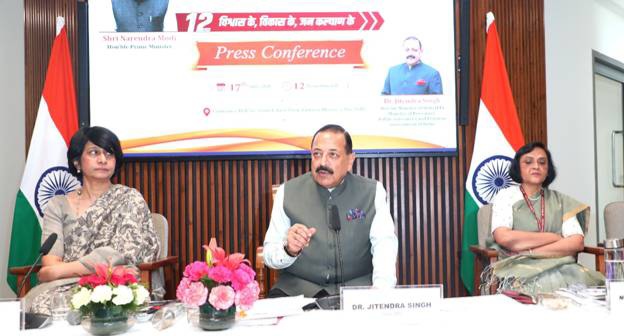
Union Minister Jitendra Singh on Wednesday called on state governments to adopt the Centre’s governance reforms and citizen-centric service delivery platforms, saying such initiatives have transformed public administration, strengthened public trust and can help accelerate India’s journey towards Viksit Bharat 2047.
Addressing a press conference on the achievements of the Ministry of Personnel, Public Grievances and Pensions over the past 12 years, Singh said governance reforms under Prime Minister Narendra Modi have evolved beyond administrative changes to become instruments of social and economic transformation. He highlighted initiatives such as Mission Karmayogi, the Centralized Public Grievance Redress and Monitoring System (CPGRAMS), Digital Life Certificates and other technology-driven platforms as examples of reforms that have improved transparency, accountability and efficiency in governance.
The minister said the Department of Personnel and Training (DoPT), the Department of Administrative Reforms and Public Grievances (DARPG) and the Department of Pension and Pensioners’ Welfare (DoPPW) have emerged as key drivers of reform and innovation. He noted that several Indian governance initiatives are now drawing international attention, with countries such as South Africa, Mongolia and the Maldives studying India’s experiences in digital governance, grievance redressal and civil service reforms.
Highlighting key milestones, Singh said the introduction of self-attestation of documents in 2014 marked a shift from bureaucratic procedures to a trust-based governance model. He also cited the abolition of interviews for Group B (Non-Gazetted) and Group C government posts, along with technology-enabled recruitment systems, as measures that have improved transparency and merit-based selection. According to him, more than 12 lakh appointment letters have been distributed through 19 Rozgar Melas since October 2022.
The minister said social justice remains central to personnel policies, pointing to the implementation of reservation for Economically Weaker Sections (EWS), measures to improve representation of Persons with Benchmark Disabilities and efforts to fill backlog vacancies.
Describing Mission Karmayogi as one of the world’s most ambitious civil service reforms, Singh said the iGOT Karmayogi platform has over 1.65 crore registered users and nearly 13 crore course completions. The integration of artificial intelligence through tools such as AI Sarthi and AI Tutor is helping build a future-ready civil service, he added.
On grievance redressal, Singh said annual complaints registered with the government have increased from around two lakh to nearly 25 lakh, reflecting growing public confidence in institutional mechanisms. At the same time, average grievance disposal time has fallen from 157 days to just 13 days, demonstrating the impact of technology and continuous monitoring.
The Uniom Minister also highlighted the expansion of digital governance initiatives, including e-Office, online RTI systems, e-HRMS and AI-enabled citizen interfaces. He said India is increasingly developing governance solutions that are being emulated globally.
Referring to anti-corruption measures, Singh said the operationalisation of the Lokpal, amendments to the Prevention of Corruption Act and technology-enabled vigilance systems have strengthened accountability while encouraging honest decision-making.
Additionally, Singh underlined employee-centric reforms such as expanded maternity and childcare benefits, leave provisions related to surrogacy and organ donation, and enhanced support for differently-abled children. Pension reforms, including Digital Life Certificates with face-recognition technology, Pension Adalats and the Anubhav platform, have improved convenience and dignity for retirees, he said.
Further, Singh said the reforms undertaken over the past 12 years have strengthened public confidence, improved service delivery and laid a strong foundation for achieving the vision of a developed India by 2047.


