







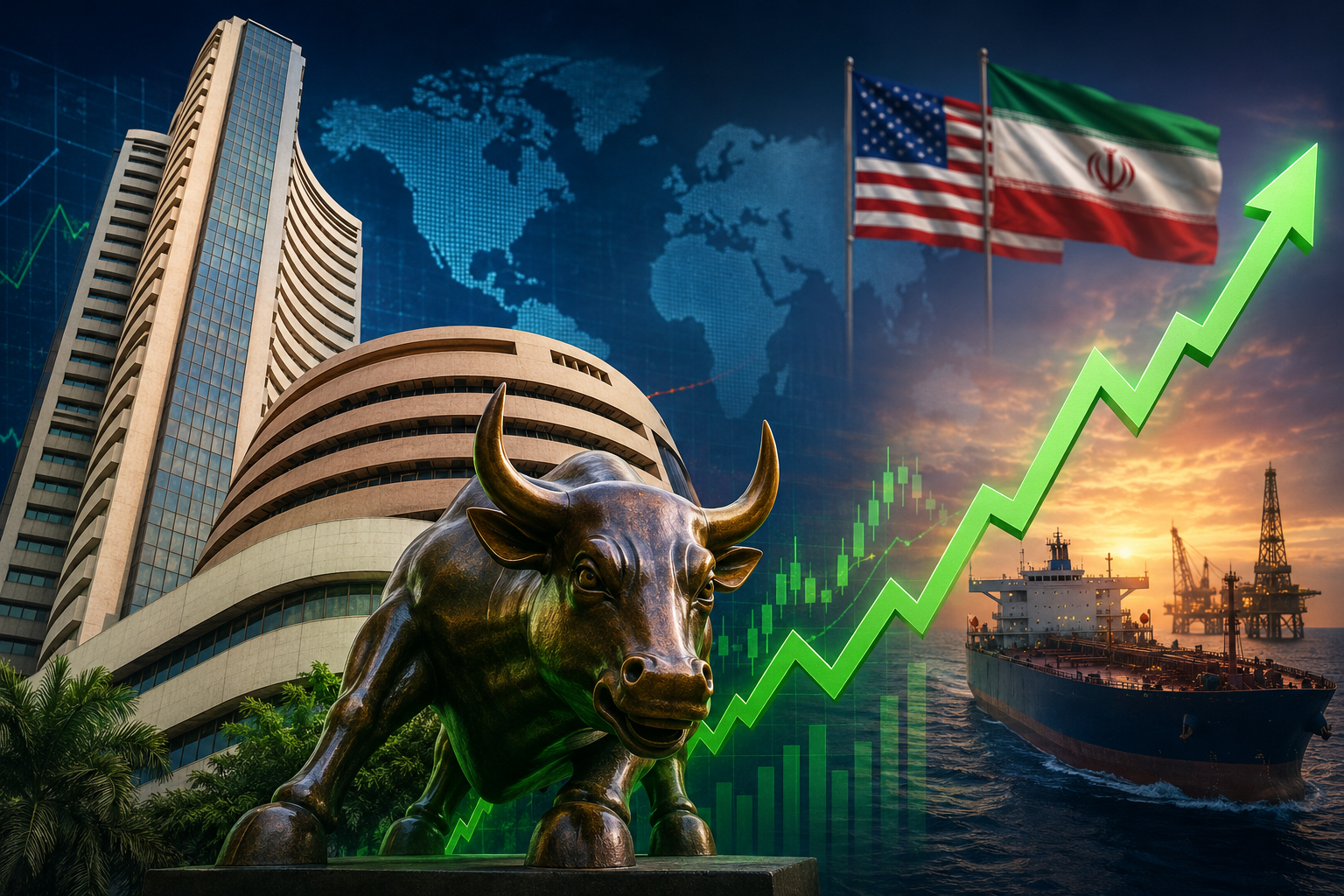
Indian equity benchmarks opened sharply higher on Monday, buoyed by easing geopolitical tensions in West Asia and a steep decline in global crude oil prices following a reported diplomatic breakthrough between the United States and Iran.
The BSE Sensex climbed 1,128.66 points, or 1.49 per cent, to 76,656.61 in early trade, while the NSE Nifty 50 gained 350.40 points, or 1.48 per cent, to reach 23,973.30.
The rally mirrored positive sentiment across Asian markets after US President Donald Trump announced the completion of a peace agreement with Iran, including the reopening of the Strait of Hormuz and the removal of the naval blockade that had raised concerns over global energy supplies.
Market participants viewed the development as a major step towards reducing uncertainty in global markets, particularly at a time when elevated oil prices and geopolitical risks had weighed on investor sentiment.
Banking and market expert Ajay Bagga said Indian markets had already begun pricing in hopes of a diplomatic resolution and were now responding to the prospect of lower energy costs and improved global risk appetite.
“A major overhang on the global economy is beginning to lift,” Bagga said, adding that the US and Iran are expected to sign a memorandum of understanding in Geneva later this week.
The optimism was reflected in energy markets, with Brent crude declining 4.70 per cent to USD 83.23 per barrel, while crude oil futures fell 5.15 per cent to USD 80.51 per barrel. Gold, traditionally considered a safe-haven asset during periods of uncertainty, rose 2.46 per cent to USD 4,325.66.
According to Bagga, the proposed agreement includes an immediate halt to military actions and the reopening of the Strait of Hormuz, a critical route for global oil shipments.
Asian equities also registered strong gains. Japan’s Nikkei 225 surged 4.81 per cent, while South Korea’s KOSPI advanced 5.32 per cent. India’s GIFT Nifty traded 1.35 per cent higher, signalling a positive start for domestic markets.
Despite the upbeat mood, Bagga cautioned that geopolitical uncertainties remain. He noted that hardline factions within Iran, sections of the US political establishment and Israel could pose challenges to the implementation of the proposed agreement.
He said the next phase would involve technical discussions on Iran’s nuclear programme, including oversight of enriched uranium and measures aimed at preventing further weaponisation. In return, Iran is expected to seek sanctions relief and the release of frozen funds.
Bagga also pointed out that Israel is not a party to the proposed arrangement and may have reservations regarding its outcome.
Meanwhile, US equity futures indicated continued optimism. Dow Jones Futures rose 0.86 per cent, while the S&P 500 and Nasdaq futures gained 0.50 per cent and 0.31 per cent respectively.
On the domestic front, technical analysts remained positive on the market outlook. Shrikant Chouhan, Head of Equity Research at Kotak Securities, said chart patterns suggested that the recent consolidation phase had ended and an upward trend had resumed.
“On daily charts, the market has formed a strong reversal pattern, while weekly charts show a long bullish candle, which is largely positive,” Chouhan said.
He identified the 23,500 level on the Nifty and 74,800 on the Sensex as key support zones for positional traders. As long as the indices remain above these levels, the broader uptrend is expected to continue.
According to Chouhan, the Nifty could move towards the 24,000-24,100 range in the near term, while the Sensex may target the 76,300-76,600 zone. However, a fall below the support levels could weaken the current bullish momentum.
-ANI


