







Scientists at the Institute of Nano Science and Technology (INST), Mohali, have developed a new electrolyte additive that could make aqueous zinc-ion batteries safer, longer-lasting and more affordable, offering a potential boost for large-scale renewable energy storage.
The research addresses some of the key challenges that have limited the commercial adoption of aqueous zinc-ion batteries (AZIBs), including zinc dendrite formation, hydrogen evolution, corrosion and poor cycling stability. Instead of redesigning battery materials, the study focuses on improving the electrolyte interface to enhance battery performance.
The findings, published in the journal ACS Electrochemistry, were led by Dr Ramendra Sundar Dey, Scientist E at INST, an autonomous institute under the Department of Science and Technology (DST).
The team developed an electrolyte additive, 1,3-bis (1,3-dicarboxypropyl)-1H-imidazole-3-ium chloride (BDIM), which selectively adsorbs onto the zinc metal surface and regulates the Inner Helmholtz Plane (IHP) — the region where electrochemical reactions occur during battery operation.
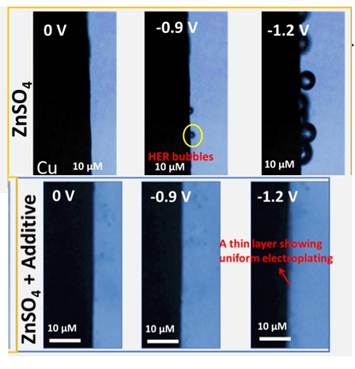
According to the researchers, BDIM contains multiple oxygen and nitrogen donor sites that strongly interact with zinc. During battery operation, the additive preferentially occupies the Inner Helmholtz Plane, displacing water molecules from the zinc surface. This suppresses water-induced side reactions such as hydrogen evolution and corrosion while also reducing zinc dendrite formation, three factors that are responsible for limiting battery life and performance.
To investigate the zinc-deposition mechanism, the researchers combined a laboratory-developed ultramicroelectrode (UME) with fast-scan cyclic voltammetry (FSCV). The UME, which measures less than 50 micrometres in size, alters the diffusion behaviour of ions and enables high scan rates, while FSCV allowed the team to observe changes in charge-transfer behaviour after the addition of BDIM.
The technique enabled researchers to directly examine interfacial charge-transfer and mass-transfer kinetics, providing fresh insights into the mechanism of zinc deposition.
According to the study, the technology could be applied to aqueous zinc-ion batteries used in renewable energy storage, backup power systems and grid-scale energy storage. By improving battery lifetime and reducing performance degradation, the researchers said the additive could help lower maintenance costs while enhancing the reliability of sustainable energy infrastructure.


