







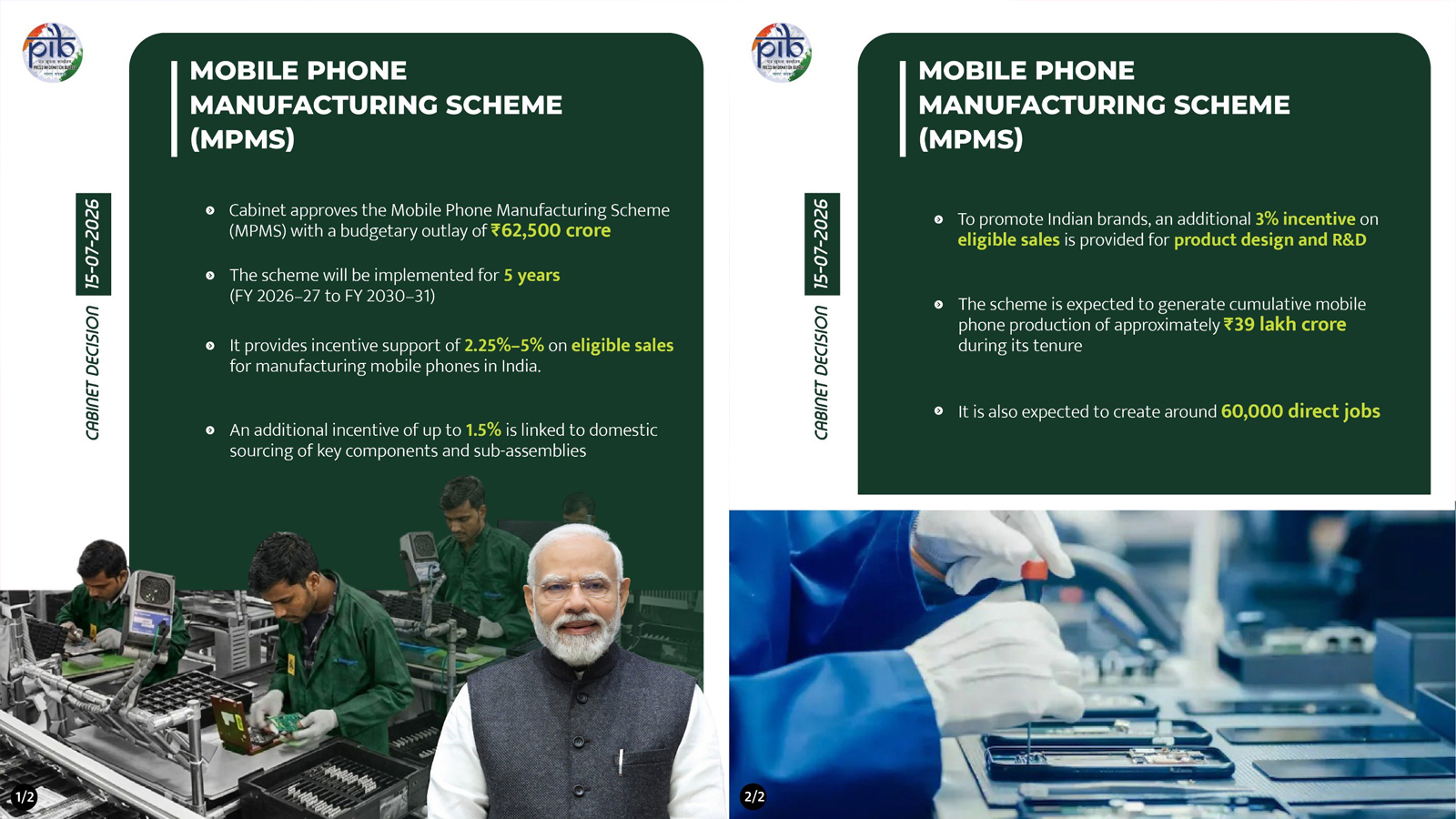
The Union Cabinet, chaired by Prime Minister Narendra Modi, on Wednesday approved the Mobile Phone Manufacturing Scheme (MPMS) with a budgetary outlay of ₹62,500 crore to further expand domestic mobile phone production, increase value addition, strengthen supply chains and enhance India’s competitiveness in global electronics manufacturing.
The new scheme, which will be implemented over five years from FY 2026-27 to FY 2030-31, aims to build on India’s emergence as one of the world’s leading mobile phone manufacturing hubs while promoting indigenous technology, design and research capabilities.
According to the government, MPMS seeks to scale up production, deepen domestic value addition and create a more resilient electronics manufacturing ecosystem. The scheme also aims to support the development of Indian mobile phone brands by encouraging technological innovation, research and development, and intellectual property creation.
Under the scheme, manufacturers will receive incentive support on eligible sales of mobile phones produced in India at differentiated rates ranging from 2.25 per cent to 5 per cent. An additional incentive of up to 1.5 per cent will be provided to companies based on domestic sourcing of key components and sub-assemblies, encouraging greater localisation across the supply chain.
To promote Indian brands and strengthen indigenous technological capabilities, the scheme also provides an additional 3 per cent incentive on eligible sales linked to product design and research and development activities.
The government expects the scheme to significantly expand India’s mobile phone manufacturing capacity over the next five years. During the scheme period, cumulative mobile phone production is projected to reach approximately ₹39 lakh crore, accompanied by a substantial increase in mobile phone exports.
The scheme is also expected to generate around 60,000 direct jobs, contributing to employment generation, economic growth and further strengthening India’s position as a global electronics manufacturing hub.
Highlighting the sector’s rapid growth over the past decade, the government said Prime Minister Narendra Modi’s Make in India initiative has transformed India’s electronics manufacturing landscape. Since FY 2014-15, electronics manufacturing in the country has increased seven-fold, while electronics exports have grown eleven-fold.
The electronics manufacturing sector has also emerged as a major source of employment, particularly for young men and women from rural areas. According to the government, several electronics manufacturing facilities now employ more than 5,000 workers at a single location, reflecting the sector’s growing contribution to industrial employment.
Mobile phone manufacturing has played a central role in this transformation and has emerged as the anchor of India’s broader electronics manufacturing ecosystem. India is now the world’s second-largest mobile phone manufacturer by volume, with 99.2 per cent of the mobile phones used in the country being manufactured domestically.
The government also noted that smartphones have become India’s largest export product category in 2025, surpassing traditional export leaders such as diesel fuel and cut diamonds. Mobile phones now account for a significant share of India’s electronics production and exports, strengthening the country’s integration into global value chains.
The Cabinet noted that the Production Linked Incentive Scheme for Large Scale Electronics Manufacturing (PLI-LSEM), which concluded on March 31, 2026, played a transformative role in establishing India as a major global hub for mobile phone manufacturing and exports.
The newly approved Mobile Phone Manufacturing Scheme is expected to build on that momentum by supporting the next phase of growth in domestic manufacturing, increasing local value addition, encouraging innovation and creating globally competitive Indian mobile phone brands.


