







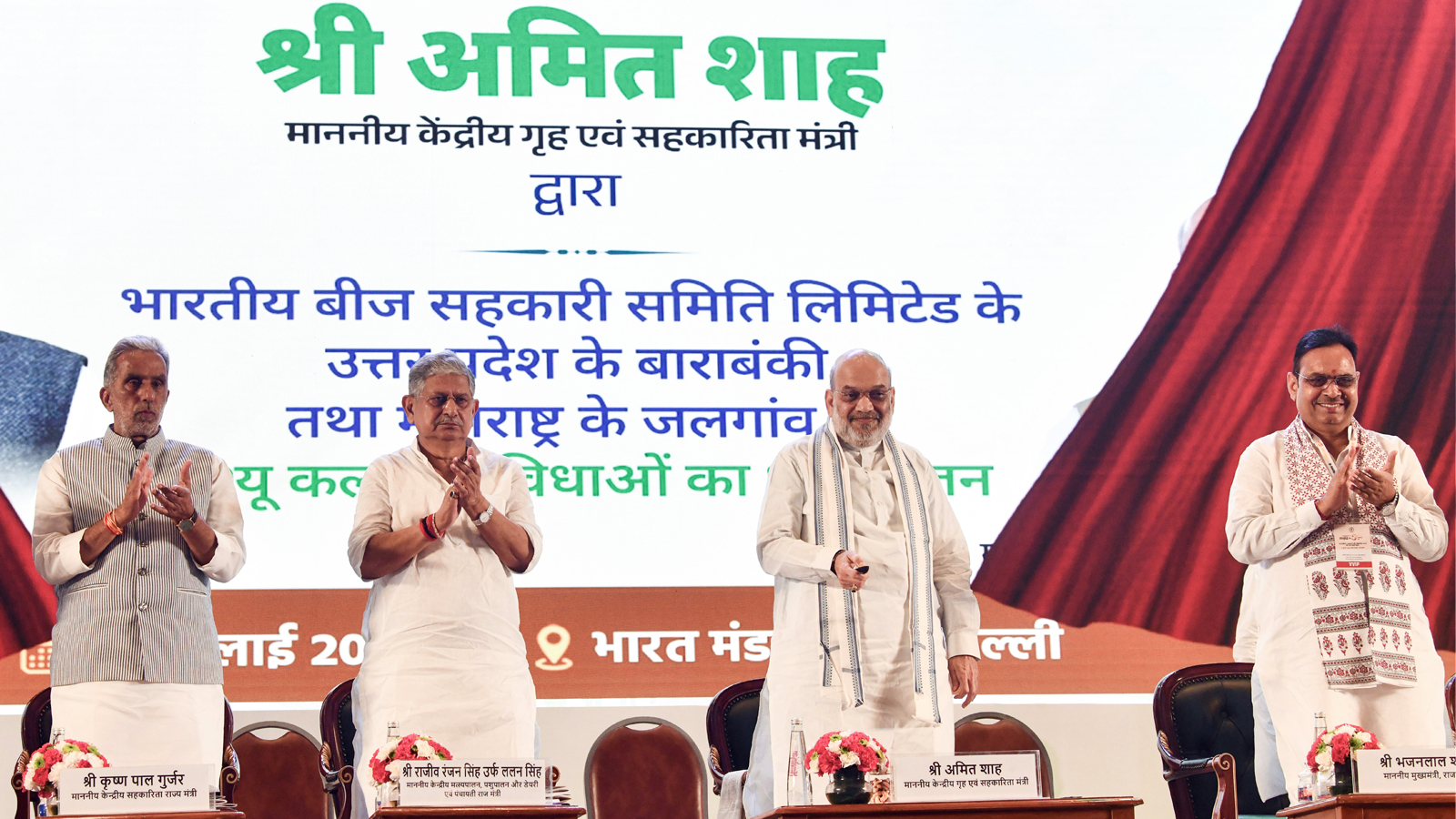
Union Home Minister and Minister of Cooperation Amit Shah on Monday said the Ministry of Cooperation has infused new energy into the lives of nearly 30 crore people associated with the cooperative sector over the past five years, asserting that the movement would become the foundation of a prosperous India by the time the country celebrates 100 years of Independence in 2047.
Addressing the fifth Foundation Day celebrations of the Cooperation Ministry in New Delhi, HM Shah said the ministry, established by Prime Minister Narendra Modi in 2021, has transformed the cooperative ecosystem into one that is modern, transparent, technology-driven and competitive.
“Under the leadership of Prime Minister Narendra Modi Ji, the Ministry of Cooperation has, over the past five years, infused new energy into the lives of 30 crore people associated with the cooperative sector,” HM Shah said.
He said the ministry has identified the key challenges facing the cooperative sector, prepared a comprehensive roadmap for its development and resolution, and introduced reforms that have modernised the entire ecosystem.
“When the nation celebrates the centenary of its Independence in 2047, the cooperative movement will serve as the strong foundation of a Prosperous India,” he said.
Ministry gave new direction to cooperative movement
Recalling the creation of the Ministry on July 6, 2021, HM Shah said the decision ended a 75-year wait for millions of people associated with the cooperative sector.
“Exactly five years ago, the 75-year-long wait of 32 crore people associated with cooperation and more than 8.50 lakh cooperative institutions across the country came to an end. On this very day, Prime Minister Shri Narendra Modi took the historic decision to establish an independent Ministry of Cooperation in the Government of India,” he said.
HM Shah said the ministry ended decades of neglect faced by the cooperative sector and infused new life into it.
He also rejected criticism that the ministry would interfere in the powers of states.
“Five years have passed, but even States governed by opposition parties have never complained that the Union Ministry of Cooperation is interfering in any way, and this is our biggest achievement,” HM Shah said.
“The Ministry of Cooperation has proved that it was created not to interfere in the functioning of the States, but to assist them, support policy-making and help in their advancement,” he added.
Modernisation and digital transformation
Highlighting the ministry’s achievements, HM Shah said an integrated digital database covering over 8.58 lakh cooperative societies across 30 sectors and 32 crore members has been created.
The database includes information on audit status, turnover, grading and the presence of cooperative institutions across villages, enabling states to identify gaps and strengthen cooperative networks.
He also announced the launch of a national ranking framework under which the top-performing cooperative societies in every sector would be recognised and encouraged.
HM Shah said the government has amended the Multi-State Cooperative Societies Act, making the system more transparent and democratic, while Tribhuvan Cooperative University has been established to create trained professionals for every segment of the cooperative sector.
“The biggest question in the field of cooperation has always been leadership and institutional stability. Tribhuvan Sahkari University will prepare trained professionals in banking, dairy, marketing, agriculture, fertilizers and other areas of cooperation,” he said.
PACS transformed into multi-service centres
The minister said the government has expanded the role of Primary Agricultural Credit Societies (PACS), enabling them to offer over 300 services through Common Service Centres.
He said 55,000 PACS are now providing services including railway ticket booking, birth and death registration, applications for government schemes and digital payments.
HM Shah said 39,000 PACS have become Kisan Samriddhi Kendras, more than 600 PACS are operating Jan Aushadhi Kendras, while several others are managing fuel outlets and water supply schemes.
He added that the government invested Rs 3,000 crore to computerise PACS and that 50,000 PACS have already become e-PACS, making their operations completely digital.
Credit expansion and stronger cooperative banks
HM Shah said cooperative banks have also witnessed significant improvement through digitisation, cyber security measures, e-KYC and digital lending.
He said the business of District Cooperative Banks has increased from Rs 19.6 lakh crore to over Rs 25 lakh crore, while Urban Cooperative Banks have nearly doubled their net profits.
HM Shah also highlighted a sharp improvement in asset quality.
“In the last five years, we have brought down the gross NPA of these banks from 12.8 percent to 6.2 percent and succeeded in reducing net NPA from 5.1 percent to 0.7 percent,” he said.
Nine national cooperative societies created
The Home Minister said the government has established nine national-level cooperative societies covering sectors such as agriculture, dairy, banking, exports, logistics, mobility, organic farming and seeds.
“Just as IFFCO, KRIBHCO, Amul and NDDB have built the identity of the cooperative movement globally, our nine national-level cooperative societies will also grow into large international-level cooperative institutions,” he said.
He said Bharat Beej Sahakari Samiti Limited (BBSSL) would emerge as India’s largest seed production company within three years, helping farmers access high-quality seeds while promoting indigenous varieties.
Organic farming and circular economy
HM Shah said the government is integrating organic farming, renewable energy, cattle waste management and bio-fertiliser production into the cooperative model.
He appealed to farmers to gradually reduce dependence on chemical fertilisers.
“The last five years have proved that reducing the use of chemical fertilizers does not reduce production; rather, production increases and soil is also protected,” HM Shah said.
He said the newly launched Gomay Cooperative Society Multi-State Limited would promote a complete circular economy through cattle waste management, organic fertilisers, renewable energy generation and animal health services.
Bharat Taxi and new cooperative initiatives
The minister said Bharat Taxi would expand to over 500 cities in the next two years, providing drivers with an alternative cooperative-based platform free from exploitation.
He also announced plans to develop utility aggregator cooperatives and cooperative life insurance companies while strengthening marketing support for farmers through newly established export cooperatives.
Projects launched
During the event, HM Shah launched and inaugurated several initiatives, including foodgrain storage infrastructure, tissue culture facilities under BBSSL, dairy productivity initiatives, Cooperative Milk Producers Organization Multi-State Limited, Gomay Cooperative Society Multi-State Limited, Sahakar CBS core banking platform, Sahakar Sahayogi AI platform for urban cooperative banks and the transformation of 50,000 PACS into e-PACS.
An MoU between BBSSL and the Indian Council of Agricultural Research (ICAR) to strengthen India’s seed systems was also signed.
Tribute to Dr. Syama Prasad Mookerjee
At the beginning of his address, HM Shah paid tribute to Dr. Syama Prasad Mookerjee on his 125th birth anniversary.
He said Mookerjee established the values of nationalism and Indian culture and played a decisive role in ensuring that Kashmir, Assam and parts of Bengal remained integral parts of India.
“It was Dr. Mookerjee who had said that one country cannot have two constitutions, two heads and two flags. He not only launched a movement for this cause, but also sacrificed his life for it,” HM Shah said.
He added that PM Modi fulfilled Mookerjee’s dream by abrogating Article 370 and that the government has decided to celebrate his 125th birth anniversary across the country throughout the year.


