







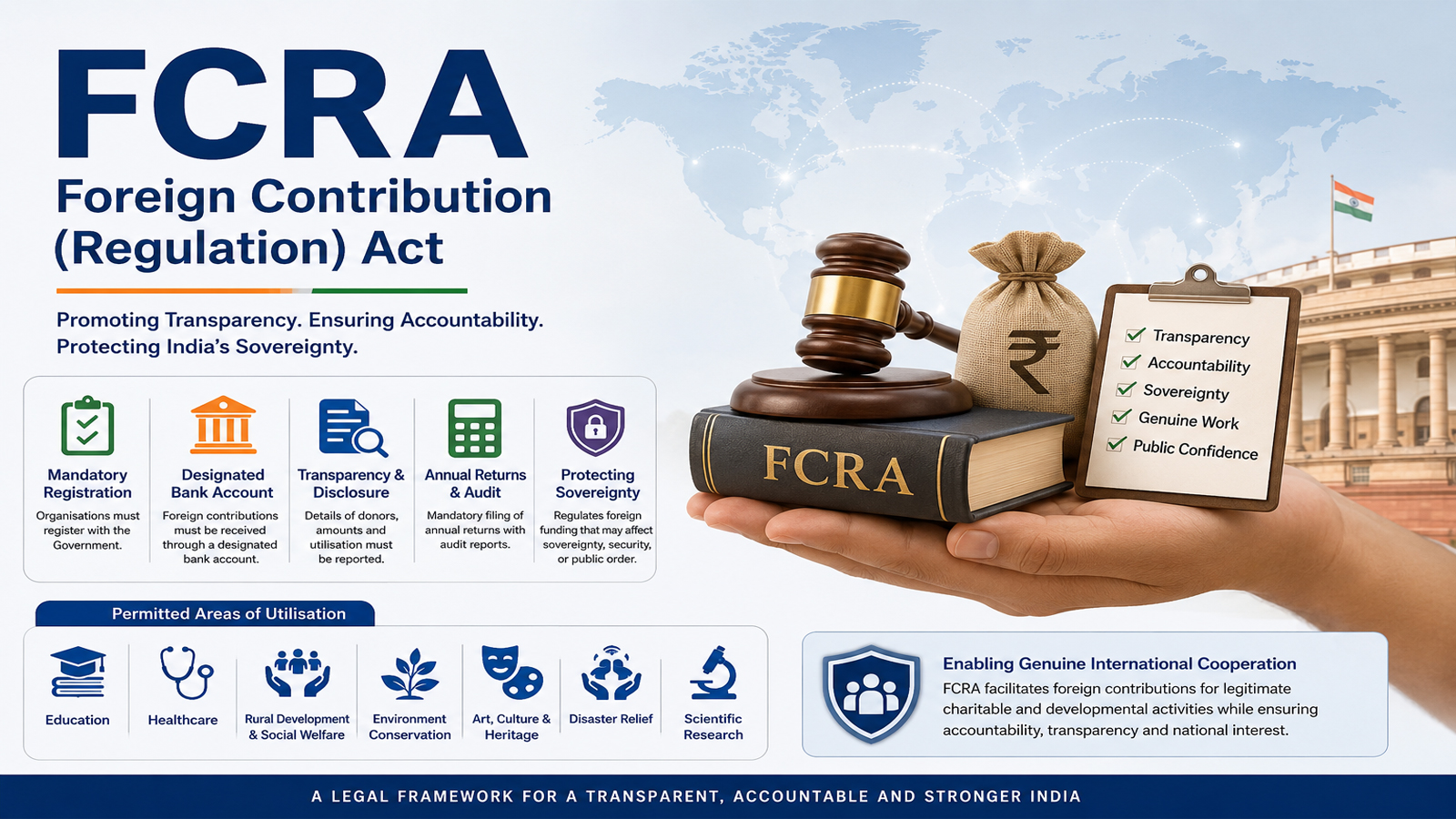
As cross-border financial flows have expanded with globalisation, India has steadily strengthened its legal framework governing foreign contributions through the Foreign Contribution (Regulation) Act (FCRA). According to the Ministry of Home Affairs (MHA), the legislation seeks to facilitate legitimate international cooperation while ensuring that foreign contributions remain transparent, accountable and consistent with India’s sovereign interests.
The FCRA governs how Indian individuals, associations, NGOs, trusts and companies receive and utilise foreign contributions in the form of money, securities or articles from sources outside India. Administered by the Ministry of Home Affairs, the Act identifies eligible recipients, prescribes the manner in which foreign contributions must be received and reported, and regulates a limited category of foreign-funded activities that could affect India’s sovereignty, security or public order.
According to the Ministry, the law rests on five core principles—transparency, accountability, sovereignty, enabling genuine work and public confidence. Organisations receiving foreign contributions are required to register with the government, route funds through designated banking channels and disclose the source, utilisation and purpose of the funds. Annual audited returns create a traceable record of foreign funding and its utilisation, while the framework seeks to facilitate genuine work in education, healthcare, scientific research, disaster relief, environmental conservation and cultural exchange.
The FCRA has undergone continuous refinement since it was first enacted in 1976. The original legislation was introduced to regulate foreign contributions in line with the values of a sovereign democratic republic. A 1984 amendment made registration mandatory for NGOs receiving foreign funds and expanded regulatory oversight. The current FCRA, enacted in 2010, replaced the earlier law with a stronger compliance architecture, introducing provisions such as mandatory five-year registration renewals, suspension and cancellation mechanisms, vesting of assets and compounding of offences.
Subsequent amendments have focused on strengthening governance rather than expanding prohibitions. The 2020 amendments introduced mandatory Aadhaar or passport identification for office-bearers, required foreign contributions to be received through a single SBI account in New Delhi, prohibited sub-granting and reduced the administrative expense ceiling from 50 per cent to 20 per cent. The 2022 Rules eased compliance for contributions received from relatives abroad, while the 2024-25 amendments clarified administrative provisions and strengthened documentation requirements.
The proposed FCRA Amendment Bill, 2026, together with the notified FCRA Amendment Rules, 2026, seeks to further strengthen transparency, governance and regulatory clarity. Proposed changes include establishing a designated authority to manage foreign-funded assets when registrations lapse, introducing activity- and state-specific registrations, enhancing reporting requirements, requiring minimum utilisation for renewal and strengthening judicial safeguards. According to the Ministry, every amendment has moved in the direction of tighter disclosure and accountability while leaving the core objectives of the law unchanged.


