







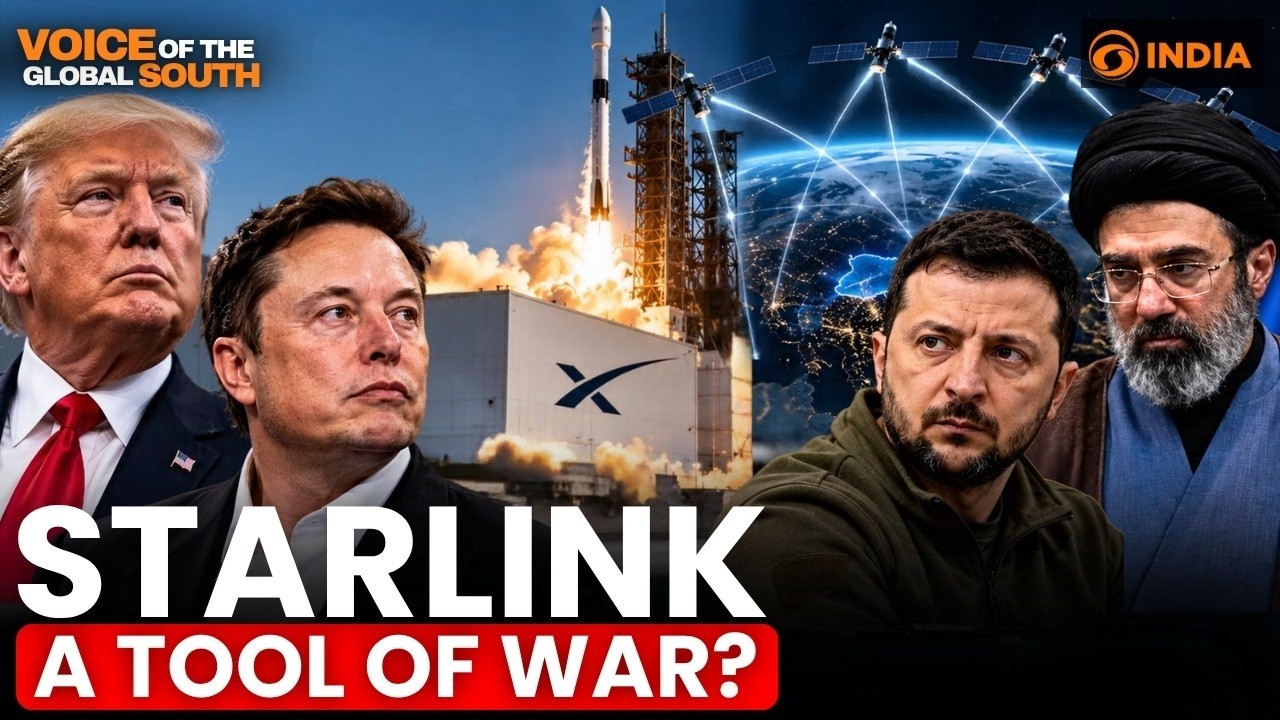
In modern warfare, the battlefield is no longer fought just on land, air or sea – it is waged in the invisible world of information. A high-stakes conflict over connectivity has officially extended into space, centring squarely on U.S. billionaire Elon Musk’s Starlink satellite internet network.
As Iran formally labels the constellation a “tool of war” and introduces severe capital punishments to suppress it, the Ukrainian military is simultaneously grappling with sudden, devastating speed caps on the battlefield. Together, these parallel crises expose an unsettling vulnerability: The immense geopolitical risk of sovereign nations depending on a single private corporation for wartime communications.
As military tensions escalate with the U.S. and Israel, Iran is treating the satellite network as a direct threat to its national security rather than a civilian service. Mohammad Amin Aghamiri, head of Iran’s Supreme National Cyberspace Council, has officially designated Starlink a “tool of war,” arguing that it grants foreign adversaries the exact data pipelines required for drone coordination, intelligence gathering and covert operations.
Operating via a massive constellation of Low Earth Orbit satellites, Starlink completely bypasses the State-controlled gateways that allow the Iranian regime to filter the web. During volatile anti-government protests in January 2026, smuggled Starlink terminals reportedly kept citizens connected to the outside world, effectively piercing the State’s intended digital blackout.
In response to the technology, Tehran has launched an aggressive, multi-pronged crackdown:
— Aghamiri admitted that Iran deployed specialised electronic jammers and G.P.S.-spoofing technology to disrupt Starlink signals during the January 2026 protests;
— Iranian security forces are now actively deploying surveillance drones and ground patrols to hunt down and confiscate illegal satellite terminals;
— Possessing an illegal terminal carries up to a two-year prison sentence while importing one can result in five years behind bars. If the State adds charges of espionage or threats to national security, the offence carries the death penalty.
Simultaneously, Iran is fighting a diplomatic war. After spending three years bombarding the International Telecommunication Union with formal complaints, Iran’s Foreign Ministry summoned Norway’s ambassador on 4th October because Norway handles key regulatory filings for SpaceX.
To insulate itself from the global web, Iran is rushing to complete its National Information Network. Designed to keep domestic government and banking apps online during a total global internet blackout, development of this digital fortress has surged from 20 per cent to 60 per cent capacity in just three years. Iran’s Deputy Communications Minister, Mohammad Hafez Hakami, warned that widespread satellite internet represents the final nail in the coffin for state cyberspace governance.
While Iran fights to keep Starlink out, Ukraine is realising the terrifying operational danger of depending entirely on a private space infrastructure to survive. On 13th October, the Ukrainian military reported unexpected and severe data restrictions on their specialised, military-focussed “Starshield” packages during intensive Russian strikes.
According to Ukrainian Presidential Adviser Serhiy Beskrestnov, SpaceX instituted speed caps of 160 kilometres per hour on moving hardware systems. The moving speed limit caused immediate connection dropouts on the frontline. Troops were cut off in mid-operation, forcing them to abort critical drone reconnaissance and strike missions.
Ukrainian President Volodymyr Zelenskyy heavily criticised the sudden limitations, warning that capping military connectivity in active combat zones will directly result in the loss of human lives.
For his part, Musk has countered the backlash by claiming that these specific speed limits are dictated directly by U.S. Government and military directives, rather than an arbitrary decision by SpaceX.
Two conflicts. Two completely different crises. In Iran, a regime is desperate to stop a private network from breaking its absolute control. In Ukraine, a military is realising the terrifying operational risk of depending on an external, corporate provider. At the epicentre of it all sits SpaceX and the unpredictable influence of Elon Musk.
It all points to one urgent, unsettling question: What happens when a private company holds the power to either sustain a frontline or breach a regime’s digital walls?


