







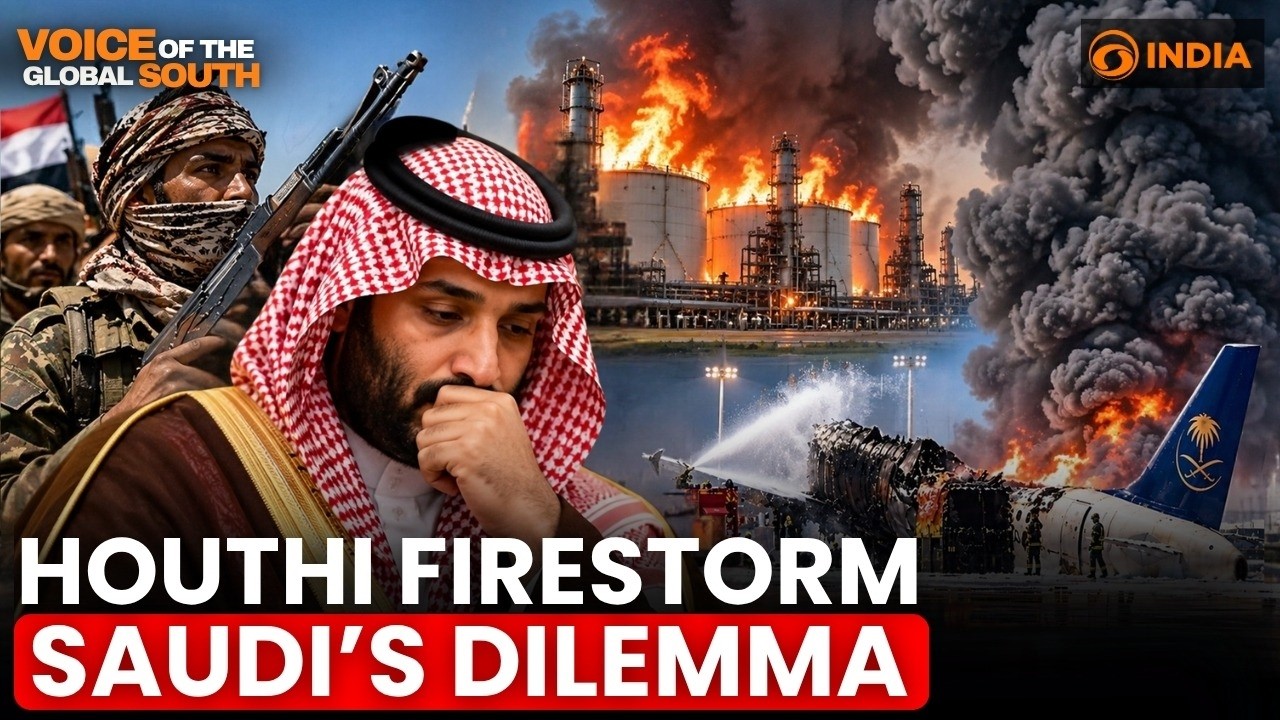
Saudi Arabia boasts one of the most expensive and sophisticated military arsenals on earth. It is packed with U.S.-made fighter jets, advanced radar networks, and cutting-edge missile defence systems. Yet, a relentless barrage of missiles and drones has exposed a critical vulnerability. Yemen’s Houthi rebels are fundamentally challenging the kingdom’s ability to protect its skies.
The month of October has seen a dramatic escalation. On 15th October, Houthi missiles struck the Al-Maashiq Palace complex in Aden — the seat of Yemen’s Saudi-backed administration. The attack killed five people. Just two days earlier, on 13th October, a missile struck a Saudi Aramco administrative building in Dhahran, sparking a major facility fire.
However, the most devastating strikes have targeted civilian infrastructure deep inside Saudi territory. Riyadh’s King Khalid International Airport has become a primary target, enduring an intense two-week bombardment. A major strike on 10th October left at least a dozen people dead.
The disruption to aviation has reignited fears of a broader war on the Arabian Peninsula. Once dismissed as a ragtag militia, the Houthis have evolved into a highly formidable fighting force. The United Nations estimates that by 2024, the group had already recruited up to 3,50,000 fighters. Since capturing Yemen’s capital, Sanaa, in 2014, the group has mass-produced an arsenal capable of striking targets thousands of kilometres away.
Military analysts point to three primary weapons driving this threat:
— The Palestine-2: A medium-range ballistic missile boasting a 2,000-kilometre reach
— The Toufan: A long-range missile heavily linked to Iran’s Ghadr missile family
— The Burkan and Badr variants: Shorter-range, highly adaptable tactical projectiles
Experts say that much of this arsenal relies on Iranian weapons technology, with growing traces of Chinese component influences. While Tehran denies directly supplying or training the group, the strategic alignment is clear. Furthermore, Prof. Andreas Krieg from King’s College London says that the Houthis’ experience of challenging Israel’s advanced air-defence systems has given them greater confidence and expertise as they target Saudi Arabia. It’s given the Houthis unprecedented combat experience. They have learned how to over-saturate advanced radar networks.
So why are these weapons so difficult to stop? The challenge lies in asymmetric tactics. Ballistic missiles dive from the upper atmosphere at extreme speeds. Simultaneously, low-flying cruise missiles and small drones hug the terrain, evading standard radar signatures. When launched in mixed swarms, they overwhelm command systems, forcing defenders to make split-second choices.
This introduces a punishing economic reality. Saudi Arabia has poured billions into defence, absorbing 12 per cent of all U.S. arms exports between 2021 and 2025. Saudi Arabia’s 2026 budget allocated $83 bn for military expenditure. According to the Stockholm International Peace Research Institute, the kingdom operates top-tier Patriot and Terminal High Altitude Area Defence (THAAD) systems. In fact, earlier this year, it struck a nine-billion-dollar deal with the U.S. for 730 Patriot missiles. But shooting down a cheap, locally manufactured drone requires a multi-million-dollar interceptor missile. It is a war of attrition that is rapidly draining Saudi interceptor stockpiles.
Geography exacerbates the strain. Saudi Arabia must defend a vast territory containing oil installations, airports, military bases, and population centres. Concentrating defensive resources around one location can leave other sites less protected. Historically, its defences were positioned to counter threats from the north and east – namely Iraq and Iran. The threat from the south-west caught the kingdom off guard.
Michael Ratney, a former U.S. ambassador to Saudi Arabia and now an adviser at the Centre for Strategic and International Studies, says that the kingdom had assumed that the Houthis would not target civilian facilities such as airports. He describes the attacks as a “paradigm shift”, as civilian infrastructure is explicitly held hostage.
For the Houthis, success does not necessarily mean defeating Saudi Arabia in a conventional war. Disrupting the kingdom’s economy, threatening critical infrastructure, and creating insecurity may be enough to strengthen their position in any future negotiations.
The fallout is already stalling Saudi Arabia’s grand economic ambitions. The Gulf Cooperation Council has officially postponed the high-profile E.U.-Gulf summit in Riyadh. Concerns are also mounting over the upcoming 2027 A.F.C. Asian Cup. Militarily, regional alliances remain fragile. Joint defence pacts with Pakistan and Turkiye have yielded little active support. While U.S. President Donald Trump considers joining retaliatory strikes, no concrete action has been taken. Israeli Prime Minister Benjamin Netanyahu reportedly asked Saudi Arabia for permission to join the military fight against Houthi rebels in Yemen but Saudi Crown Prince Mohammed bin Salman rejected the offer.
For Riyadh, the core lesson of modern warfare is clear. The most expensive military arsenal cannot guarantee complete safety when an adversary uses cheap, sustained, and highly adaptable technology. The kingdom must now find a way to secure its skies before a wider regional conflict spirals completely out of control.


