







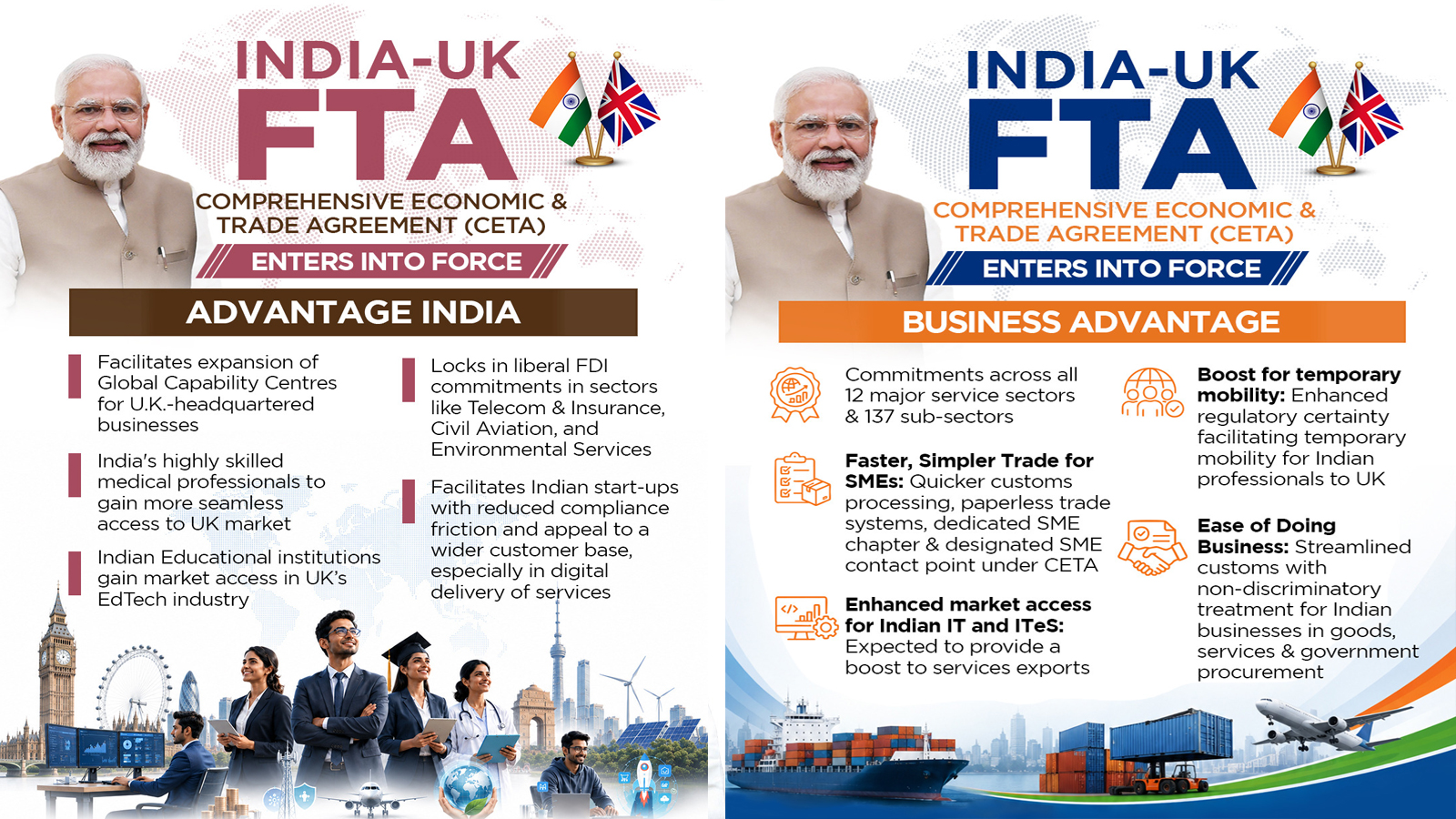
The Federation of Indian Chambers of Commerce and Industry (FICCI) and Nasscom on Wednesday welcomed the operationalisation of the India–United Kingdom Comprehensive Economic and Trade Agreement (CETA), describing it as a landmark step that will expand trade, strengthen investment, enhance technology collaboration and improve global competitiveness for Indian businesses.
The India-UK Free Trade Agreement came into force on Wednesday along with the Agreement on Social Security, also known as the Double Contribution Convention (DCC). The pact provides zero-duty market access for nearly 99 per cent of India’s exports, covering almost 100 per cent of the bilateral trade value, while the DCC exempts Indian professionals on temporary assignments in the UK from making double social security contributions for up to five years.
FICCI said the agreement would create new opportunities for Indian industry across both goods and services while deepening the country’s integration into global value chains.
Congratulating Prime Minister Narendra Modi on the agreement coming into force, FICCI Secretary General Anant Swarup said the India-UK CETA would open up fresh opportunities for businesses in both merchandise and services sectors.
“Heartiest congratulations from FICCI to PM Modi on the operationalisation of India-UK Free Trade Agreement. This agreement would open up new opportunities for the Indian industry in both goods and services. The cooperation in innovation, technology and talent mobility will enhance Indian industry’s competitiveness,” Swarup said.
He described the agreement as a major milestone in India’s free trade agreement journey, saying it would encourage innovation-led growth while strengthening India’s participation in global value chains.
FICCI President Anant Goenka said the landmark agreement complements the vision of Viksit Bharat by reinforcing India’s aspirations for sustained economic growth, global competitiveness and deeper integration with international markets.
“As India advances towards becoming a developed economy, high-quality economic partnerships will play an important role in expanding business opportunities, strengthening industrial capabilities, and enhancing the country’s participation in global trade and investment networks,” Goenka said.
He added that the agreement reflects a forward-looking approach to economic engagement and supports India’s journey towards greater prosperity, innovation and economic transformation.
The IT industry’s apex body Nasscom also hailed the implementation of the trade pact, saying it would unlock significant opportunities across digital trade, investment, innovation and talent mobility.
Welcoming the accompanying Double Contribution Convention, Nasscom said the arrangement would allow Indian professionals on short-term assignments in the UK to continue making social security contributions in India instead of the UK for up to five years, benefiting thousands of professionals and technology companies.
Nasscom President Rajesh Nambiar said the organisation remains committed to working with both governments and industry to translate the agreement into tangible outcomes.
“As technology becomes an increasingly powerful driver of economic growth, Nasscom remains committed to working with both governments and industry to translate the FTA into tangible outcomes through greater trade, investment, innovation, and talent collaboration,” he said.
The industry body also highlighted the launch of the Nasscom UK Forum in November 2025, describing it as a strategic platform that brings together leading Indian technology companies with significant investments in the UK.
According to Nasscom, the forum will help deepen bilateral digital trade, advance the India-UK Technology Security Initiative and Vision 2035 roadmap, and strengthen engagement with governments, policymakers and innovation ecosystems.
Manish Malhotra, Chair of the Nasscom UK Forum, said the India-UK technology partnership is entering a new phase of growth.
“The Nasscom UK Forum was created to provide a long-term platform for industry and government to jointly shape the future of this strategic corridor,” he said.
The industry body noted that a sample of leading Indian technology companies alone supports more than 35,000 jobs across the UK, with nearly 62 per cent of employees based outside London, contributing significantly to regional economic growth, local talent development and AI capability building.
The operationalisation of CETA is expected to provide a major boost to bilateral trade by offering duty-free access to almost all Indian exports to the UK, while expanding opportunities across sectors including manufacturing, services, technology, innovation and skilled workforce mobility. The accompanying social security agreement is also expected to reduce costs for Indian companies deploying professionals to the UK, further strengthening business and technology partnerships between the two countries.
(With IANS inputs)


