







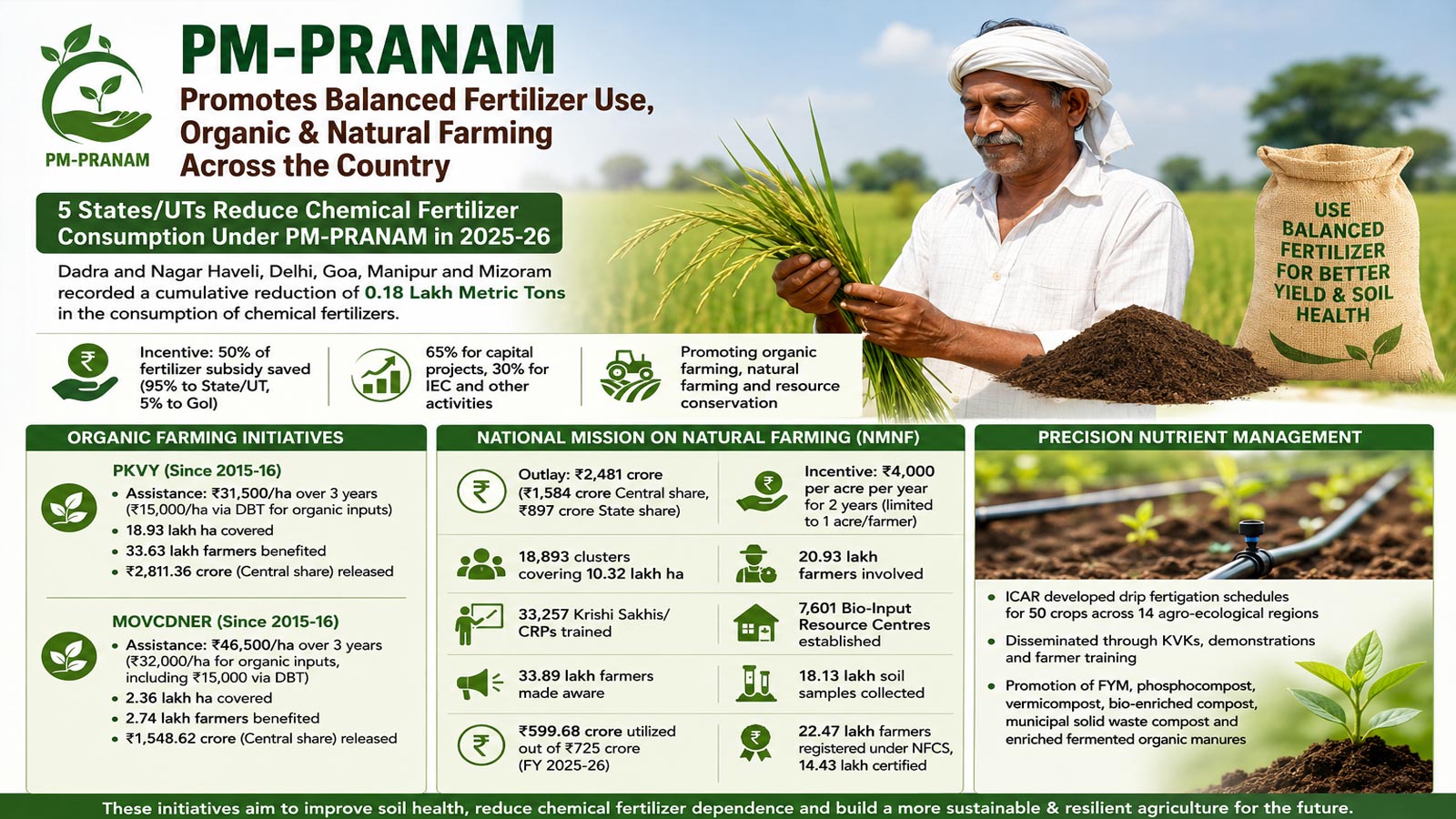
The Centre is intensifying efforts to promote balanced fertilizer use and sustainable agriculture through the PM Programme for Restoration, Awareness Generation, Nourishment and Amelioration of Mother Earth (PM-PRANAM), alongside expanding organic farming, natural farming and precision nutrient management to improve soil health and reduce dependence on chemical fertilizers.
The PM-PRANAM scheme, approved by the Cabinet Committee on Economic Affairs (CCEA) on June 28, 2023, is being implemented for the period 2023-24 to 2025-26. It aims to encourage States and Union Territories to reduce the consumption of chemical fertilizers such as Urea, Di-Ammonium Phosphate (DAP), NPK and Muriate of Potash (MOP) by promoting balanced nutrient application, alternative fertilizers, organic farming and resource conservation technologies.
The scheme provides financial incentives to States and Union Territories that reduce their consumption of chemical fertilizers compared with the average consumption during the previous three financial years. The incentive amounts to 50 per cent of the fertilizer subsidy saved, of which 95 per cent is allocated to the concerned State or Union Territory, while 5 per cent is retained by the Government of India. Of the State’s share, 65 per cent is to be used for capital expenditure projects, preferably under Centrally Sponsored Schemes, while the remaining 30 per cent can be utilised for activities such as Information, Education and Communication (IEC) campaigns.
According to the Department of Fertilizers under the Ministry of Chemicals and Fertilizers, five States and Union Territories – Dadra and Nagar Haveli, Delhi, Goa, Manipur and Mizoram – recorded a cumulative reduction of 0.18 lakh metric tonnes in the consumption of chemical fertilizers during 2025-26 compared with the average consumption of the previous three financial years. However, incentives under the scheme are yet to be disbursed.
To complement PM-PRANAM, the government has launched several initiatives aimed at training farmers in precision farming techniques, encouraging balanced nutrient management and promoting large-scale production and use of certified organic compost.
Organic farming is being promoted through the Paramparagat Krishi Vikas Yojana (PKVY) across States and Union Territories and the Mission Organic Value Chain Development for North Eastern Region (MOVCDNER) in the northeastern states. Introduced in 2015-16, both programmes provide end-to-end support covering production, processing, certification and marketing while encouraging the formation of organic farming clusters, particularly among small and marginal farmers.
Under PKVY, farmers receive financial assistance of ₹31,500 per hectare over three years, including ₹15,000 per hectare through Direct Benefit Transfer (DBT) for organic inputs. As of June 30, 2026, the scheme has covered 18.93 lakh hectares, benefiting 33.63 lakh farmers, with the Centre releasing ₹2,811.36 crore as its share.
The MOVCDNER scheme provides assistance of ₹46,500 per hectare over three years for creating Farmer Producer Organisations (FPOs) and supporting organic cultivation. Farmers receive ₹32,500 per hectare for organic inputs, including ₹15,000 through DBT. Since its inception, the scheme has brought 2.36 lakh hectares under organic farming, benefiting 2.74 lakh farmers, while the Centre has released ₹1,548.62 crore.
The government is also implementing the National Mission on Natural Farming (NMNF), launched on November 25, 2024, to promote chemical-free farming integrated with livestock, diversified cropping systems and traditional Indian agricultural practices. The mission has a total financial outlay of ₹2,481 crore, including a Central share of ₹1,584 crore and a State share of ₹897 crore.
Under the mission, farmers adopting natural farming are eligible for an Output Based Incentive of ₹4,000 per acre per year for two years, limited to one acre per farmer.
During 2025-26, the mission facilitated the formation of 18,893 clusters covering 10.32 lakh hectares and involving 20.93 lakh farmers. To strengthen implementation, 33,257 Krishi Sakhis and Community Resource Persons (CRPs) were trained, while 7,601 Bio-Input Resource Centres (BRCs) were established across the country.
The Department said awareness programmes on natural farming reached 33.89 lakh farmers during the financial year. In addition, 18.13 lakh soil samples were collected, while ₹599.68 crore was utilised out of the allocated ₹725 crore. More than 22.47 lakh farmers have been registered under the Natural Farming Certification System (NFCS), of whom over 14.43 lakh have been certified.
To promote precision nutrient management, the Indian Council of Agricultural Research (ICAR) has developed drip fertigation schedules for 50 crops covering 14 agro-ecological regions. These are being disseminated through Krishi Vigyan Kendras (KVKs), frontline demonstrations, field demonstrations and farmer training programmes to help farmers optimise nutrient use and improve crop productivity.
ICAR has also standardised and promoted the use of organic nutrient sources such as Farm Yard Manure (FYM), phosphocompost, vermicompost, bio-enriched compost, municipal solid waste compost and enriched fermented organic manures through demonstrations, awareness campaigns, training programmes and media outreach.
The Department said the combined implementation of PM-PRANAM, organic farming schemes, the National Mission on Natural Farming and precision nutrient management initiatives is aimed at improving soil health, reducing excessive dependence on chemical fertilizers, encouraging environmentally sustainable farming practices and enhancing long-term agricultural productivity.
The information was provided by Minister of State for Chemicals and Fertilizers Anupriya Patel in a written reply to a question in the Rajya Sabha on Tuesday.


