







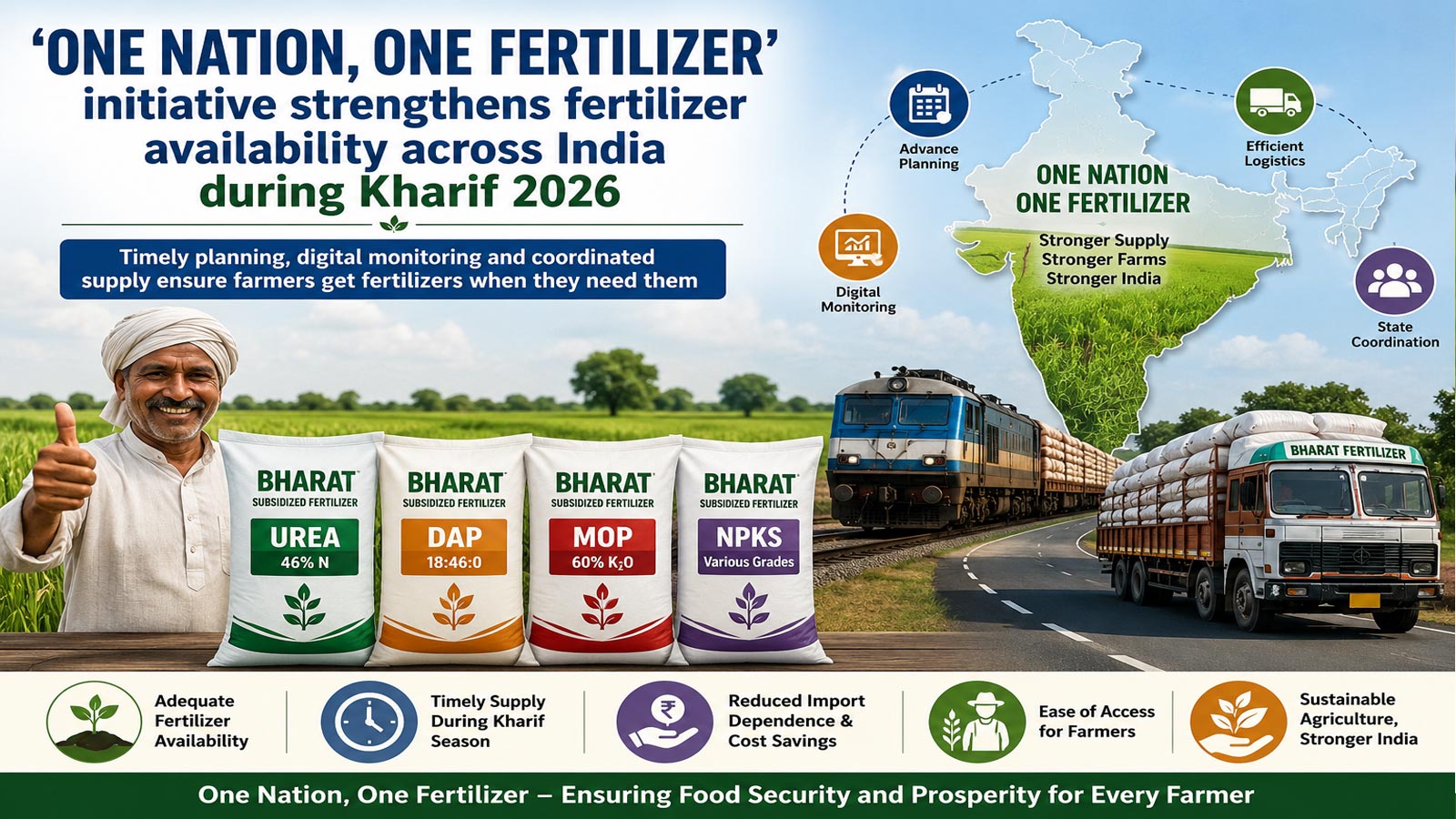
The Centre has said that the ‘One Nation, One Fertilizer’ initiative has significantly strengthened the availability and distribution of subsidized fertilizers across the country by ensuring timely supplies, improving logistics and simplifying fertilizer access for farmers under a single national brand.
The initiative, implemented under the Pradhanmantri Bhartiya Janurvarak Pariyojana (PMBJP) with effect from August 24, 2022, mandates all public sector, cooperative and private fertilizer companies to market subsidized fertilizers under the common “BHARAT” brand. At present, all subsidized fertilizers, including Urea, Di-Ammonium Phosphate (DAP), Muriate of Potash (MOP) and NPKS grades, are sold under the Bharat brand.
The scheme aims to eliminate confusion among farmers caused by the availability of multiple fertilizer brands in the market while ensuring equitable access to subsidized fertilizers across states.
According to the Department of Fertilizers under the Ministry of Chemicals and Fertilizers, a unified branding system has helped improve transparency, reduce malpractices, minimise unnecessary inter-state movement of fertilizers and ensure their timely availability during critical cropping seasons.
To support the initiative, the Centre has established a comprehensive fertilizer supply and distribution mechanism. Before every cropping season, the Department of Agriculture and Farmers Welfare (DA&FW), in consultation with state governments, assesses the state-wise and month-wise fertilizer requirement. Based on these projections, the Department of Fertilizers (DoF) prepares monthly allocation plans to ensure adequate supplies across the country.
The Department has also strengthened digital monitoring of fertilizer movement through the Integrated Fertilizer Management System (iFMS), a web-based platform that tracks the movement of major subsidized fertilizers throughout the supply chain. This enables authorities to monitor availability in real time and respond quickly to any supply-related issues.
To bridge the gap between domestic production and demand, fertilizer imports are finalised well in advance to ensure adequate supplies during the cropping season. The Centre also regularly advises state governments to coordinate with fertilizer manufacturers and importers for timely placement of indents and smooth distribution. Close coordination is maintained with the Ministry of Railways to ensure the availability of sufficient railway rakes, priority transportation of fertilizer consignments and their timely evacuation to various states. Distribution at the district level is managed by the respective state governments.
The Department said that these coordinated efforts have ensured comfortable availability of fertilizers during the ongoing Kharif 2026 season. Data covering the period from April 1 to July 29, 2026, indicates that fertilizer availability remained higher than both the assessed requirement and actual sales at the national level.
Across India, the requirement for Urea during the period stood at 122.84 lakh metric tonnes (LMT), while availability reached 177.27 LMT. Actual sales were recorded at 112.53 LMT, leaving a closing stock of 64.75 LMT.
For DAP, the national requirement was 35.44 LMT, against an availability of 43.03 LMT. Sales stood at 26.59 LMT, with a closing stock of 16.44 LMT.
Similarly, MOP recorded a requirement of 11.20 LMT, while availability was 14.31 LMT. Sales reached 5.85 LMT, leaving 8.47 LMT in stock.
For NPKS fertilizers, the requirement stood at 53.99 LMT, whereas availability was 88.93 LMT. Sales during the period were 44.73 LMT, and the closing stock remained at 44.19 LMT.
The data showed that most major agricultural states maintained adequate fertilizer stocks. Uttar Pradesh, Maharashtra, Madhya Pradesh, Punjab, Rajasthan, Karnataka, Gujarat and Telangana reported fertilizer availability well above assessed requirements, ensuring uninterrupted supply during the peak sowing season.
The Department noted that the combination of advance planning, digital monitoring, coordinated logistics, timely imports and improved transportation has enhanced the efficiency of fertilizer distribution nationwide. The initiative has also reduced avoidable movement of fertilizers across states while enabling farmers to access subsidized fertilizers under a single trusted national brand.
The information was shared by Union Minister for Chemicals and Fertilizers Jagat Prakash Nadda and Minister of State Anupriya Patel in a written reply in the Rajya Sabha on Tuesday.


