







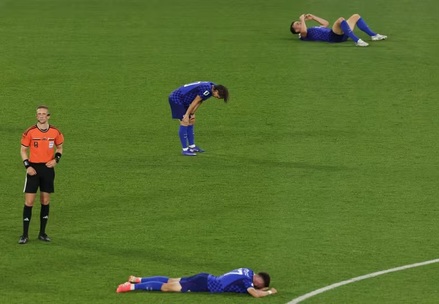
FIFA has clarified why Croatia’s dramatic stoppage-time equaliser against Portugal in the FIFA World Cup Round of 32 was disallowed, saying Connected Ball Technology detected a crucial touch from striker Igor Matanovic that resulted in an offside offence.
Croatia appeared to have forced extra drama when Josko Gvardiol bundled home after Mario Pasalic collected a long ball inside the box and squared it for the defender in the 103rd minute. However, following a VAR review, the goal was ruled out for offside.
At first glance, it appeared Pasalic had received the ball after a deflection off Portugal defender Renato Veiga, which would have reset the offside phase. But replay analysis showed the ball had instead brushed Matanovic’s head before reaching Veiga.
Because Pasalic was already in an offside position when Matanovic made contact with the ball, the goal was correctly disallowed under the Laws of the Game.
FIFA later said the decisive touch was identified using the Inertial Measurement Unit (IMU) sensor embedded inside the official Adidas Trionda match ball.
“According to the data provided by Connected Ball Technology housed within the Adidas Trionda, the official match ball of the FIFA World Cup, it was proven that contact was made by Croatia’s No. 20 Igor Matanovic in the build-up to the goal against Portugal, allowing the referee to correctly determine offside and disallow the goal,” FIFA said in a post on X.
The governing body added that the IMU sensors inside the ball can detect even the slightest contact, with the data displayed during broadcasts through a “heartbeat” graphic, helping match officials make quicker and more accurate decisions.
Earlier, Ivan Perisic had put Croatia ahead soon after halftime before Cristiano Ronaldo equalised with his third goal of the tournament. Goncalo Ramos then headed home a Rafael Leao cross deep into stoppage time to seal Portugal’s comeback victory and a place in the last 16.
IANS


