







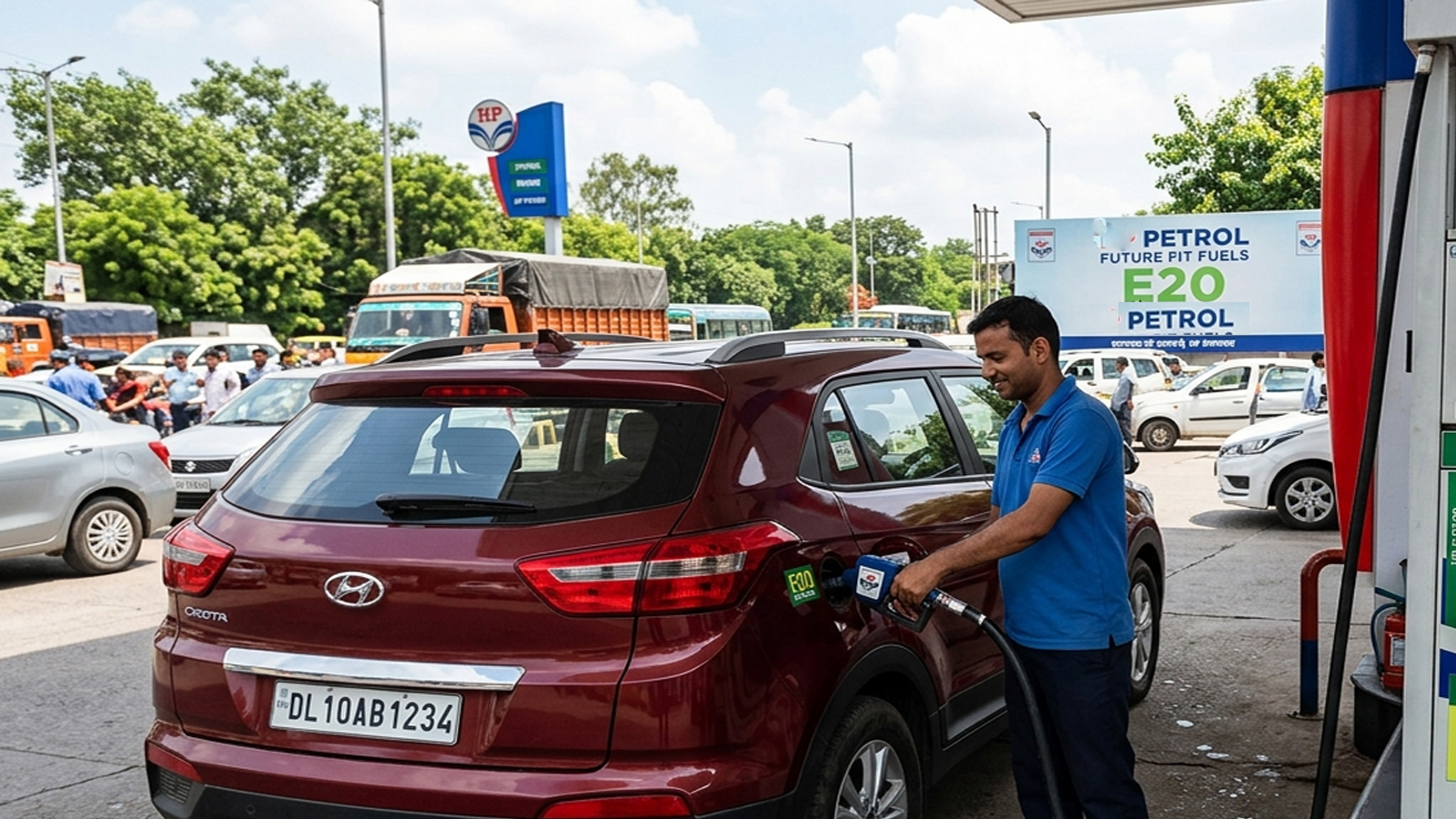
The government on Thursday clarified that it has taken no decision to increase ethanol blending in petrol beyond 20 per cent, while reaffirming that E20 fuel is scientifically validated, safe for vehicles and has delivered substantial economic, environmental and energy security benefits.
In a written reply in the Lok Sabha, Minister of State for Petroleum and Natural Gas Suresh Gopi said any future decision on introducing higher ethanol blends would be taken only after detailed scientific and technical studies and consultations with all stakeholders, including automobile manufacturers, Oil Marketing Companies (OMCs) and research institutions.
The Minister clarified that E85 fuel, comprising 85 per cent ethanol and 15 per cent petrol, has been introduced exclusively for Flex Fuel Vehicles (FFVs) designed and certified for its use and does not amount to an increase in the nationwide ethanol blending level for regular petrol.
The Ministry of Petroleum and Natural Gas informed Parliament that India has steadily increased ethanol blending under the Ethanol Blended Petrol (EBP) Programme, with average blending rising from around 12 per cent in 2022-23 to 14.6 per cent in 2023-24, 19.2 per cent in 2024-25, and reaching 20 per cent during November 2025 to June 2026. India achieved the 20 per cent blending target five years ahead of its original deadline after more than two decades of phased policy development, scientific evaluation, stakeholder consultations and infrastructure creation.
According to the Ministry, ethanol has been used globally as a transport fuel for over a century, with countries such as Brazil successfully operating on much higher ethanol blends. In India, the EBP Programme began with a pilot project in 2001, followed by the introduction of E5 fuel in 2006. While ethanol blending remained at around 1.53 per cent in 2013-14, it has since been increased gradually after establishing the required production capacity, supply infrastructure and regulatory framework.
The Ministry said the rollout of E20 fuel was carried out only after extensive consultations with NITI Aayog, the Automotive Research Association of India (ARAI), the Society of Indian Automobile Manufacturers (SIAM), the Indian Institute of Petroleum (IIP), automobile manufacturers, component suppliers, testing agencies and Oil Marketing Companies.
The Ministry said scientific studies, laboratory testing, field validation and large-scale operational experience have confirmed that E20 is a safe, cleaner and technologically superior fuel when used according to prescribed standards and manufacturer recommendations. The studies assessed engine durability, drivability, startability, corrosion resistance, material compatibility, emissions and fuel efficiency, and found no widespread adverse impact on vehicle performance.
The Ministry said it has not received any widespread or substantiated complaints from vehicle manufacturers, automobile associations or consumer organisations regarding engine performance, maintenance costs, fuel efficiency, vehicle pick-up or rusting of fuel tanks attributable to E20 petrol. While certain concerns raised through media and social media have been examined, scientific assessments have not established any abnormal wear, compatibility issues or significant deterioration in vehicle performance.
The government’s assessment is also based on extensive real-world experience. Around eight crore vehicles, of which nearly 80 per cent are petrol-powered, visit retail fuel outlets every day. E15-plus petrol has been in widespread use for over three-and-a-half years, while E19-E20 fuel has been available for more than two-and-a-half years. During this period, more than 20 crore two-wheelers and over three crore petrol cars have operated on higher ethanol blends without any verified evidence of widespread engine failure or vehicle breakdown linked to ethanol blending.
Manufacturer service data have further reinforced these findings. One of the country’s largest passenger vehicle manufacturers serviced 2.84 crore vehicles during 2025-26, including around 1.5 crore older vehicles that were not originally certified as E20 compatible, without reporting any E20-related engine damage, corrosion or abnormal component wear. Another leading automobile manufacturer reported that analysis of 1.4 crore E20-operated vehicles over an extended period found no evidence of ethanol-induced corrosion. A leading two-wheeler manufacturer has also reported no higher incidence of damage in vehicles operating on E20 compared with earlier fuel blends. Manufacturers continue to honour warranty obligations for vehicles using E20 fuel.
On concerns regarding mileage, the Ministry said fuel efficiency depends on several factors, including driving conditions, driving habits and vehicle maintenance. It noted that any reduction in fuel economy in vehicles originally designed for E10 fuel is generally limited to three to five per cent, while E20 provides a higher octane rating, superior anti-knock characteristics, cleaner combustion and smoother engine performance.
According to SIAM and ARAI, E20 also improves acceleration and ride quality while reducing carbon emissions. Ethanol’s higher octane number supports modern high-compression engines, while its higher heat of vaporisation contributes to improved combustion efficiency.
The Ministry highlighted the wider national gains from the Ethanol Blended Petrol Programme, stating that it has saved more than ₹1.97 lakh crore in foreign exchange, substituted nearly 316 lakh metric tonnes of crude oil, reduced around 952 lakh metric tonnes of carbon dioxide emissions, and transferred over ₹1.66 lakh crore to farmers.
Reiterating its long-term policy, the Ministry said the government is committed to progressively transitioning towards cleaner, more efficient and environmentally sustainable fuels in line with the National Policy on Biofuels, while strengthening India’s energy security and reducing greenhouse gas emissions.
The Ministry also ruled out any proposal to revert to E0 or E10 petrol, stating that E20 has been scientifically validated and accepted by the automobile industry after extensive testing. Maintaining parallel nationwide supply chains for E0, E10 and E20 fuels across more than one lakh retail outlets would significantly increase logistics complexity, inventory requirements and handling costs, it said, adding that public policy should move towards cleaner technologies rather than reverting to older fuel standards.
To ensure fuel quality, Oil Marketing Companies follow stringent standard operating procedures covering procurement, blending, storage, transportation and retail dispensing. Fuel quality is tested at distilleries, depots and retail outlets. Based on consumer complaints, OMCs have also carried out more than 30,000 quality checks at retail outlets over the past 10 to 20 days to detect adulteration and ensure compliance with prescribed fuel specifications. State governments have also been requested to adopt a zero-tolerance approach towards fuel adulteration.
The Ministry said public sector OMCs have established multiple consumer grievance redressal channels, including complaint registers at retail outlets, toll-free helplines, websites, mobile applications, customer relationship management systems, social media platforms, email and the Centralised Public Grievance Redress and Monitoring System (CPGRAMS). Public awareness campaigns are also being conducted to educate consumers about the compatibility of E20 fuel with petrol vehicles and its environmental and energy security benefits, while consumer feedback is regularly monitored to strengthen confidence in the programme.


