







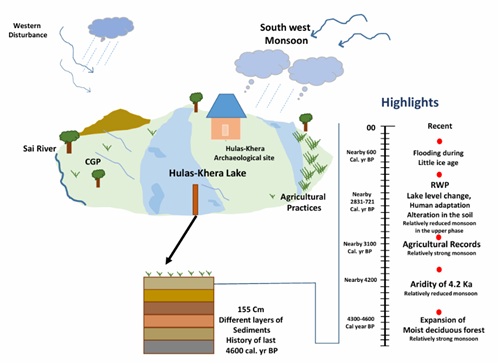
A new scientific study has reconstructed 4,600 years of climate and environmental history in the Central Ganga Plain, revealing how fluctuations in the Indian Summer Monsoon influenced lake hydrology, sediment transport, vegetation and early agricultural practices.
The findings could help improve understanding of long-term climate change and support efforts related to agricultural adaptation, water security, wetland conservation and disaster risk reduction.
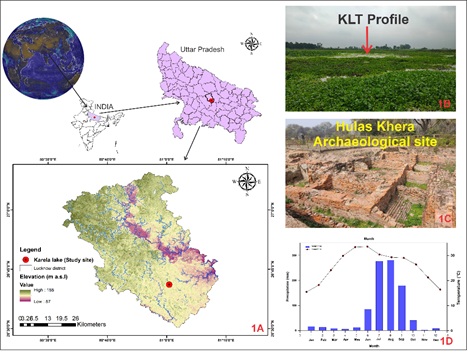
Scientists from the Birbal Sahni Institute of Palaeosciences (BSIP), an autonomous institute under the Department of Science and Technology (DST), conducted the study using sedimentary and archaeological records from Karela Lake, an oxbow lake near Hulas Khera in Lucknow district, Uttar Pradesh.
The research also examined how ancient agricultural communities adapted to changing environmental conditions in the region, which emerged as an important centre of agricultural expansion and cultural development following the decline of the Indus Valley Civilization.
Researchers noted that while the relationship between monsoon fluctuations and the rise and decline of the Indus Valley Civilization has been widely studied, less is known about how later communities in the Central Ganga Plain responded to similar climatic changes.
Lake sediments reveal long-term climate patterns
The sediments preserved in Karela Lake provided evidence of environmental changes during the Late Holocene. The lake’s proximity to the Hulas Khera archaeological site also enabled researchers to investigate connections between climate variability and human activities.
The research team used multiple scientific techniques, including accelerator mass spectrometry (AMS)-based radiocarbon dating, stable carbon and nitrogen isotopes, grain-size analysis, sediment modelling and pollen analysis.
These methods helped reconstruct changes in rainfall and moisture conditions, vegetation patterns, sediment movement, lake hydrology and agricultural practices over several millennia.
The study identified four major environmental phases associated with important climatic events, including the 4.2-thousand-year arid event, the Roman Warm Period and the Little Ice Age.
The researchers also examined moisture records associated with westerly winds during the Little Ice Age, providing further insights into the region’s environmental conditions and evidence of flooding during the colder period.
Monsoon fluctuations influenced ecosystems and farming
According to the study, changes in the Indian Summer Monsoon affected not only lake water levels and sediment transport but also vegetation composition, sedimentary organic matter and microbial activity.
The findings indicate that monsoon variability influenced shifts between C3 and C4 vegetation, while sedimentary and biological evidence helped researchers examine the environmental conditions under which early agricultural communities developed adaptive practices.
The study also investigated evidence of manure-based agricultural practices alongside records relating to herbivores, providing insights into interactions between farming activities and the surrounding environment.
Published in the Journal of Asian Earth Sciences, the research integrates geochemical, isotopic, sedimentological and biological evidence within a radiocarbon chronology to reconstruct past climate–ecosystem interactions.
Implications for climate adaptation
The researchers identified small oxbow lakes in the Central Ganga Plain as sensitive natural archives that preserve evidence of long-term monsoon patterns, ecosystem evolution and interactions between human communities and their environment.
The findings could provide a historical baseline for understanding future environmental changes in one of India’s most densely populated and agriculturally significant regions.
Long-term climate records can also contribute to climate modelling, ecosystem management and land-use planning, while supporting efforts to strengthen food security, water security and sustainable development.
The study highlights the importance of understanding historical climate variability and human adaptation in preparing for future environmental challenges.


