







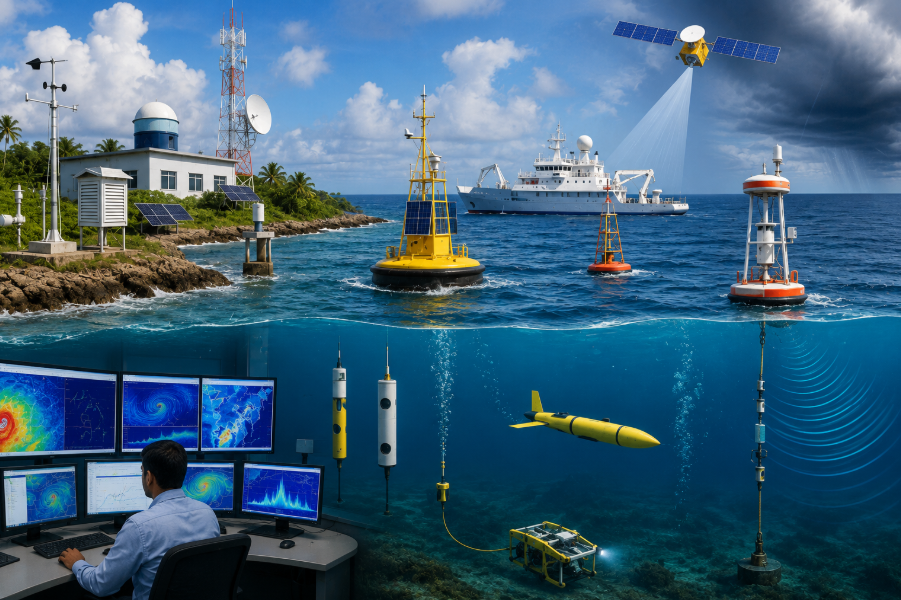
The Government has significantly expanded India’s ocean observation network, strengthening the country’s capabilities in monsoon forecasting, cyclone prediction and tsunami early warning, Parliament was informed on Wednesday.
In a written reply to the Lok Sabha, Minister of State (Independent Charge) for Earth Sciences Dr. Jitendra Singh said the enhanced observation network provides high-quality real-time ocean data that has substantially improved the accuracy of weather and ocean forecasts while strengthening disaster preparedness.
The government said the country’s ocean observation infrastructure now includes 19 subsurface moorings, with 16 located in the mainland Exclusive Economic Zone (EEZ) and three in the equatorial Indian Ocean, to monitor ocean currents and zooplankton biomass for validating ocean models.
India’s Tsunami Early Warning System has also been strengthened with 17 broadband seismic stations, seven deep-ocean tsunami buoys, 36 coastal tide gauges, 35 Global Navigation Satellite System (GNSS) receivers and strong-motion accelerometers, enabling rapid detection and assessment of tsunamigenic earthquakes.
The Indian National Centre for Ocean Information Services (INCOIS) maintains an extensive coastal observation network comprising 17 Directional Wave Rider Buoys, 20 Acoustic Doppler Current Profilers (ADCPs), 32 Automatic Weather Stations (AWS), two Water Quality Buoys and 50 tide gauges for continuous monitoring of coastal and ocean conditions.
The government further informed that INCOIS has deployed 302 Argo profiling floats between 2014 and 2025, along with 12 deep-sea glider missions, 45 drifting buoys, 64 wave drifters and advanced ocean observation instruments, including Vertical Microstructure Profilers (VMPs), Underway Conductivity-Temperature-Depth (uCTD) systems and Wire Walker systems, to strengthen deep-sea observations.
According to the Ministry, real-time observations from these platforms are received at INCOIS, quality-checked and assimilated into advanced numerical weather and ocean models. This process has significantly improved the accuracy of monsoon prediction, cyclone forecasting and ocean-state forecasts by providing more reliable initial ocean conditions.
The government highlighted that the assimilation of real-time ocean observations has improved wave forecast accuracy by about 43 per cent compared to 2014, while the enhanced observation network has enabled coastal forecast systems with an accuracy of about 70 per cent.
The strengthened tsunami monitoring infrastructure also enables INCOIS to issue tsunami advisories within the internationally mandated 10-minute window following a tsunamigenic earthquake.
The Ministry said the real-time data feeds into the INCOIS Global Ocean Data Assimilation System (INCOIS-GODS), which provides initial ocean conditions for the Coupled Forecast System (CFS) used for seasonal and extended-range forecasts, and the Hybrid Coordinate Ocean Model (HYCOM) that supports the Hurricane Weather Research and Forecasting (HWRF) model used by the India Meteorological Department (IMD) for cyclone prediction.
The government also outlined recent initiatives to further expand the national ocean observation network. These include the installation of 14 additional tide gauges and 15 co-located GNSS receivers to strengthen tsunami monitoring and coastal observations, deployment of a Directional Wave Rider Buoy off Mauritius to improve forecasts of Southern Ocean swells affecting India’s coastline, and institutionalisation of regular pre- and post-monsoon research vessel cruises for deployment and maintenance of observation systems.
The Ministry added that collaboration with the Council of Scientific and Industrial Research–National Institute of Oceanography (CSIR-NIO), the National Centre for Polar and Ocean Research (NCPOR) and other partner institutions has been strengthened to ensure sustained expansion and operation of the country’s ocean observation network.


