







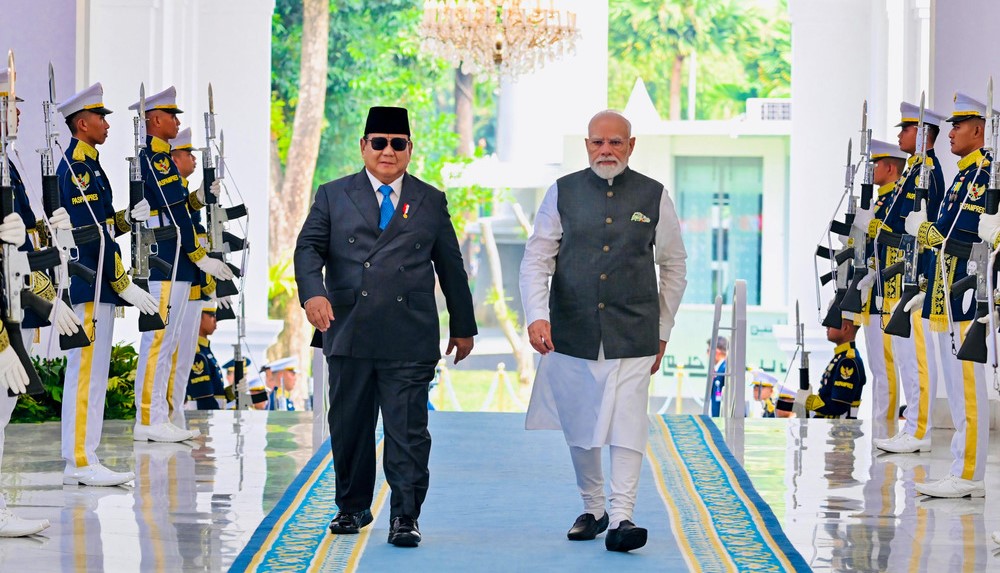
India and Indonesia have strongly condemned terrorism in all its forms and called for decisive, coordinated international efforts to combat the threat in accordance with international law.
In a joint statement issued after bilateral talks between Prime Minister Narendra Modi and Indonesian President Prabowo Subianto, the two leaders urged action against globally proscribed terrorists and terrorist organisations, including those designated under the UN Security Council’s 1267 Sanctions Committee.
The leaders agreed to deepen cooperation in preventing and countering terrorism and violent extremism conducive to terrorism. The cooperation will include measures to curb terror financing, strengthen implementation of internationally agreed anti-money laundering and countering the financing of terrorism (AML/CFT) standards, prevent the misuse of emerging technologies by terrorist groups, and tackle online radicalisation and recruitment through digital platforms.
Reaffirming a zero-tolerance approach to terrorism, the two sides pledged to continue disrupting terror financing networks and enhance bilateral and multilateral cooperation, including through the United Nations and the Financial Action Task Force (FATF).
Recognising the links between terrorism and transnational organised crime, India and Indonesia agreed to strengthen information sharing and exchange of best practices in line with their domestic laws and international obligations. They also welcomed the early conclusion of a Memorandum of Understanding (MoU) on counter-terrorism cooperation, which is expected to be signed soon.
The leaders expressed deep concern over the situation in West Asia and its global implications. Referring to an MoU signed on June 17, 2026, they stressed the need for de-escalation and reiterated that disputes should be resolved through dialogue and diplomacy. They also underlined the importance of freedom of navigation, uninterrupted global commerce, and transit passage through the Strait of Hormuz in accordance with international law, including the provisions of the UN Convention on the Law of the Sea (UNCLOS).
The two countries welcomed the planned third India-Indonesia Security Dialogue as a platform to expand cooperation in counter-terrorism, transnational crime, cybersecurity, emerging technologies, defence industry, maritime security and space.
Both leaders also agreed to explore greater cooperation in the cyber domain through policy dialogue, capacity building, exchange of expertise and best practices on digital public infrastructure, financial technology, the digital economy, artificial intelligence, digital forensics, Computer Emergency Response Team (CERT) cooperation, protection of critical information infrastructure and digital skills development.
Economic and trade cooperation remained a key focus of the discussions, with both leaders highlighting the complementarities between India’s Viksit Bharat 2047 vision and Indonesia’s Indonesia Emas 2045 agenda. They agreed that deeper economic integration would unlock greater trade and investment opportunities.
The two sides called for the timely conclusion of the review of the ASEAN-India Trade in Goods Agreement (AITIGA) to create a balanced and mutually beneficial trade environment, followed by broader bilateral trade engagement.
They also emphasised the need to strengthen existing bilateral economic mechanisms, including convening the second Working Group on Trade and Investment, the fourth Biennial Trade Ministers’ Forum and the inaugural Joint Economic and Financial Dialogue in 2026. These mechanisms will focus on addressing tariff and non-tariff barriers, improving market access, facilitating trade and investment, and enhancing cooperation in finance, digital economy, industry and supply chains while respecting domestic regulations and development priorities.
Highlighting the strategic importance of critical minerals and rare earths, the leaders agreed to strengthen collaboration to build diversified and resilient supply chains that support domestic manufacturing and economic security. They welcomed the signing of an MoU involving the Non-Ferrous Materials Technology Development Centre (NFTDC), Midwest Ltds., and Indonesia’s PT Perusahaan Mineral Nasional (PERMINAS) to boost cooperation in the sector.
Prime Minister Modi invited President Subianto to visit India at a mutually convenient time.
The talks covered a wide range of issues, including political engagement, defence and maritime cooperation, trade and investment, digital economy, science and technology, space, energy, agriculture, health, pharmaceuticals, education, culture, tourism, youth exchanges and regional and global developments.
The two leaders also witnessed the exchange of several bilateral agreements aimed at strengthening the India-Indonesia Comprehensive Strategic Partnership.
They welcomed the establishment of India-Indonesia Parliamentary Friendship Groups in their respective legislatures and agreed to promote regular parliamentary exchanges.
Taking note of current geopolitical developments, economic uncertainties and supply chain disruptions, both sides underscored the need for closer strategic coordination in multilateral and regional forums, including the United Nations and its specialised agencies, to promote a more balanced and representative international order based on international law.
The joint statement reaffirmed both countries’ commitment to sovereignty, territorial integrity, cultural and religious diversity, pluralism and the rule of law. The leaders also agreed to strengthen South-South Cooperation and enhance the collective voice of the Global South.
The two countries reiterated support for comprehensive reform of the UN Security Council, including expansion in both permanent and non-permanent categories through inclusive, member state-driven intergovernmental negotiations, including text-based negotiations. They also discussed mutual support for each other’s candidatures in international organisations.
India and Indonesia reaffirmed their commitment to a free, open, inclusive, peaceful and rules-based Indo-Pacific, stressing respect for sovereignty, adherence to international law, including the 1982 UNCLOS, freedom of navigation and overflight, and peaceful resolution of disputes.
President Prabowo appreciated India’s continued support for ASEAN Unity and ASEAN Centrality. Both sides also pledged to strengthen the ASEAN-India Comprehensive Strategic Partnership and deepen cooperation between the ASEAN Outlook on the Indo-Pacific (AOIP) and India’s Indo-Pacific Oceans Initiative (IPOI).
The leaders welcomed cooperation under the India-Indonesia-Australia trilateral mechanism and agreed to explore collaboration in maritime domain awareness, marine pollution, the blue economy, and through platforms such as the East Asia Summit (EAS), the Indo-Pacific Oceans Initiative (IPOI) and the Indian Ocean Rim Association (IORA).
The statement also highlighted the need for reforms in the global financial architecture and reaffirmed support for a rules-based, fair, open and inclusive international trading system with the World Trade Organization (WTO) at its core.
Indonesia reaffirmed its support for India’s BRICS Chairship in 2026, while India expressed its commitment to supporting Indonesia’s role as a BRICS member.
Both leaders agreed to intensify cooperation through multilateral platforms, including BRICS, the G20 and IORA, to contribute to equitable global governance and sustainable development.
(With ANI inputs)


