







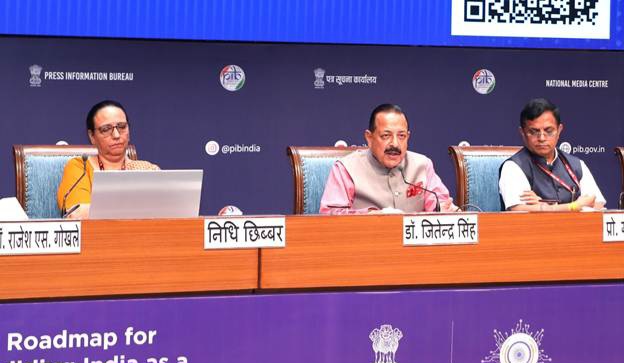
Union Minister for Science and Technology, Jitendra Singh, on Friday announced India’s first undergraduate course in Engineering Biology, alongside the launch of a national roadmap aimed at positioning the country as a global bioeconomy powerhouse by 2035.
Launching the roadmap titled “Building India as a Leading Bioeconomy Powerhouse by 2035”, the minister said Engineering Biology would become a foundational discipline for the next phase of India’s biotechnology growth, much like computer science drove the digital revolution.
“We have to build our own independent, sovereign biotechnology ecosystem,” Jitendra Singh said, adding that the new programme would prepare professionals capable of working at the intersection of engineering, biology, medicine and emerging technologies. He noted that IITs have already begun submitting proposals for interdisciplinary programmes in collaboration with medical institutions.
Highlighting India’s rapid biotechnology growth, the minister said the country’s bioeconomy has expanded from around USD 10 billion in 2014 to nearly USD 95 billion today and is projected to reach USD 300 billion by 2030. He added that India now has over 11,000 biotechnology start-ups, reflecting the strength of its innovation ecosystem.
Jitendra Singh underlined that India is among the few countries with a dedicated biotechnology policy focused on Biotechnology for Economy, Employment and Environment, enabling faster translation of research into economic and societal benefits.
Referring to India’s achievements in healthcare biotechnology, he said the country developed the world’s first DNA vaccine against COVID-19 and supplied vaccines to nearly 30 countries. He also highlighted indigenous advances in CAR-T cell therapy and gene-based treatments, which are making advanced healthcare more affordable while strengthening India’s position as a global healthcare destination.
Additionally, the minister said the future of biotechnology would be driven by synthetic biology, AI-enabled biological research and bio-manufacturing, with applications ranging from next-generation medicines and protein engineering to clean fuels and sustainable food systems.
Calling for stronger industry participation, the Union Minister stressed the need for closer collaboration between scientists, entrepreneurs and manufacturers to accelerate innovation. He also emphasised expanding indigenous bio-manufacturing capabilities, strengthening talent development and promoting collaboration across science, healthcare and industry to create a future-ready workforce.
Department of Biotechnology Secretary Dr. Rajesh S. Gokhale said India is among the world’s fastest-growing bioeconomies, registering 15-18 per cent annual growth. He said the country has established nearly 100 bio-incubators and more than 10,000 biotechnology companies, supported by initiatives such as the BioE3 Policy.
Dr. Gokhale said the roadmap provides a strategic framework to advance innovation-led bio-manufacturing, precision healthcare, sustainable agriculture and AI-enabled biology while developing a globally competitive biotechnology ecosystem.
NITI Aayog Member Prof. Gobardhan Das said India’s bioeconomy has grown nearly 16-fold over the past decade, contributing 4.8 per cent to the country’s GDP. He said the roadmap envisions expanding the bioeconomy to nearly USD 700 billion by 2035, supported by a proposed ₹50,000 crore Bioeconomy Growth Fund, stronger talent pipelines and world-class bio-manufacturing infrastructure.
Further, Singh said the coming decade would be crucial in determining India’s global position in biotechnology. He expressed confidence that sustained investments in research, talent development, industry partnerships and emerging technologies would strengthen health and food security, generate millions of high-skilled jobs and establish India as a leading global bioeconomy.


