







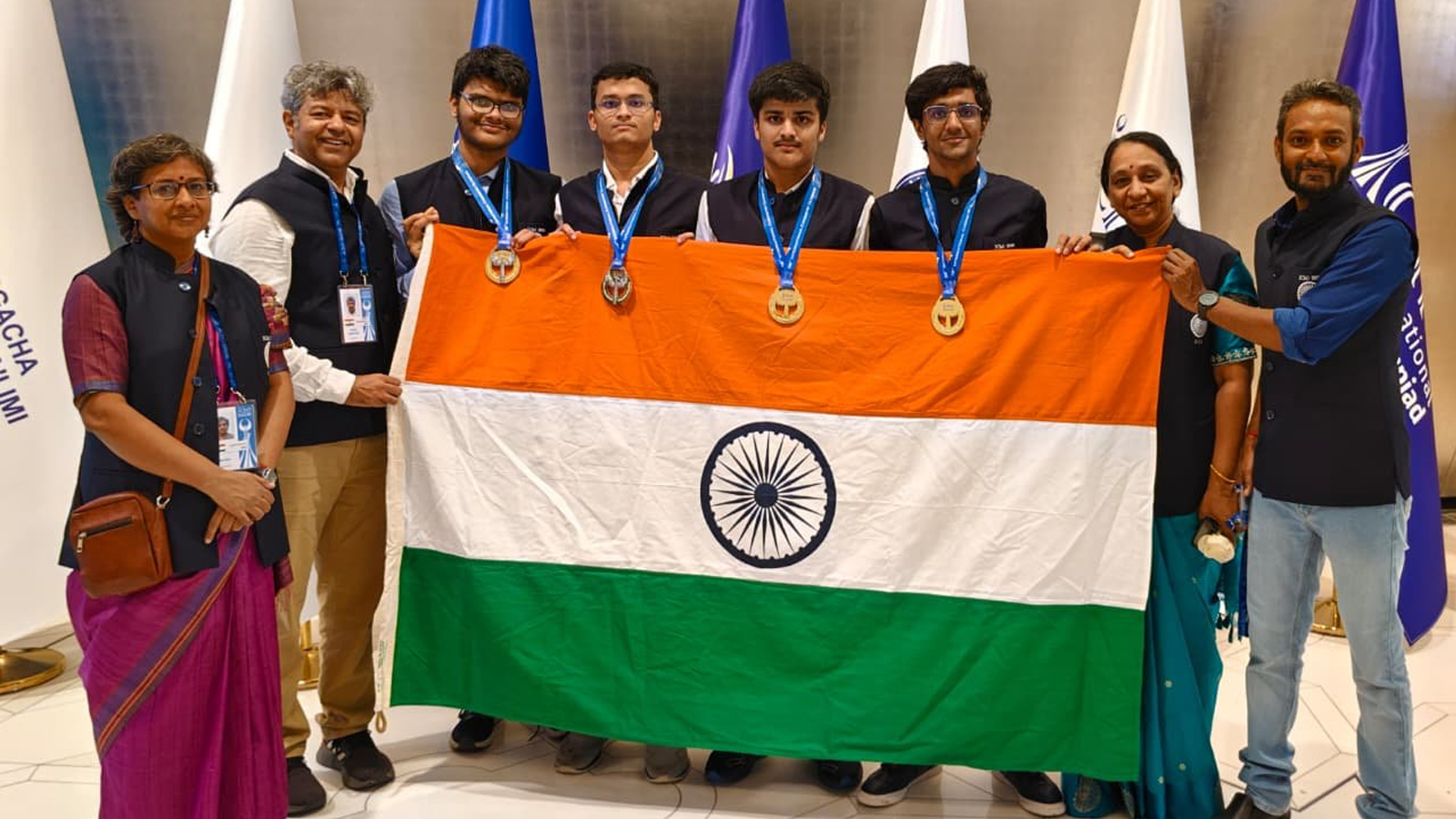
India scripted history at the 58th International Chemistry Olympiad (IChO) 2026 in Tashkent, Uzbekistan, with all four members of the national team winning gold medals, marking the country’s best-ever performance at the prestigious global competition.
The Olympiad, held from July 10 to 19, witnessed participation from 363 students representing 93 countries, making it the largest edition of the competition to date. India finished joint first in the country-wise medal tally alongside China, Vietnam and the Individual Participants Group B (Russia), achieving its first-ever clean sweep of gold medals at the event.
The four Indian students who secured gold medals are Debadatta Priyadarshi from Bhubaneswar, Odisha; Harshit Singla from Mandi Gobindgarh, Punjab; Kabeer Chillar from Delhi; and Sandeep Kuchi from Hyderabad, Telangana.
Prime Minister Narendra Modi congratulated the Indian team for its historic performance.
In a post on X, the Prime Minister said, “India’s Yuva Shakti continues to make a mark globally! Congratulations to our team of Debadatta Priyadarshi, Harshit Singhal, Kabeer Chhillar and Sandeep Kuchi for winning Gold Medals at the 58th International Chemistry Olympiad. This was India’s best performance at this prestigious platform.”
“Their brilliance, dedication and passion for science have made the entire nation proud. It will also motivate countless young minds to study and excel in chemistry,” he added.
The Indian delegation was led by Prof. Subhajit Bandyopadhyay as Head Mentor, with Dr. Indrani Sen of Homi Bhabha Centre for Science Education (HBCSE), Mumbai, serving as Mentor. Dr. Anubendu Adhikary of IIT Kharagpur and Dr. Jayasree Gopalakrishnan of NES Ratnam College of Arts, Science and Commerce, Mumbai, participated as Scientific Observers.
The International Chemistry Olympiad tested participants through both theoretical and experimental examinations covering advanced concepts in chemistry. The theoretical section featured nine challenging problems spanning areas such as reaction kinetics, carbon dioxide reduction, nitrogen fixation, porous framework materials, cyclocarbons, stereochemistry and molecular analysis. The practical examination assessed students’ laboratory skills through experiments involving synthesis and analysis of metal complexes, identification of biochemical mixtures using enzyme-based techniques, and pH-metric titrations to determine the composition of acid mixtures.
The Department of Atomic Energy (DAE) credited the Chemistry Olympiad Cell at HBCSE and its network of teachers and mentors for preparing the team through intensive orientation and pre-departure training camps before the international competition.
India’s performance at this year’s Olympiad further strengthens its impressive record in the competition. Since making its debut 27 years ago, Indian participants have won gold medals in 32 per cent of appearances, silver in 51 per cent and bronze in 17 per cent. Over the last ten editions, India’s performance has improved further, with 43 per cent of its medals being gold and 53 per cent silver.
The organisers also acknowledged the continued support of the National Steering Committee on Science Olympiads, teacher organisations and government funding agencies, including DAE, the Department of Science and Technology (DST) and the Ministry of Education, for nurturing young scientific talent and enabling Indian students to compete successfully on the global stage.


