







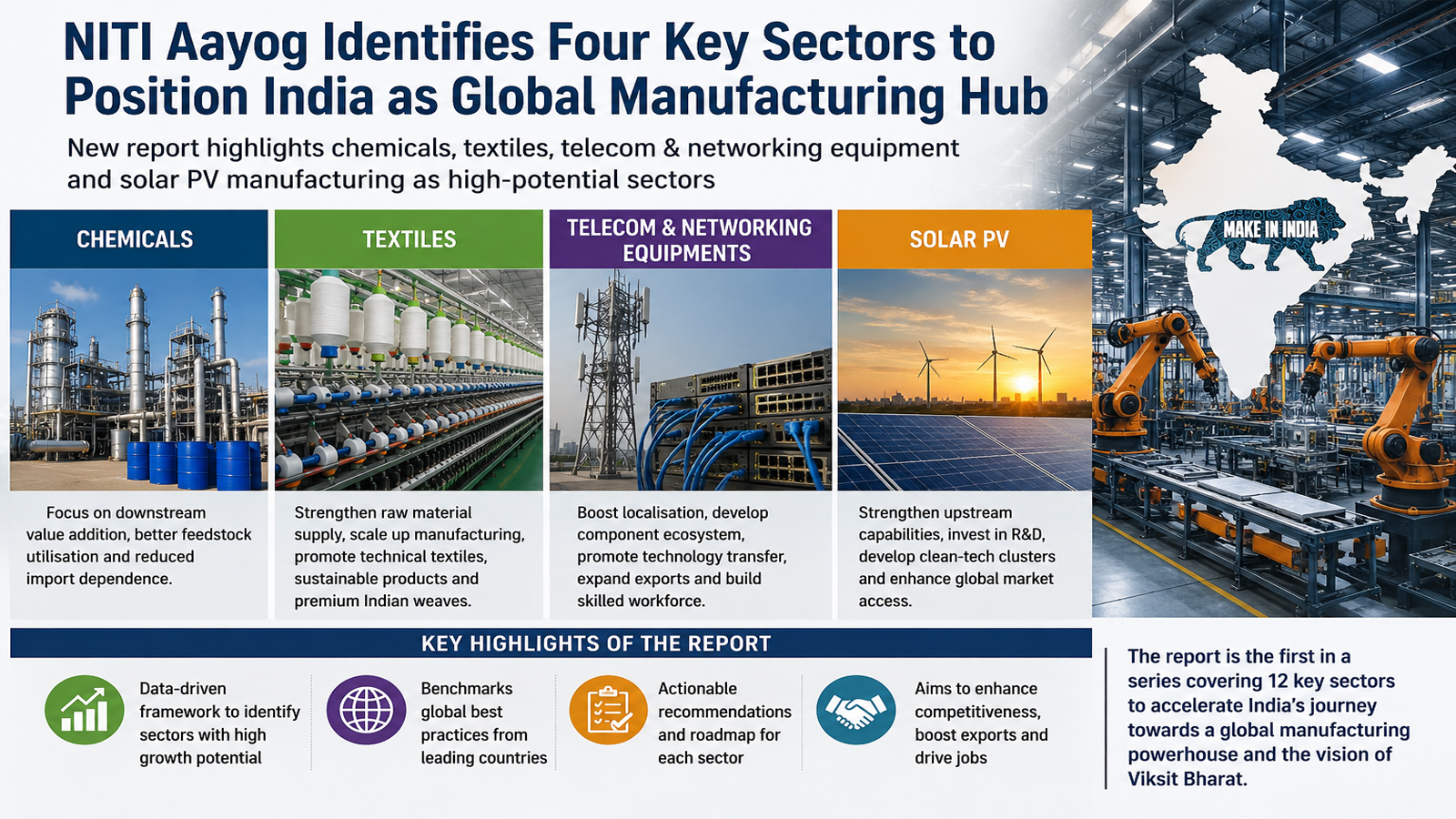
NITI Aayog has released a report titled “Key Sectors to Position India as a Global Manufacturing Hub”, identifying chemicals, textiles, telecom and networking equipment, and solar photovoltaic (PV) manufacturing as four high-potential sectors that could drive India’s manufacturing growth and strengthen its position in global value chains.
The report provides a data-driven assessment of India’s manufacturing landscape and examines factors such as market potential, infrastructure, policy support, availability of raw materials, technology readiness, employment potential and the country’s position in global value chains.
According to NITI Aayog, the study aims to identify sectors where targeted interventions can boost domestic capabilities, increase value addition, reduce import dependence and accelerate export-oriented manufacturing.
The exercise was undertaken in four phases, beginning with the identification of sectors based on their domestic and global growth potential. This was followed by a comprehensive assessment of market potential, competitiveness and strategic relevance, benchmarking of international best practices and formulation of sector-specific recommendations and an implementation roadmap.
The current report covers four sectors and will be followed by assessments of eight more sectors.
Chemicals: focus on downstream value addition
The report identifies the chemicals industry as an important area for expanding domestic manufacturing and value addition. The sector is broadly driven by petrochemicals and organic chemicals, specialty chemicals and inorganic chemicals.
Petrochemicals and organic chemicals constitute the largest segment and include polymers, synthetic fibres, performance plastics, building blocks, intermediates and finished products.
NITI Aayog said India can strengthen the sector by expanding downstream production, improving feedstock utilisation and increasing investments aimed at enhancing competitiveness. Greater use of free trade agreements (FTAs) and stronger domestic manufacturing capabilities could also help reduce import dependence and support sustainable growth.
Textiles: scope to expand global competitiveness
The textile and apparel sector remains one of India’s most important manufacturing industries, contributing around 2% of GDP, 11% of manufacturing GVA and 9% of merchandise exports. It provides livelihoods to more than 45 million people and is the country’s second-largest employment-generating sector after agriculture.
India exported textile products worth $37.7 billion in FY2025, accounting for 4.1% of global textile and apparel exports and making the country the world’s sixth-largest textile exporter.
The report highlights the need to improve raw material availability, expand manufacturing capacity through better infrastructure and increase market access through deeper trade integration.
It also recommends greater emphasis on skilling, technology adoption and productivity, along with the promotion of technical textiles, man-made fibre-based products, sustainable textiles and premium Indian weaves to increase value addition and expand India’s global footprint.
Telecom and networking equipment: strengthening domestic components
India is currently the world’s second-largest telecommunications market, with more than 1.2 billion subscribers, around 85% telecom penetration and nearly 75% internet usage, according to the report.
The National Telecom Policy 2025 has set targets to double the sector’s contribution to GDP, double exports of telecom products and services, create one million new jobs and significantly increase investment and research and development expenditure by 2030.
NITI Aayog has identified localisation and stronger domestic component manufacturing as key priorities for the sector. It has recommended promoting joint ventures and technology transfers, developing integrated industrial clusters, expanding high-potential export segments and strengthening testing, certification and skill development.
These measures, the report said, can help improve scale, innovation and productivity in India’s telecom manufacturing ecosystem.
Solar PV: emphasis on upstream capabilities
The report also identifies solar photovoltaic manufacturing as a major opportunity for India. The country had 106 GW of installed solar capacity by March 2025 and needs to add around 174 GW to achieve its 2030 target of 280 GW.
India’s domestic PV market, estimated at around Rs 32,400 crore ($3.7 billion), is projected to grow at a compound annual growth rate of 17-20% between FY2023 and FY2030. Growth is expected to be supported by utility-scale solar, rooftop projects, open-access solar and demand linked to green hydrogen.
NITI Aayog said India can deepen domestic value addition in solar manufacturing by developing upstream capabilities and reducing import dependence. The report recommends technology partnerships and joint ventures, increased R&D, performance-linked support, integrated clean-tech clusters and industry-led skill development.
It also calls for stronger trade partnerships and government-to-government frameworks to expand export opportunities and improve access to global markets.
Coordinated approach needed to boost manufacturing
The report emphasises closer collaboration between industry and government to address sector-specific constraints and strengthen India’s manufacturing ecosystem.
NITI Aayog said targeted interventions tailored to the requirements of individual sectors can help enhance domestic capabilities, improve competitiveness and accelerate India’s integration into global value chains.
The report is intended to serve as a strategic instrument for guiding the development of the identified manufacturing sectors and supporting India’s broader ambition of achieving Viksit Bharat through a stronger, more competitive and export-oriented manufacturing base.


