







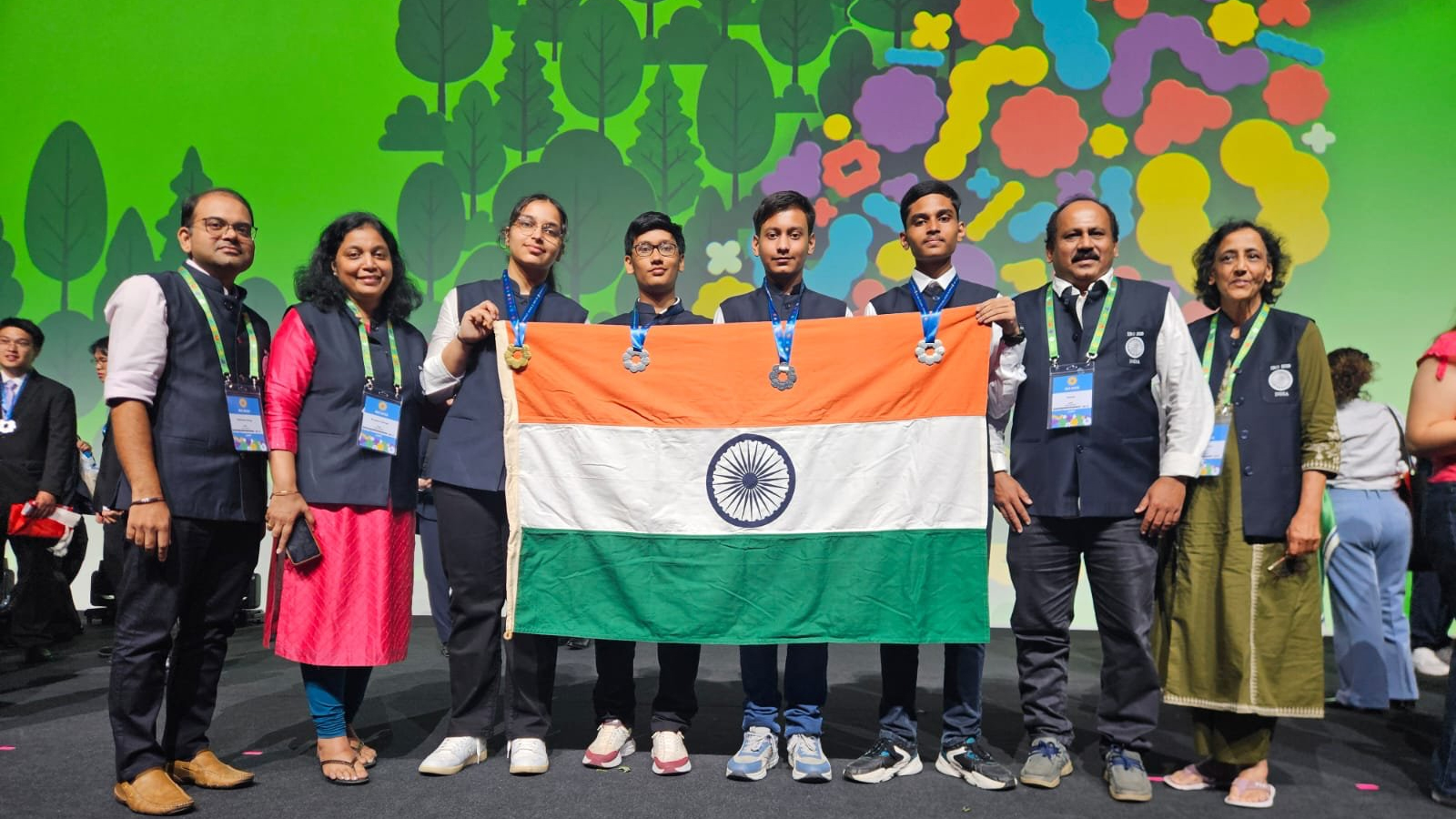
India delivered another impressive performance on the global academic stage, with all four members of its team winning medals at the 37th International Biology Olympiad (IBO) 2026 held in Vilnius, Lithuania, from July 12 to 19.
The Indian contingent secured one gold medal and three silver medals in the prestigious international competition, which brought together 307 students from 78 countries. A total of 31 gold, 61 silver and 91 bronze medals were awarded at this year’s Olympiad.
Bhavyaa Gunwal from Mahendragarh, Haryana, won the gold medal, while Soumil Maity from Howrah, West Bengal, Nishit Kalani from Pali, Rajasthan, and Anmol Kumar from Mansa, Punjab, each secured silver medals.
Prime Minister Narendra Modi congratulated the Indian team for its outstanding performance.
In a post on X, PM Modi said, “It is a matter of immense happiness that in the 37th International Biology Olympiad held in Vilnius, Lithuania, all four Indian team members secured medals, including one Gold.”
“Proud of Bhavyaa Gunwal, Soumil Maity, Nishit Kalani and Anmol Kumar for their success at the Olympiad. They have shown immense knowledge of subjects like Molecular Biology and Biochemistry, Animal Physiology, Animal Morphology and Systematics as well as Plant Computational Biology. I am certain that this success will encourage several more youngsters,” he added.
The Indian team was led by Prof. Rekha Vartak, former faculty member at the Homi Bhabha Centre for Science Education (HBCSE-TIFR), Mumbai, and Dr. Anupama Ronad of HBCSE-TIFR. The delegation also included Scientific Observers Dr. Ranjithsinh Devkar of The Maharaja Sayajirao University of Baroda and Dr. Siddhesh Ghag of the UM-DAE Centre of Excellence in Basic Sciences, Mumbai.
The Olympiad featured rigorous practical and theoretical examinations designed by the Vilnius University Life Sciences Centre to assess advanced biological knowledge and scientific reasoning.
During the six-hour practical examination, participants carried out experiments across four specialised disciplines. These included molecular biology and biochemistry, where students analysed plasmids and conducted enzyme assays; animal physiology, which involved studying aspirin pharmacokinetics using specialised digital tools; animal morphology and systematics, requiring insect classification and detailed dissections; and plant computational biology, where participants used image analysis software to study plant traits and perform transcriptome analysis.
The theoretical examination, also spanning six hours, consisted of 100 research-based questions covering cell and molecular biology, genetics, evolution, ecology, plant and animal sciences, ethology and biosystematics. The questions emphasised analytical thinking and problem-solving rather than rote memorisation.
The Homi Bhabha Centre for Science Education credited the students’ success to intensive training provided through orientation and pre-departure camps conducted by the Biology Olympiad Cell, supported by teachers and mentors from across the country.
India’s latest performance adds to its strong record at the International Biology Olympiad. This was the country’s 26th participation in the competition. Since its debut, 104 Indian students have represented the country, winning 17 gold medals, 69 silver medals, 17 bronze medals and one honourable mention. Over the past decade, Indian participants have maintained an impressive success rate, with 25 per cent of medals being gold and 68 per cent silver.
The organisers also acknowledged the continued support of the National Steering Committee, teacher organisations and the Government of India’s funding agencies for strengthening the Olympiad programme and helping showcase Indian scientific talent on the global stage.


