







Prime Minister Narendra Modi will arrive in Indonesia on Monday for a three-day official visit aimed at reviewing bilateral ties and further strengthening the India-Indonesia Comprehensive Strategic Partnership.
The visit, scheduled from July 6 to 8, marks the Prime Minister’s first bilateral visit to Indonesia since the two countries elevated their relationship to a Comprehensive Strategic Partnership in May 2018. According to the Ministry of External Affairs (MEA), cultural exchanges and strong people-to-people ties continue to form an important pillar of the bilateral relationship.
India and Indonesia share centuries-old civilisational and cultural links, reflected in historical, religious and artistic traditions that continue to foster close engagement between the two countries.
The MEA said Indonesia is home to nearly 1.2 lakh Persons of Indian Origin (PIOs), most of whose ancestors migrated during the Dutch and British colonial period in the 19th and 20th centuries. The majority of the community traces its roots to South India, while sizeable populations of Sindhis, Sikhs, Gujaratis and other communities have also made Indonesia their home.
In addition, around 15,000 Indian nationals live and work in Indonesia. The Indian community comprises entrepreneurs, engineers, chartered accountants, information technology professionals, consultants, bankers and other skilled professionals who contribute to Indonesia’s economy while strengthening bilateral people-to-people ties.
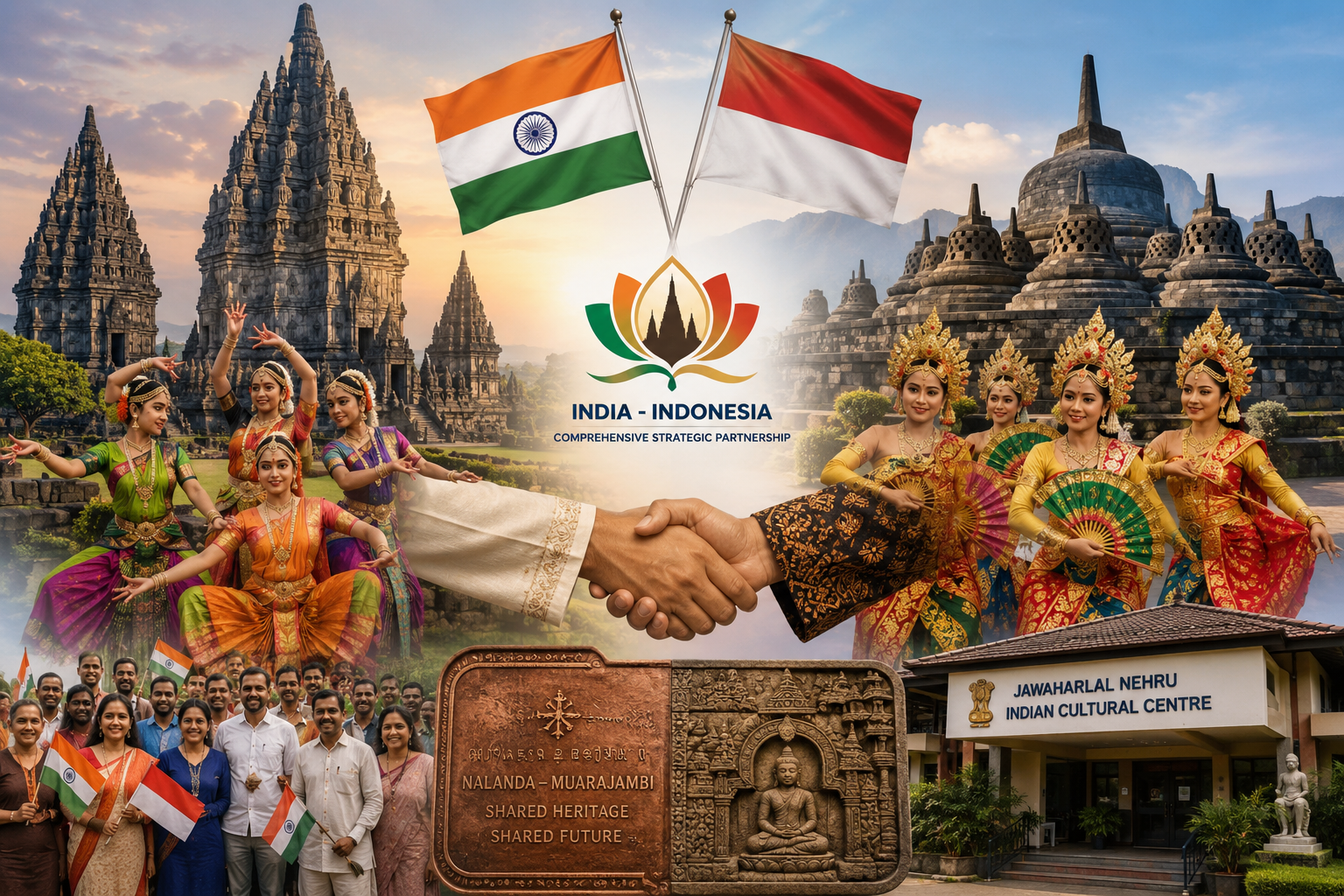
According to the MEA, India’s cultural outreach in Indonesia is anchored by two dedicated cultural centres. The Jawaharlal Nehru Indian Cultural Centre (JNICC), established in Jakarta in 1989, has played a key role in promoting cultural exchanges through collaborative events, performances, exhibitions and training programmes. The centre serves as a platform for showcasing the rich cultural traditions of both countries.
The Swami Vivekananda Cultural Centre in Bali, formerly known as the Indian Cultural Centre, was inaugurated in October 2005 at the premises of the Consulate General of India. It continues to promote Indian art, culture and language while encouraging greater cultural interaction between the two countries.
Cultural cooperation has also expanded through heritage initiatives. On December 9, on the sidelines of the UNESCO Intergovernmental Committee meeting in New Delhi, India’s Ministry of Culture handed over a replica of the 9th-century Nalanda Copper Plate to Indonesia’s Ministry of Culture. The replica symbolises the historic links between the ancient Nalanda university and Muarajambi, one of Southeast Asia’s largest Buddhist temple complexes.
The replica was later incorporated into the Muarajambi Museum during a commemorative ceremony attended by Indonesia’s Culture Minister Fadli Zon, highlighting the shared Buddhist heritage and deep cultural connections between the two countries.
According to the MEA, the enduring presence of the Indian diaspora, expanding cultural exchanges and growing cooperation in preserving shared heritage continue to reinforce the strong foundation of India-Indonesia relations.


