







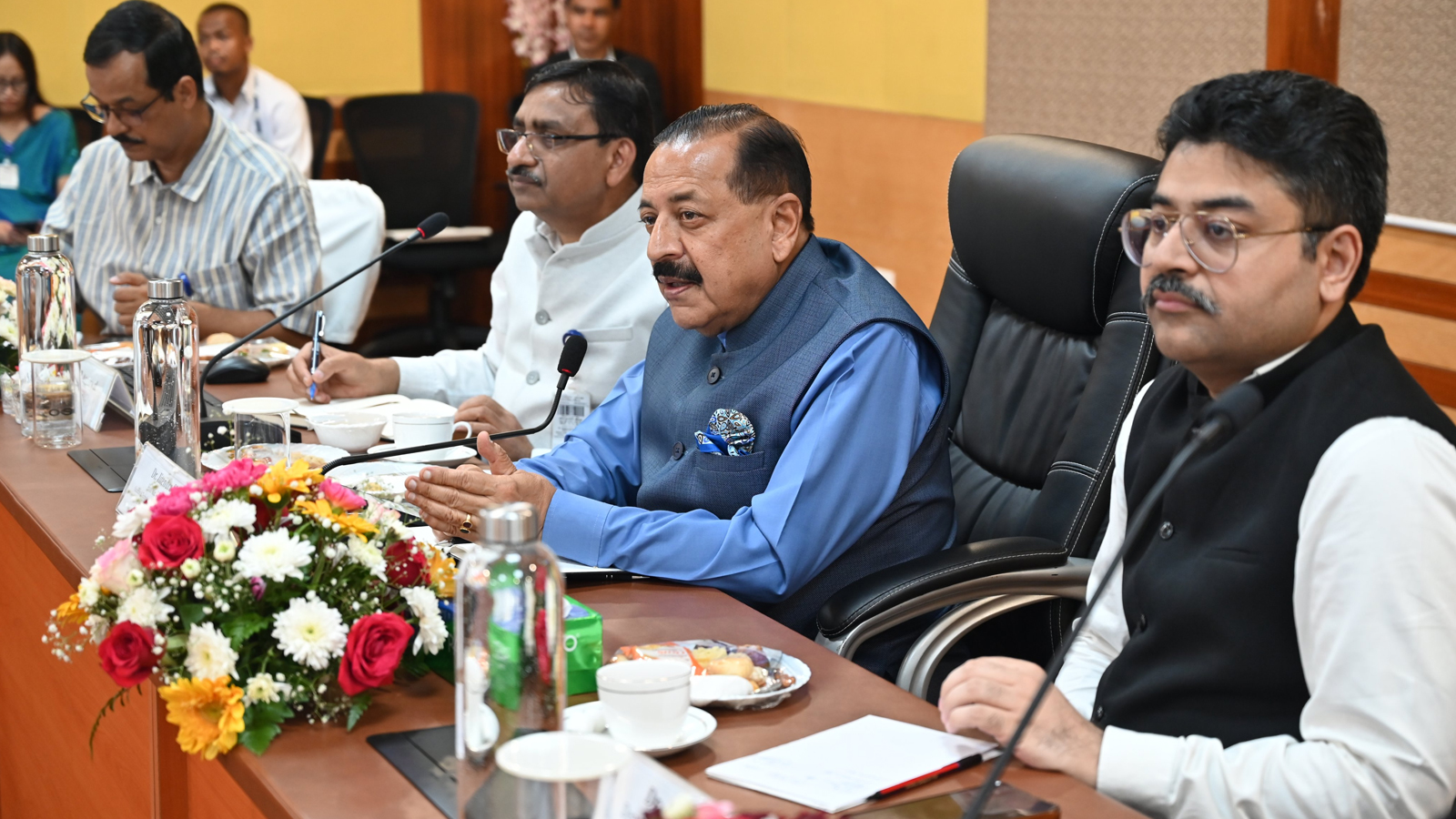
Union Minister of State (Independent Charge) for Science and Technology and Earth Sciences, Dr. Jitendra Singh, on Tuesday said the North Eastern Space Applications Centre (NESAC) has emerged as a key institution supporting India’s strategic priorities and the socio-economic development of the Northeast through the application of space technology.
During a visit to NESAC at Umiam in Meghalaya, the minister said the Centre is contributing to geospatial mapping of the India–Myanmar border and inter-state boundaries in the Northeast while implementing a wide range of technology-driven projects in agriculture, disaster management, natural resource management, water resources and governance.
Singh was received by NESAC Director Dr. S.P. Aggarwal, who presented an overview of the Centre’s achievements and ongoing programmes. The presentation highlighted nearly 130 space application projects, including around 50 recently completed initiatives and 78 ongoing projects covering agriculture, forestry, water resources, geosciences, urban and regional planning, geoinformatics, information technology, satellite communication, UAV applications, space and atmospheric sciences, disaster management support, and outreach and capacity-building across the Northeastern region.
The minister praised NESAC for translating advanced space technologies into practical developmental solutions and said the Centre has become an important bridge between scientific innovation and the development aspirations of the eight Northeastern states. He noted that the institution’s growing collaboration with state governments has enabled space technology to support planning, governance, resource management and public service delivery.
Emphasising the importance of the region’s bamboo resources, Singh called for closer collaboration between NESAC, the North East Cane and Bamboo Development Council (NECBDC) and state governments to maximise the benefits of the Centre’s ongoing bamboo mapping programme. He said scientific mapping would strengthen the bamboo value chain, improve resource planning, promote value addition and generate sustainable livelihood opportunities.
The minister also urged NESAC to further improve the precision and location-specific capabilities of its flood early warning system to ensure vulnerable communities receive timely and actionable alerts. He encouraged the Centre to work closely with state governments to replicate successful water harvesting models, including the initiative implemented at the Ramakrishna Mission in Cherrapunjee, to strengthen long-term water security across the region.
Highlighting the strategic importance of geospatial technologies, Singh said NESAC should continue supporting national priorities in strategically important border areas while maintaining close coordination with relevant agencies. He also suggested strengthening the GeoTourism ‘ManzilNE’ dashboard by encouraging greater participation from the private tourism sector to promote the Northeast’s natural, ecological and cultural heritage.
The minister further called for deeper partnerships between NESAC and central ministries, state governments, research institutions, academia, start-ups and private industry to accelerate the adoption of space-based applications across sectors. Such collaboration, he said, would help translate scientific innovations into scalable solutions capable of addressing the region’s developmental challenges.
Singh said the Northeast has emerged as one of India’s fastest-growing regions under the leadership of Prime Minister Narendra Modi, with science and technology playing a crucial role in driving inclusive development. He expressed confidence that NESAC would continue to strengthen governance, improve disaster resilience, support sustainable resource management and contribute to the vision of a technologically empowered and prosperous Northeast.


