







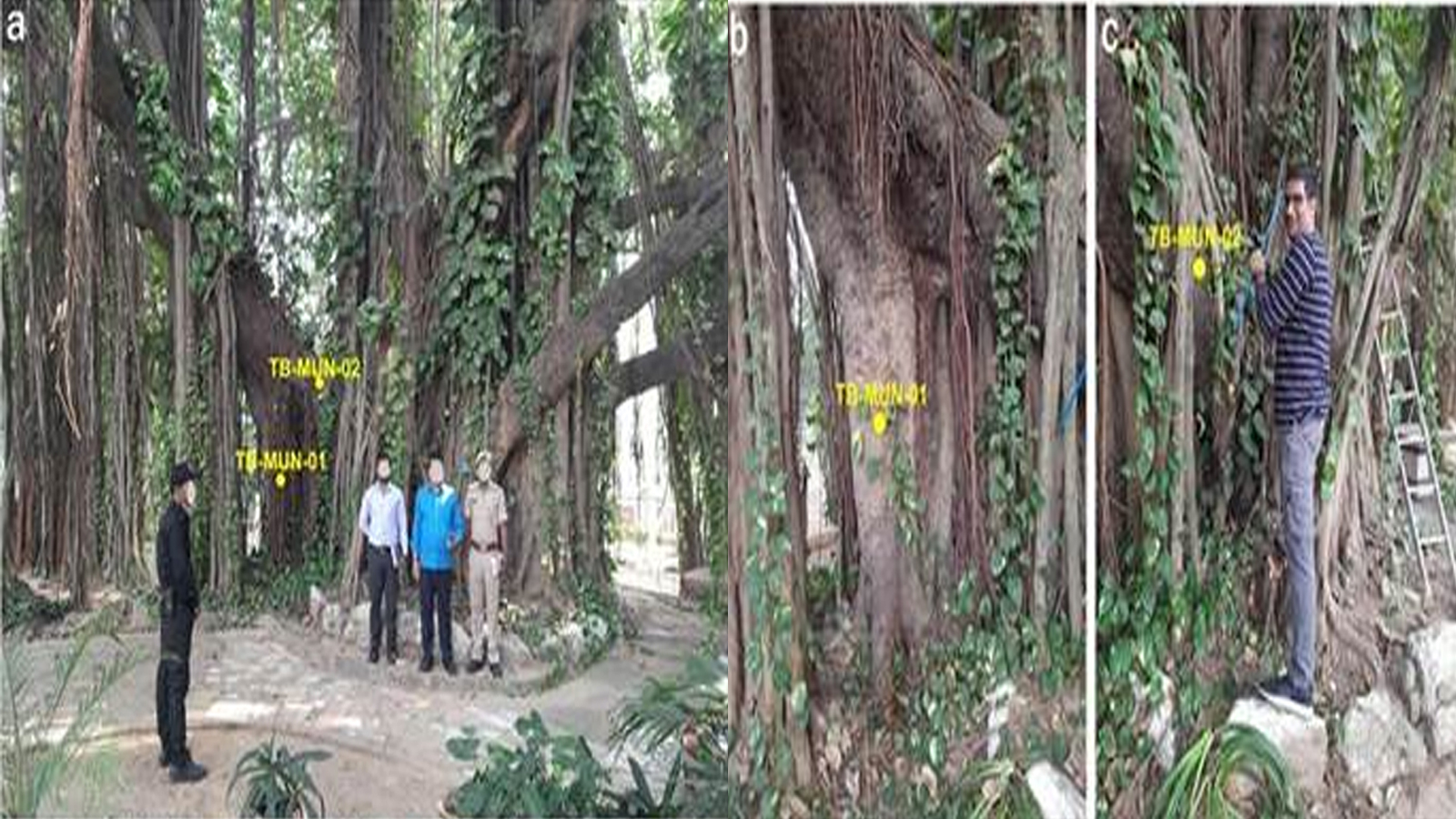
A banyan tree in Bihar’s Munger district has been identified as the world’s oldest accurately dated banyan tree, with scientists estimating its age at around 700 years using high-precision radiocarbon dating, marking a major breakthrough in the scientific dating of tropical heritage trees.
The study, published in the journal Quaternary Research, establishes the age of the Ficus benghalensis tree through scientific evidence rather than relying on folklore, historical records or local traditions that have long been used to estimate the ages of such ancient trees.
Banyan trees are an integral part of India’s ecological, cultural and social landscape, providing habitats for a wide range of birds, insects and other wildlife while serving as centres for community gatherings, religious ceremonies and cultural activities for centuries. However, accurately determining their age has remained a challenge because most tropical broadleaf trees do not form distinct annual growth rings, making conventional dendrochronological techniques ineffective.
The scientific breakthrough came after Dr. Trina Bose of the Birbal Sahni Institute of Palaeosciences, Lucknow, an autonomous institute under the Department of Science and Technology (DST), was invited by the Bihar Forest Department to determine the age of the historic Munger banyan tree. Recognising the limitations of existing methods for dating tropical broadleaf species, Dr. Bose initiated the development of a new scientific approach for age determination.
Leading a research team that included Dr. Mayank Shekhar and Dr. Akhilesh K. Yadava, Dr. Bose developed and applied an innovative methodology using radiocarbon dating to establish the tree’s age.
The researchers extracted alpha-cellulose, the most stable component of plant cell walls, from wood samples collected near the pith of a secondary trunk and an ancient primary branch. The pith was particularly significant because it represents the earliest wood formed during the juvenile stage of the tree’s secondary growth.
The extracted cellulose samples were then analysed using high-precision radiocarbon dating through Accelerator Mass Spectrometry (AMS). The results were subsequently calibrated using the latest IntCal20 calibration curve and OxCal software, enabling the team to arrive at a robust and scientifically reliable estimate that places the tree’s age at approximately 700 years.
The findings also overturn a long-held belief regarding the tree’s history. Earlier assumptions suggested that the banyan had been planted in front of the historic Burra Bunglow, a structure dating to the late Mughal-Early British period, approximately 300 to 350 years ago, where rulers and common citizens reportedly gathered for dialogue, village assemblies, religious ceremonies and cultural exchanges.
The scientific analysis instead establishes that the banyan tree predates the building by several centuries, indicating that it is likely a surviving remnant of a natural forest that once covered the region and that it witnessed the construction of the Burra Bunglow itself. The discovery effectively redefines the sequence of historical events associated with the site.
Researchers believe the newly developed methodology has far-reaching implications beyond this single tree. It provides governments, forest departments and conservation agencies with a scientifically validated approach to accurately determine the ages of heritage trees, replacing uncertain estimates based on oral traditions or historical assumptions.
The technique can also be applied to other ancient tropical trees across the world, supporting biodiversity conservation, heritage management, environmental education and research into historical landscapes and past climatic conditions.
According to the researchers, the study represents a significant advancement in the scientific dating of culturally important tropical trees and is expected to strengthen efforts to preserve natural, historical and cultural heritage across South Asia and beyond.


