







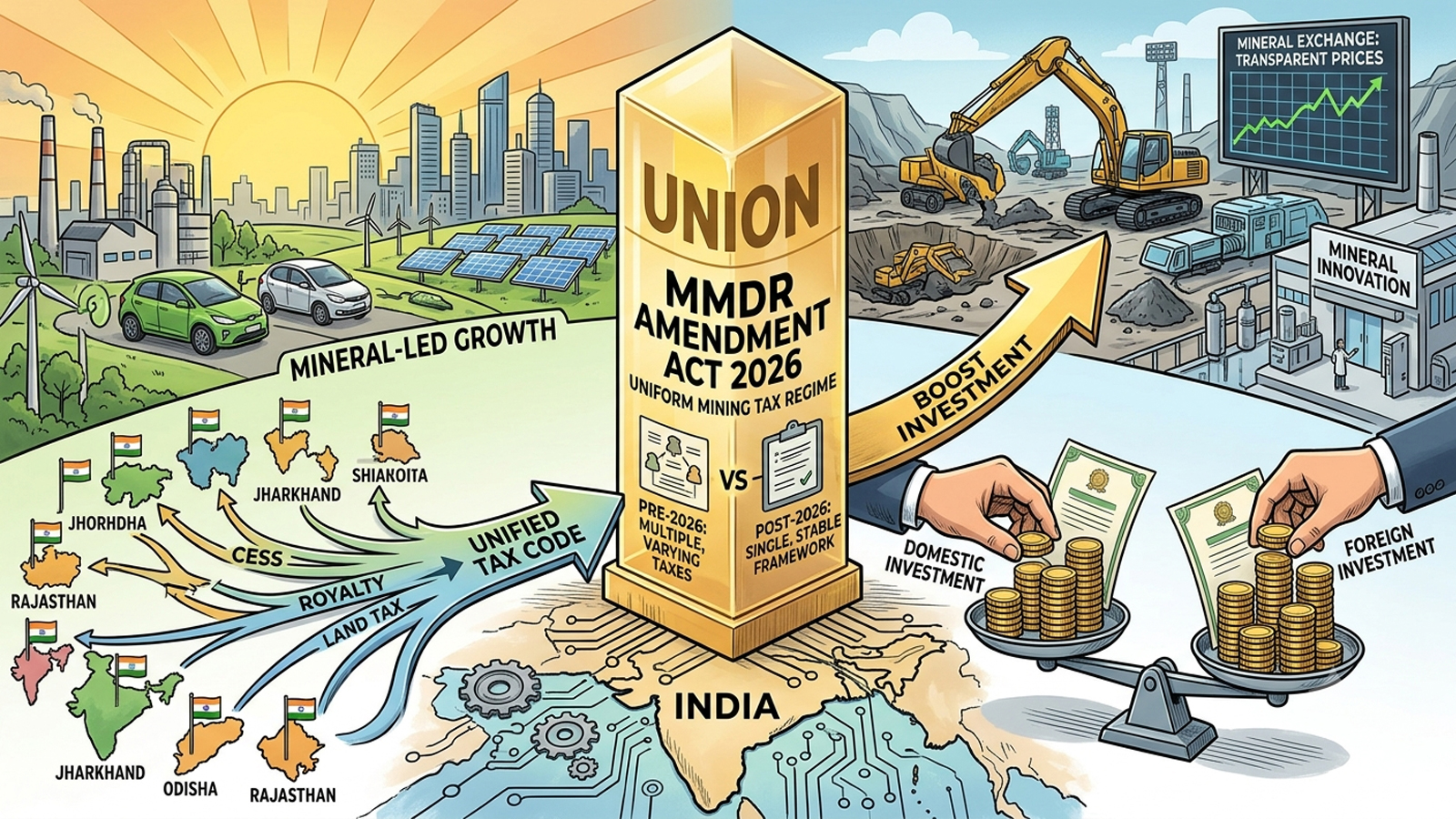
The Mines and Minerals (Development and Regulation) Amendment Act, 2026 marks a significant shift in India’s approach to mineral taxation and governance, seeking to establish a more uniform, predictable and balanced fiscal framework for the mining sector while preserving the revenue interests of States.
The legislation amends the Mines and Minerals (Development and Regulation) Act, 1957 at a time when access to minerals has emerged as a strategic concern globally. Minerals form the foundation of industries ranging from steel, cement and power to electronics, transport and defence, making a stable domestic supply increasingly important for India’s economic and national security priorities.
At the centre of the 2026 amendment is an attempt to address the growing burden of multiple levies imposed on mining and bring greater predictability to the fiscal environment in which mining companies operate.
The government said that mineral resources, although concentrated in a limited number of States, support the entire national economy. Consequently, the taxation of minerals has implications far beyond individual mining regions.
Why the government says the reform is necessary
The mining sector currently faces a range of taxes, charges and fees. According to the government, States impose around 14 different taxes, charges and fees on mining, including royalty, auction premium, dead rent, payments to District Mineral Foundations (DMFs), GST and transit fees.
In addition to these existing payments, some States have begun imposing levies on mineral-bearing lands, in certain cases at rates of up to 20 per cent.
The government said that the cumulative and open-ended nature of these charges is affecting the viability of mining operations, increasing costs for industries that depend on minerals and ultimately raising the prices paid by consumers.
The MMDR Amendment Act, 2026 seeks to address this issue by introducing greater uniformity and rationality into the taxation of mineral rights and mineral-bearing lands.
The reform assumes added significance because the government views a viable domestic mining sector as essential for energy security, critical mineral security and the broader goal of reducing dependence on imports.
New restrictions on State levies
A key provision of the amendment is the introduction of Section 9D into the MMDR Act.
Under the new provision, a State Government cannot impose a tax, cess or other levy, regardless of the name under which it is imposed, on mineral rights or mineral-bearing lands.
This restriction applies to levies based on mineral quantity, mineral value, royalty or any other basis.
However, such levies may be imposed by States subject to conditions or restrictions prescribed by the Central Government.
The amendment also addresses levies imposed before its commencement. Any levy that has not been paid or collected by a State before the amendment comes into effect will be treated as invalid. Amounts that had already been deposited or recovered before commencement, however, will not be refundable.
To facilitate the new framework, Section 13 of the MMDR Act has also been amended to empower the Central Government to make rules prescribing the conditions or restrictions under which such State levies may be imposed.
The issue of multiple levies and mining viability
The government has linked the reform directly to the competitiveness of India’s mining sector.
The mineral sector supports the country’s energy, manufacturing, infrastructure and defence requirements. Coal is central to India’s energy security, while iron ore, limestone, bauxite and copper provide essential inputs for steel, cement, aluminium, electricity, modern industry and defence.
The government noted that growing global uncertainty makes a resilient domestic mining industry particularly important.
India has also been giving greater attention to critical minerals in an effort to protect supply chains from external shocks. At the same time, the coal sector is being made more competitive and technologically advanced to reduce dependence on imports.
A predictable fiscal environment, according to the government, is necessary for both objectives.
The cumulative burden of multiple levies can be particularly significant for small and medium-sized mining operators, which often work on relatively thin margins. The government has said that some mines have already been forced to close, while other projects have remained unopened because of high costs.
Strategic minerals also affected by taxation
The government pointed out that levies are not confined to conventional minerals. They can also affect strategically important resources such as graphite and atomic minerals such as uranium.
High levies can make the extraction of such minerals commercially unviable, while differing tax structures between States can create disparities within the sector.
The government therefore said that rationalisation of the fiscal regime is necessary to ensure that strategic mineral projects remain commercially workable.
This is particularly relevant to India’s broader push for critical mineral security.
Impact on imports and foreign exchange
The government has also linked the cost of domestic minerals to India’s import dependence.
When domestically produced minerals become more expensive than imported alternatives, user industries such as steel may find it economically attractive to source raw materials from overseas.
India imported minerals worth ₹10,12,529 crore in FY 2025-26, according to the government.
At the same time, expensive domestic minerals can become less competitive in international markets. Iron ore exports alone generated ₹15,136 crore in FY 2025-26.
The government said that curbing cost escalation in domestic mineral production is therefore important not only for import substitution but also for maintaining India’s competitiveness in export markets.
The broader objective is linked to the country’s push for self-reliance, or Atmanirbhar Bharat, in the mineral sector.
A fragmented mineral market
Another concern highlighted by the government is the variation in levies imposed by different States.
When the same mineral attracts substantially different costs depending on where it is mined, the result can be significant regional differences in mineral prices.
Such fragmentation can disrupt supply chains and increase transportation and logistics costs, making it difficult to establish a unified national mineral market.
The amendment seeks to bring greater uniformity to this environment by placing restrictions on the introduction of new State levies and providing for a framework directed by the Centre.
Why mining taxation ultimately affects households
The government has also presented the reform as an issue affecting ordinary consumers.
A levy imposed at the mining stage becomes part of the cost of the mineral. That cost then moves through the production chain into steel, cement, electricity and construction.
As a result, higher mineral costs can eventually translate into higher costs for housing, power and essential goods.
The government has therefore described rationalisation of mining taxation as a matter not only of industrial competitiveness but also of everyday affordability.
Employment implications
The mining sector also has a significant employment footprint.
The coal sector employs more than five lakh people directly and indirectly, while the non-coal mining sector supports more than one crore workers.
According to the government, high levies can place pressure on the viability of mines, with smaller operators particularly vulnerable to closure.
A stable fiscal environment is consequently being positioned as a means of supporting investment, mining operations and employment, including in mining-dependent and tribal regions.
Investment and long-term planning
Mining projects require substantial capital and long-term planning. The government has argued that investors are more likely to commit capital when the tax and regulatory environment is stable and predictable.
Sudden or uncertain changes in the fiscal regime can discourage investment and delay technological upgrades and infrastructure development.
This has implications beyond mining itself, since manufacturing, defence, shipping, construction and renewable energy all depend on a reliable mineral base.
The MMDR amendment seeks to provide greater certainty to investors and mining operators by establishing clearer limits around the imposition of new State levies.
States to retain the overwhelming share of mining revenue
A central part of the government’s case for the amendment is that it does not alter the basic distribution of mining revenue between the Centre and the States.
According to the government, nearly 90 per cent of mining-sector revenue currently accrues to the States.
The government said revenue to States from mineral production has increased by 354 per cent since 2014, with States receiving more than ₹7 lakh crore, including coal.
The States’ share in total mineral revenue from coal and non-coal mining has increased by around 28 percentage points over the past decade, reaching approximately ₹1,14,549.28 crore in 2025-26.
The coal sector provides a particularly clear example of this shift.
In 2014-15, States received ₹11,947.97 crore, representing 55.6 per cent of total coal-sector revenue. By 2025-26, their receipts had increased to ₹32,183.09 crore, or 89.5 per cent.
During the same period, the Centre’s share declined from ₹9,534.24 crore to ₹3,771.82 crore, representing a reduction from 22.97 per cent to 10.5 per cent.
Major mineral-producing States received ₹13,586.16 crore in FY 2013-14, which rose to ₹82,366.19 crore in FY 2025-26. This represents a compound annual growth rate of 16.20 per cent over 12 years.
Between FY 2015-16 and FY 2025-26, more than ₹5 lakh crore accrued to these States, compared with around ₹82,000 crore to the Centre.
The government said the MMDR Amendment Act leaves this revenue position unchanged.
Auction premium has created another revenue stream
The government also highlighted the impact of the auction-based mineral allocation regime introduced in 2015.
Before 2014, the mineral sector was characterised by discretionary and non-transparent grant and renewal of concessions, according to the government. Litigation was frequent, production was low and State revenues remained modest.
The 2015 amendment to the MMDR Act introduced competitive e-auctions and ended discretionary allocation of concessions.
Since then, 723 major mineral blocks have been auctioned across 17 States.
Rajasthan leads with 140 blocks, followed by Madhya Pradesh with 127 and Odisha with 76.
FY 2025-26 was the strongest year so far, with 212 blocks auctioned and 36 operationalised.
In the coal sector, 141 mines have been auctioned and 23 operationalised.
The auction regime has also created auction premiums as an additional source of State revenue.
Since 2015, States have collected ₹2.32 lakh crore in royalty from 1,200 working mines. From only 100 auctioned mines, they have collected ₹96,000 crore in auction premium.
Odisha, which has operationalised 35 of its 79 auctioned blocks, earned around ₹87,000 crore in premium between 2020-21 and 2025-26.
The government has illustrated the distribution of revenue through a typical iron ore transaction. At an average sale price of ₹3,000 per tonne, the mining company pays ₹3,150, of which ₹3,016 goes to the State.
This distribution pattern, the government said, continues under the amended framework.
Minor minerals remain under State control
The amendment does not alter State control over minor minerals.
Nearly 50 minor minerals remain entirely under the control of State Governments.
These include sand, gravel, clay, silica, granite, marble, gypsum and laterite.
The government has specifically clarified that the amendment has no bearing on this category and that State authority over minor minerals continues as before.
A decade of mining-sector reforms
The MMDR Amendment Act, 2026 comes against the backdrop of a broader series of reforms undertaken in the mineral sector since 2014.
The government has described these measures as an effort to make mining more transparent, competitive and better prepared to meet future demand.
Competitive auctions and increased mine operationalisation
The 2015 MMDR amendment established competitive e-auctions as the mechanism for allocating mineral concessions.
Since then, 723 major mineral blocks have been auctioned across 17 States.
The record performance in FY 2025-26 saw 212 blocks auctioned and 36 operationalised.
Coal has also seen increased auction activity, with 141 mines auctioned and 23 operationalised.
Higher mineral production
The value of major mineral production increased by 26.8 per cent in FY 2025-26.
Iron ore production reached a record 313 million tonnes, while limestone production reached 484 million tonnes.
Coal production has crossed one billion tonnes in each of the last two years.
Non-coal mineral production has nearly tripled since 2014.
India now ranks second globally in limestone, third in zinc, fourth in iron ore and fifth in bauxite.
Critical Mineral Mission
The government has placed particular emphasis on critical minerals.
The National Critical Mineral Mission (NCMM) was approved on January 29, 2025, with an outlay of ₹16,300 crore, including ₹2,600 crore in budgetary support, up to FY 2030-31.
The Geological Survey of India (GSI) and the National Mineral Exploration and Development Trust (NMEDT) are working towards 1,200 critical mineral projects.
Of the 777 projects sanctioned by NMEDT at ₹3,828.52 crore, 255 relate to critical minerals.
An amendment made in 2025 also allows NMEDT to support mineral exploration abroad.
Khanij Bidesh India Limited (KABIL) has secured exclusive lithium exploration rights in Argentina as part of this broader overseas sourcing effort.
Recycling and processing capacity
India has also expanded its focus beyond extraction to the processing and recycling of critical minerals.
A ₹1,500 crore incentive scheme for critical mineral recycling was launched on October 2, 2025.
The scheme has attracted 58 entities, which have pledged 850 thousand tonnes per annum of capacity, against a target of 270 thousand tonnes.
Critical Mineral Processing Parks are being supported in Andhra Pradesh, Gujarat, Odisha and Maharashtra with an allocation of ₹500 crore.
Basic customs duty has been removed on critical minerals, lithium-ion battery scrap and processing capital goods in three successive Budgets.
Nine institutes have been designated as Centres of Excellence under the MAHA mission, with ₹210 crore allocated for the initiative.
Expansion of exploration
Exploration activity has also expanded significantly.
The government said exploration has grown nearly 200 times since 2014, with 51 private agencies now notified for exploration work.
The NMEDT contribution has been increased to 3 per cent, while half of direct exploration costs are reimbursed.
The reimbursement ceiling is ₹20 crore for exploration licence holders and ₹8 crore for composite licence holders.
The Geological Survey of India (GSI) completed 457 projects during Field Season 2025-26, including 230 projects involving critical and strategic minerals.
NMEDT funded 62 such projects in 2024-25 and 84 in 2025-26.
Easier mining operations and digital monitoring
Several operational reforms have also been introduced.
Mining leases can now receive a one-time area extension of up to 10 per cent, while composite licences can receive an extension of up to 30 per cent.
The cap on mineral sales from captive mines has been removed.
Additional payment requirements for adding critical, strategic or deep-seated minerals to a lease have also been removed.
The Unified Mining Portal (UMP), developed with the States, tracks the lifecycle of a mineral block from auction through operationalisation.
Coal and Mineral Exchanges have also been introduced to support fair price discovery.
Welfare of mining-affected communities
Mining-related revenue is also being directed towards communities affected by mining.
The Pradhan Mantri Khanij Kshetra Kalyan Yojana (PMKKKY) and 656 District Mineral Foundations (DMFs) have been established for local welfare, including 106 DMFs in aspirational districts.
The government said the entire DMF collection goes towards local projects, with district administrations deciding the areas requiring support.
Projects include roads, hospitals, schools, drinking water facilities and measures aimed at improving living conditions.
These collections will continue unchanged under the MMDR Amendment Act, 2026.
What changes under the new framework?
The government has described the amendment as a transition from a fragmented mining taxation system towards a more uniform, Centre-directed framework.
Under the earlier system, mining could face different tax structures in different States, and new levies could potentially be introduced after mining operations had begun.
The amended framework provides that States cannot impose new levies on mineral rights or mineral-bearing lands except under conditions prescribed by the Central Government.
The amendment also invalidates pending retrospective demands that had not been paid or collected before its commencement.
The government said the result will be a more predictable fiscal environment, with the same basic framework applying across the mineral sector.
The reform is also intended to address concerns that the maximum burden of multiple and changing levies often falls on small and medium-sized mining operators.
A reform with wider economic implications
The government has positioned the MMDR Amendment Act as a measure whose impact extends beyond the mining industry.
Coal provides energy, while iron ore, limestone and bauxite support steel, cement and aluminium production. Copper is important for modern industry, electricity and defence.
The availability and cost of these minerals therefore influence sectors such as power, manufacturing, railways, roads, housing and transport.
By seeking to reduce the cost burden and provide greater certainty to mining operations, the government expects the reform to strengthen downstream industries and infrastructure development.
The government has also linked competitive mineral prices with lower electricity and industrial costs, arguing that the benefits can ultimately reach households through more affordable power, housing and essential goods.
Towards Viksit Bharat
The MMDR Amendment Act, 2026 is being presented as part of a broader effort to build a competitive, transparent and predictable mining sector capable of supporting India’s long-term development goals.
The government sees mineral security as increasingly connected to energy security, manufacturing capacity, defence preparedness, employment, infrastructure development and economic self-reliance.
The decade of reforms since 2014 – from competitive auctions and increased exploration to critical mineral missions, recycling incentives, digital monitoring and community welfare mechanisms – has laid the foundation for this approach.
The latest amendment seeks to address the fiscal side of the equation by establishing clearer limits on State levies while retaining the existing distribution of mining revenue to States.
With India’s demand for minerals expected to remain closely tied to its industrial and infrastructure ambitions, the government expects greater fiscal certainty to encourage investment, improve mining viability and strengthen domestic supply chains.
The broader objective, as articulated by the government, is to ensure that India’s mineral wealth supports economic growth, energy and national security, employment and self-reliance while contributing to the country’s journey towards Viksit Bharat.


