







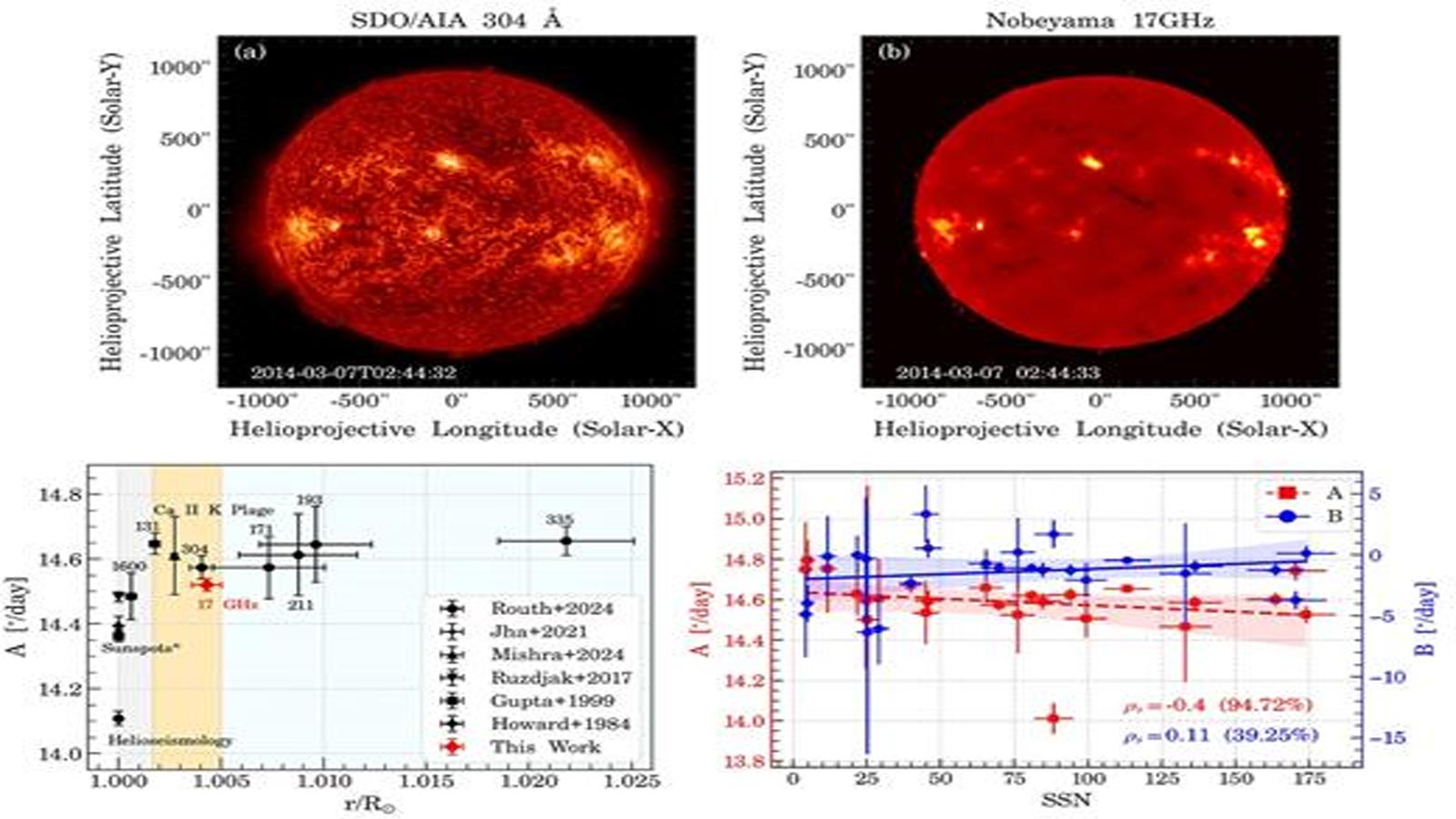
Scientists have discovered that the Sun’s upper atmosphere rotates significantly faster than its visible surface, with the rotation speed increasing at greater heights above the solar surface, challenging long-held expectations based on classical physics.
The findings, published in the journal Astronomy & Astrophysics Letters, are expected to improve understanding of the Sun’s behaviour and help refine models of solar activity and space weather, which can affect satellites, communication systems, navigation networks and power infrastructure on Earth.
The study was conducted by researchers from the Aryabhatta Research Institute of Observational Sciences (ARIES), an autonomous institute under the Department of Science and Technology (DST), in collaboration with the Udaipur Solar Observatory (USO), Physical Research Laboratory (PRL) and Ahmednagar College.
Researchers Srinjana Routh and Vaibhav Pant (now at IIT Delhi) from ARIES, Anshu Kumari from USO-PRL and Jaydeep Kandekar from Ahmednagar College carried out the research using observations from the Nobeyama Radioheliograph in Japan.
According to the study, the Sun does not follow the behaviour predicted by the classical law of conservation of angular momentum, which generally explains how rotating bodies behave. In simple terms, an object such as a spinning ice skater rotates faster when pulling its arms inward and slows down when stretching them outward—a principle that also broadly applies to Earth’s atmosphere.
However, scientists found that the Sun’s atmosphere behaves differently.
The research revealed that the Sun’s atmosphere rotates faster than the visible solar surface and that the rotation speed continues to increase with height above the surface. The study also found that the rotation rate decreases slightly during periods of heightened solar activity, as indicated by an increase in the number of sunspots.
Since the Sun is composed primarily of gas and lacks a solid surface, accurately measuring its rotation has remained a challenge for scientists.
To determine the rotational behaviour of the Sun’s atmosphere, the researchers employed a two-dimensional image-correlation method. The technique involved comparing solar images captured on different days by cropping them to identical regions and measuring how much the features had shifted over time. This displacement was then used to calculate the atmospheric rotation speed.
Scientists said the findings offer fresh insights into the complex dynamics of the Sun’s atmosphere and could contribute to more accurate forecasting of solar activity and space weather events, improving preparedness for their impact on critical technological infrastructure on Earth.


