







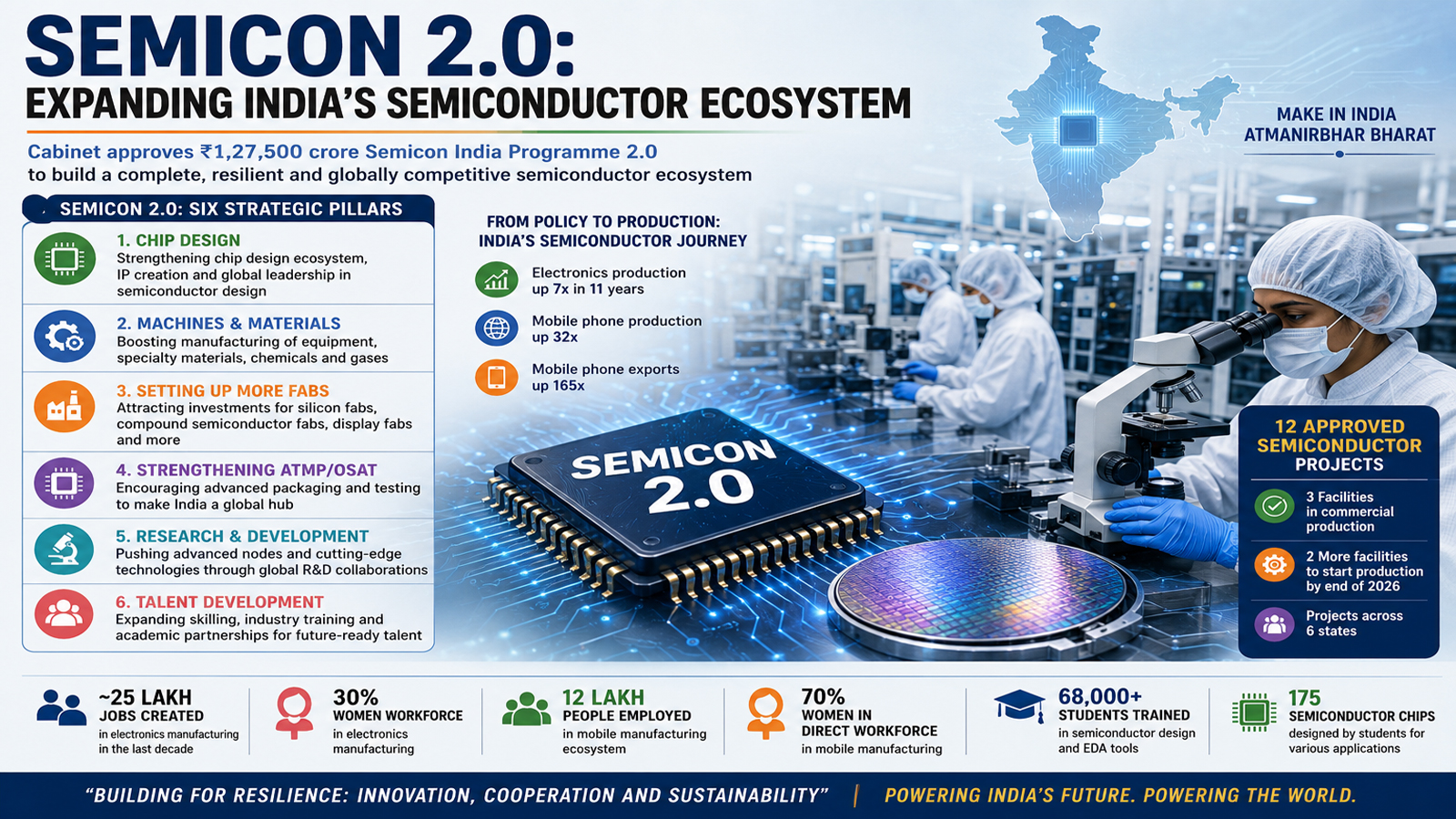
The Union Cabinet on Wednesday approved Semicon India Programme 2.0 with a budgetary outlay of ₹1,27,500 crore, marking the next phase of India’s ambition to emerge as a globally competitive semiconductor manufacturing and design hub. Building on the momentum created under the ₹76,000-crore Semicon India Programme launched in 2021, the new initiative aims to develop a comprehensive semiconductor ecosystem spanning chip design, fabrication, advanced packaging, equipment, materials, research and talent development.
The approval comes as semiconductors increasingly underpin the global digital economy, powering everything from smartphones and electric vehicles to medical equipment, satellites and artificial intelligence systems. As demand for semiconductors continues to surge worldwide, the government is positioning India not only as a manufacturing destination but also as a trusted technology partner with resilient supply chains and strong domestic capabilities.
Building on a decade of electronics manufacturing growth
India’s semiconductor journey has been built on the rapid expansion of its electronics manufacturing ecosystem over the past decade. Successive policy initiatives, including the National Policy on Electronics, the Scheme for Promotion of Manufacturing of Electronic Components and Semiconductors (SPECS), Electronics Manufacturing Clusters (EMC) 2.0, the Production Linked Incentive (PLI) Scheme for Large Scale Electronics Manufacturing and the Electronics Components Manufacturing Scheme (ECMS), have transformed the country’s Electronics System Design and Manufacturing (ESDM) landscape.
During the past eleven years, electronics production has increased seven-fold, electronics exports have grown eleven-fold, mobile phone production has expanded thirty-two-fold and mobile phone exports have surged 165-fold. India has also become the world’s second-largest mobile phone manufacturer, creating a strong manufacturing base for its entry into semiconductor production.
The rapid growth of electronics manufacturing has generated nearly 25 lakh jobs over the last decade. Women account for around 30 per cent of the electronics manufacturing workforce, while the mobile manufacturing ecosystem employs around 12 lakh people, with women constituting nearly 70 per cent of the direct workforce, highlighting the sector’s contribution to inclusive industrial growth.
Semicon India 1.0 lays the foundation
Approved in December 2021 with an outlay of ₹76,000 crore, the Semicon India Programme was launched in response to global semiconductor supply chain disruptions witnessed during the COVID-19 pandemic. Implemented through the India Semiconductor Mission (ISM), the programme adopted a mission-mode approach offering globally competitive incentives, pari-passu funding and flexible financial support to encourage semiconductor manufacturing in India.
Unlike earlier initiatives focused mainly on fabrication, Semicon India recognised the need for a complete ecosystem encompassing chip design, fabrication, packaging, testing, equipment, specialty chemicals, industrial gases, logistics and skilled manpower.
Significant progress has already been achieved under the first phase. India has approved 12 semiconductor manufacturing projects across Gujarat, Uttar Pradesh, Punjab, Assam, Odisha and Andhra Pradesh. These include one Silicon Fab, one Silicon Carbide Fab, one integrated Gallium Nitride (GaN) Micro LED Display Fab and nine packaging facilities catering to sectors such as consumer electronics, automobiles, telecommunications, aerospace and industrial electronics.
Three companies – Micron, Kaynes Semicon and CG Power (CG Semi) – have already commenced commercial production, marking India’s transition from policy intent to actual semiconductor manufacturing. Another facility is expected to begin commercial production during 2026.
Collectively, the approved projects involve cumulative investments exceeding ₹1.64 lakh crore, laying the foundation for a resilient domestic semiconductor ecosystem.
Strengthening India’s semiconductor design leadership
Alongside manufacturing, India continues to strengthen its position as a global semiconductor design hub, with nearly 20 per cent of the world’s semiconductor design talent based in the country.
Under the Design Linked Incentive (DLI) Scheme, 24 semiconductor design projects from startups and MSMEs have received financial support, while 105 startups and MSMEs have been granted access to industry-standard Electronic Design Automation (EDA) tools.
These companies are developing semiconductor chips and Systems-on-Chip (SoCs) for a wide range of strategic and commercial applications, including satellite communications, drones, surveillance systems, Internet of Things devices, LED drivers, artificial intelligence systems, telecom equipment and smart meters. Most projects are currently at various stages of design and development before entering commercial deployment following successful prototyping.
Students have also designed and fabricated 175 semiconductor chips for applications spanning automotive, healthcare, telecommunications, artificial intelligence and satellite communications.
Talent development remains a key focus
Recognising that skilled manpower is critical to sustaining semiconductor growth, the government has expanded semiconductor education and training through the Chips to Startup (C2S) programme.
Electronic Design Automation tools have been deployed across 315 universities, enabling around 68,000 students to receive hands-on training in advanced chip design. A dedicated semiconductor curriculum has also been introduced in more than 500 engineering colleges, creating a strong pipeline of industry-ready talent.
Semicon 2.0 proposes to deepen these efforts further by strengthening industry participation in specialised training for clean rooms, fabrication facilities and semiconductor manufacturing ecosystems.
Semicon 2.0 expands the ecosystem
Building upon the progress achieved under Semicon India 1.0, the newly approved programme seeks to strengthen every stage of the semiconductor value chain rather than focusing solely on chip manufacturing.
The programme rests on six strategic pillars designed to create a complete and globally competitive semiconductor ecosystem.
The first pillar focuses on chip design, building upon the success of more than 105 startups already developing semiconductor chips. Under Semicon 2.0, emphasis will shift towards creating indigenous intellectual property, advanced chip designs and complete semiconductor systems, positioning India as a leading semiconductor design IP nation.
The second pillar aims to develop semiconductor equipment, materials, specialty chemicals and industrial gases by incentivising companies engaged in manufacturing and research of critical machinery and inputs required for semiconductor production. This is expected to strengthen India’s precision manufacturing capabilities while reducing dependence on imports.
The third pillar seeks to attract additional semiconductor fabrication plants (fabs). With India’s first silicon fabrication facility scheduled to be commissioned in 2028, the government intends to encourage investments across silicon fabs, compound semiconductor fabs, discrete component fabs and display fabrication units.
The fourth pillar focuses on expanding India’s Assembly, Testing, Marking and Packaging (ATMP) and Outsourced Semiconductor Assembly and Test (OSAT) industry. Following the success of existing ATMP facilities, Semicon 2.0 aims to attract advanced packaging technologies and position India as an alternative global destination for semiconductor packaging.
The fifth pillar prioritises research and development, with the current semiconductor journey beginning at 28nm to 110nm technology nodes before progressing towards more advanced process technologies through collaborations with leading domestic and international research institutions.
The sixth pillar centres on talent development, expanding semiconductor education, practical training and industry engagement to build a highly skilled workforce capable of supporting future manufacturing and research requirements.
States and global partnerships strengthen the ecosystem
India’s semiconductor ambitions are being reinforced through close collaboration with progressive states and international technology partners.
Multiple states have announced dedicated semiconductor policies offering additional incentives to attract investments. At the same time, partnerships with the United States, Japan, Singapore, the Netherlands, Germany and the European Union are supporting technology collaboration, ecosystem development and research.
Several global technology companies, including Applied Materials, AMD, Lam Research, KLA and Microchip Technology, have also announced investments and collaborative initiatives in India, strengthening the country’s position in the global semiconductor value chain.
Towards technological self-reliance
According to the government, Semicon India Programme 2.0 is expected to support economic growth across multiple sectors, strengthen national security through resilient semiconductor supply chains and establish India’s technological leadership in critical technologies.
By expanding capabilities across semiconductor design, manufacturing, advanced packaging, research, equipment and skilled manpower, the programme seeks to deepen domestic value addition, create high-quality employment and reduce strategic dependence on global supply chains.
As global semiconductor demand continues to rise over the coming decade, the government believes Semicon 2.0 will help position India as a trusted destination for semiconductor manufacturing and innovation, supporting the broader vision of Viksit Bharat through an integrated, innovation-driven and globally competitive semiconductor ecosystem.


