







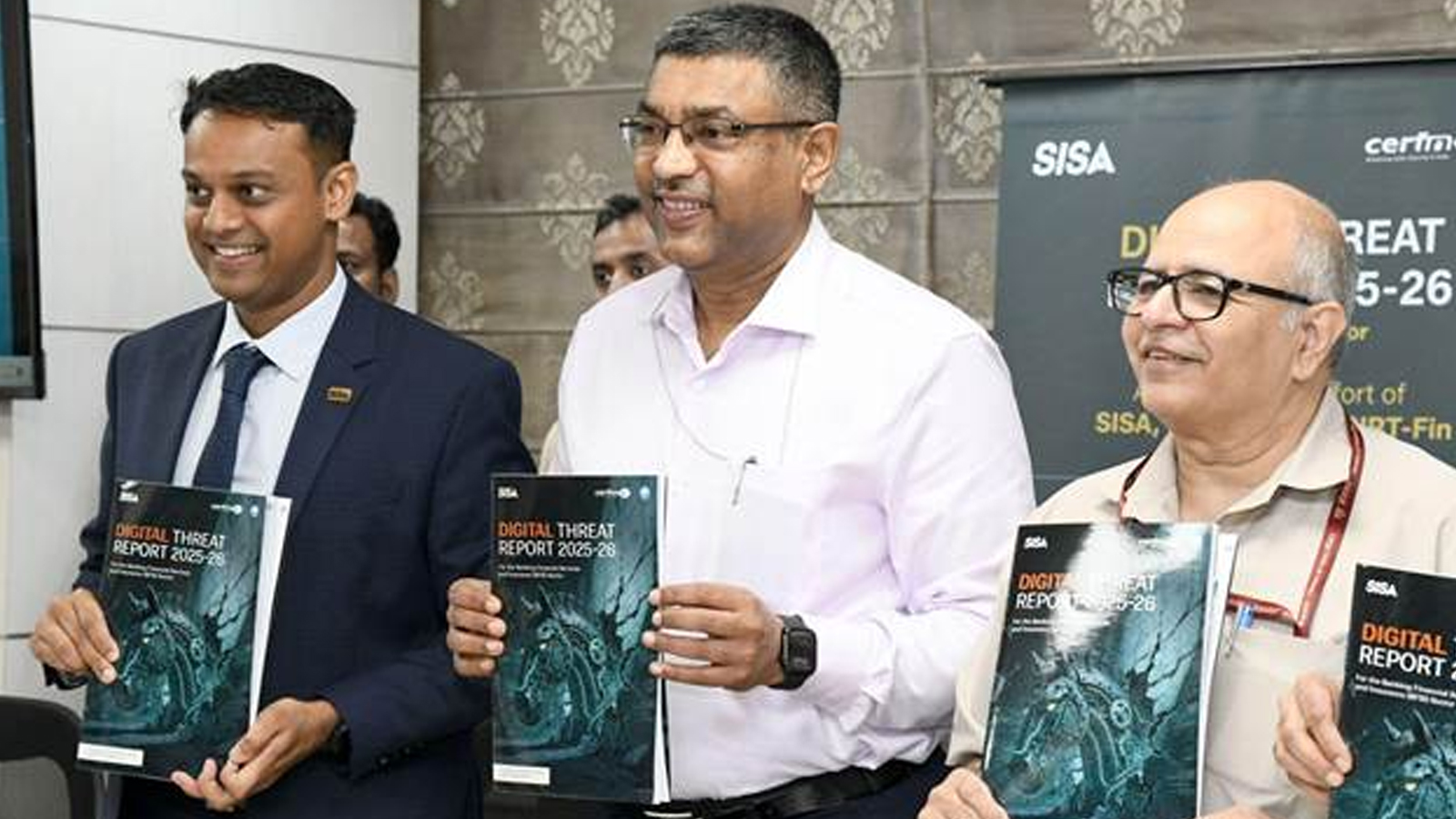
As cyber threats become more sophisticated and increasingly exploit artificial intelligence, trusted partnerships between government institutions and industry have become essential to strengthening digital trust, said Ministry of Electronics and Information Technology (MeitY) Secretary S. Krishnan on Monday.
Speaking at the launch of the Digital Threat Report 2025-26 for the Banking, Financial Services and Insurance (BFSI) and payments ecosystem, Krishnan said the report reflects the importance of collaboration in addressing emerging cyber risks.
“As cyber threats become increasingly sophisticated, trusted partnerships between public institutions and industry are essential to strengthening digital trust. The Digital Threat Report represents a meaningful collaboration among CERT-In, CSIRT-Fin and SISA. This partnership demonstrates how expertise developed in India can contribute both to our national cyber resilience and to advancing cybersecurity knowledge globally,” he said.
The report was jointly released by MeitY, the Indian Computer Emergency Response Team (CERT-In), the Computer Security Incident Response Team in Finance (CSIRT-Fin) and cybersecurity firm SISA. It provides financial institutions, regulators and cybersecurity leaders with an assessment of the evolving threat landscape affecting banking, financial services, insurance and digital payments.
Drawing on digital forensics and incident response (DFIR) research, CERT-In and CSIRT-Fin observations, and studies on adversarial artificial intelligence, the report finds that six of the seven predictions made in its previous edition have already become reality. It notes that the time between the emergence of a cyber threat and its operational exploitation has narrowed significantly—from years to months, and in some cases, even weeks.
According to the report, cyber threats such as social engineering, credential theft, supply-chain compromise and cloud exploitation have evolved into established attack methods. It warns that modern cyberattacks increasingly appear as legitimate user sessions, authorised payments or routine workflows, making them difficult to detect until the damage has already been done.
One of the report’s key findings is the growing challenge of AI asymmetry, where artificial intelligence enables relatively low-resource threat actors to execute sophisticated attacks at machine speed. The report cautions that offensive cyber capabilities are advancing faster than many defensive and regulatory mechanisms.
SISA Founder and Chief Executive Officer Dharshan Shanthamurthy said the shrinking gap between innovation and cyber exploitation has fundamentally altered the security landscape for the financial sector.
He said trust forms the foundation of the BFSI ecosystem, and a single cyber breach can have cascading consequences across customers, financial institutions, partners and markets. Stressing that cybersecurity must become a core business function rather than merely a technical responsibility, he said lessons learned from cyber incidents should be used to build stronger organisational resilience.
CERT-In Director General Dr. Sanjay Bahl said India’s increasingly interconnected and technology-driven financial ecosystem requires cyber resilience to be treated as a shared responsibility across institutions, regulators and the wider digital supply chain.
He said the report advocates a shift from periodic security interventions to continuous risk assessment, coordinated incident response and stronger information sharing. The recommendations are aimed at helping financial institutions anticipate systemic risks, strengthen operational resilience and protect trust in India’s rapidly expanding digital financial infrastructure.
A key feature of this year’s report is the Anatomy of Cyber Failure, a four-layer gap archetype framework that examines how modern cyber breaches unfold. Instead of viewing security incidents as isolated failures, the framework identifies a chain of compounding weaknesses that enable attacks to escalate, helping organisations identify recurring vulnerabilities and prioritise investments in critical security gaps.
The report also outlines an 18-month roadmap for the BFSI sector, recommending a phased approach that begins with strengthening foundational cybersecurity controls before advancing towards continuous security capabilities and more resilient enterprise security architectures.
The Digital Threat Report 2025-26 has been developed to support financial institutions, regulators and cybersecurity professionals in strengthening preparedness against evolving cyber risks as India’s digital financial ecosystem continues to expand.


