







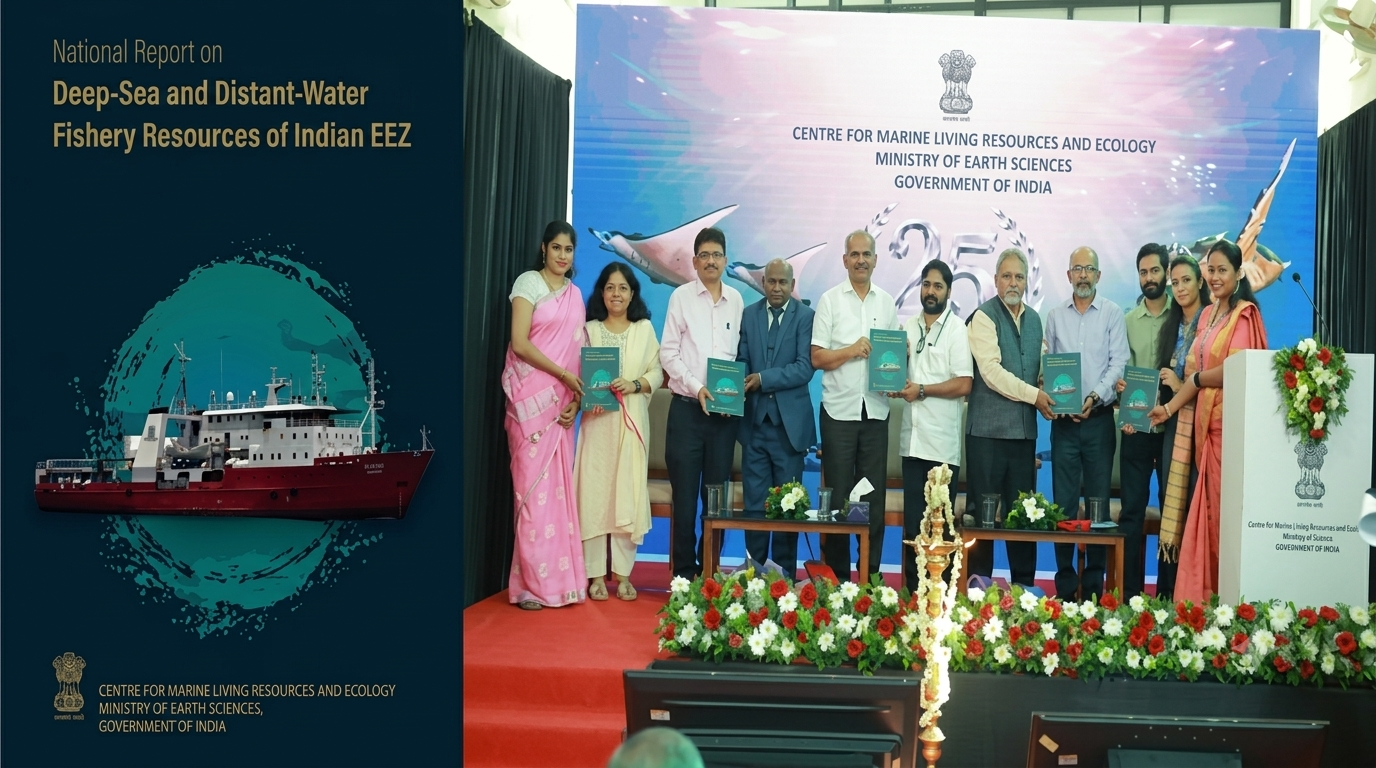
The Centre for Marine Living Resources and Ecology (CMLRE), under the Ministry of Earth Sciences (MoES), has released the “National Report on Deep-Sea and Distant-Water Fishery Resources of the Indian EEZ”, presenting a comprehensive assessment of marine resources and ecosystems to support the sustainable development of India’s Blue Economy.
Released as part of CMLRE’s Silver Jubilee celebrations, the report brings together nearly four decades of oceanographic research and three decades of systematic surveys conducted across India’s 2.37 million square kilometre Exclusive Economic Zone (EEZ). The document assesses fishery resources while also emphasising biodiversity conservation and sustainable resource management.
The report was unveiled in the presence of former MoES Secretary Dr M. Ravichandran, former CMLRE Directors Dr P. Madheswaran and Dr M. Sudhakar, Deep Ocean Mission Director Dr M. V. Ramana Murthy, CMLRE Head Dr R. S. Maheskumar and members of the marine science community.
The findings are based on more than 400 oceanographic cruises undertaken since the early 1990s under the Marine Living Resources Programme. A significant part of the research was carried out aboard India’s Fishery and Oceanographic Research Vessel, FORV Sagar Sampada, which has supported multidisciplinary expeditions across the Arabian Sea, Bay of Bengal, Lakshadweep waters, Andaman Sea and the Southern Ocean.
The report examines resources across the mesopelagic or “twilight zone”, extending from 200 to 1,000 metres below the ocean surface. These waters contain species such as lanternfishes, deep-sea shrimps and cephalopods, while their vertical migration plays an important role in the ocean’s biological carbon pump and global climate regulation.
It also provides an assessment of demersal resources along the continental slope beyond 200 metres, including deep-sea shrimps, perches, scombroids, flatfishes and eels. The report further compiles information on distant-water species such as tunas, billfishes, sharks, oceanic squids and Antarctic krill.
The publication identifies several ecologically important marine areas and biodiversity hotspots, including Kollam Bank, Angria Bank, the deep-sea slope off Mangaluru, the terrace off Thiruvananthapuram, and waters around the Lakshadweep and Andaman and Nicobar Islands.
Highlighting the role of technology in future marine resource assessment, the report outlines the use of fisheries acoustics, environmental DNA, autonomous observing platforms, satellite observations, artificial intelligence and advanced ecosystem modelling. These tools are expected to support marine spatial planning and more effective, science-based management of ocean resources.
The findings align with India’s Vision 2047, which identifies the Blue Economy as an important pillar of national growth, and support the country’s commitments under UN Sustainable Development Goal 14 on conserving and sustainably using oceans and marine resources, as well as the UN Decade of Ocean Science for Sustainable Development.
“Sustainable prosperity will not come simply from discovering new marine resources, but from understanding them, respecting the ecosystems that sustain them, and managing them with science as the guiding compass,” Dr M. Ravichandran said.
The publication was edited by former CMLRE Director Dr V. N. Sanjeevan and retired National Institute of Oceanography scientist Dr Baban Ingole, and published under the leadership of Dr R. S. Maheskumar. The core team involved in synthesising the multidisciplinary data included Dr Hashim Manjebrayakath, Dr Smitha B. R., Dr Rajeesh Kumar M. P., Dr Meera K. M., Dr Purbali Saha, Dr Sahina Akter, Dr Chinmay Kar and Dr Davood Nihal.


