







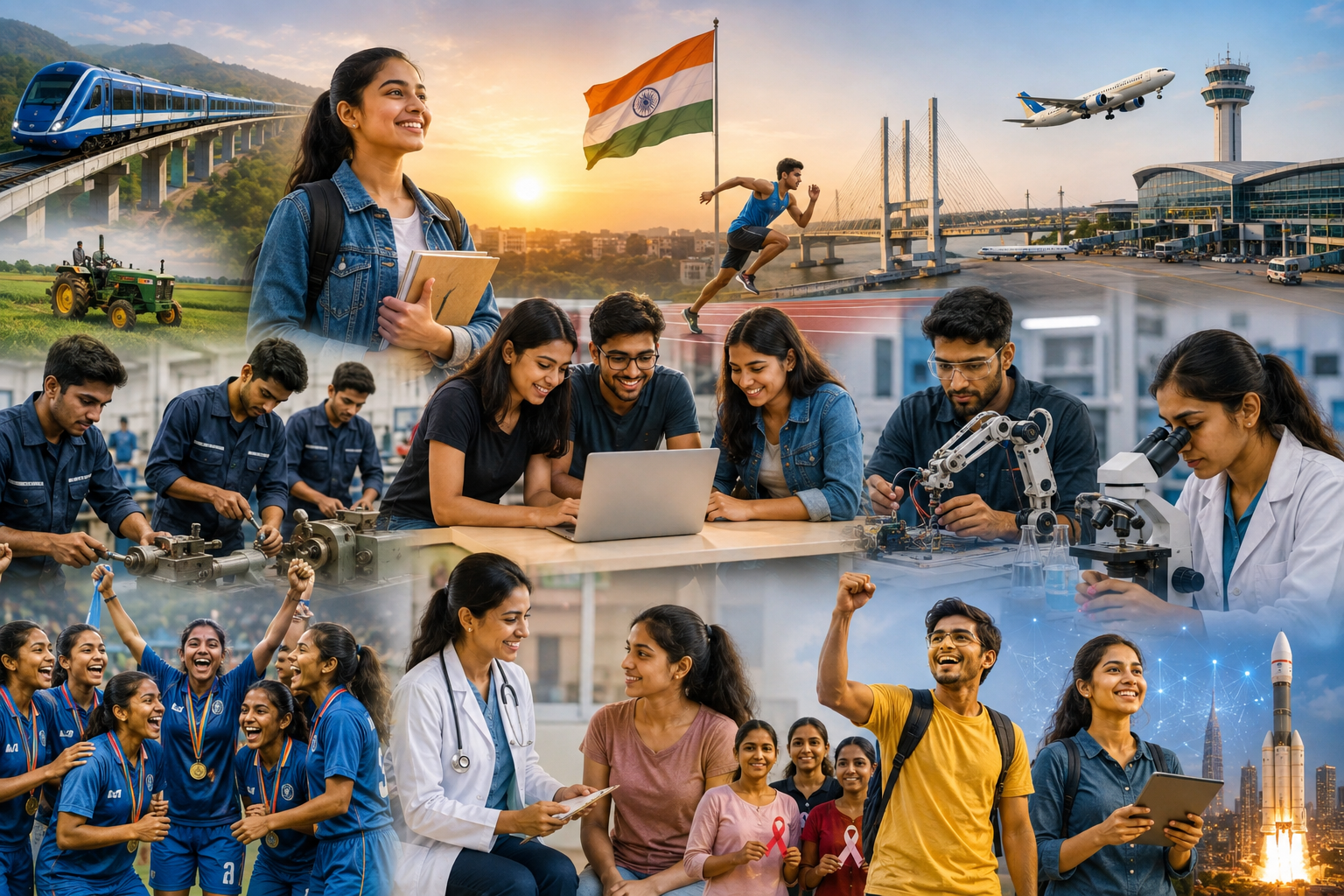
With nearly 65 per cent of India’s population below the age of 35, the government has expanded programmes in education, skilling, employment, entrepreneurship, sports, healthcare and civic participation to harness the country’s demographic potential and support the vision of Viksit Bharat @ 2047.
At the centre of the youth-focused approach is Mera Yuva Bharat (MY Bharat), launched in October 2023 for young people aged 15 to 29. More than 2.22 crore youth had registered on the platform as of July 2026, while over 1.52 lakh volunteering opportunities and more than 24,900 experiential learning programmes have been made available.
The platform provides opportunities in volunteering, experiential learning, leadership, skilling, career development and civic participation.
The Viksit Bharat Young Leaders Dialogue 2026 also saw participation from more than 50 lakh youth through a nationwide quiz. The initiative included 78 diaspora youth from 21 countries and identified 6,000 young leaders for a district-wise repository.
The National Service Scheme has also expanded its reach, with volunteer enrolment rising from 34.09 lakh in 2014-15 to 38.90 lakh in 2025-26.
Education and innovation
India’s education system has expanded in both scale and digital access. The country has 14.67 lakh schools serving 24.72 crore students, supported by more than 1.02 crore teachers.
The secondary-school dropout rate declined from 14.54 per cent in 2013-14 to 7 per cent in 2025-26.
Digital education infrastructure has also grown, with more than 1.49 lakh schools covered under ICT and digital initiatives by 2025-26. More than 1.76 lakh smart classrooms and 1.79 lakh ICT laboratories had been sanctioned as of March 2026.
The Atal Tinkering Labs initiative has established more than 10,000 laboratories, engaging over 1.1 crore student innovators and supporting more than 16 lakh projects.
Higher education enrolment increased from 3.4 crore in 2014-15 to 4.5 crore in 2023-24. Female enrolment rose by 42.2 per cent during the period to 2.2 crore.
Innovation and entrepreneurship have also received institutional support. Eighty-five Atal Incubation Centres have created more than 32,000 jobs and supported over 2,900 startups.
Digital and flexible learning
The National Credit Framework has been adopted by more than 700 universities and over 7,500 affiliated colleges.
The Academic Bank of Credits has onboarded 3,123 institutions, while more than 35.27 crore APAAR IDs had been issued as of August 12, 2026.
The SWAYAM platform offers more than 20,370 courses and has recorded over 6.5 crore enrolments. DIKSHA has recorded 19.06 crore enrolments across 342 courses, with 15.02 crore completions and 13 crore certificates issued.
Skilling and employment
The government’s skilling initiatives have benefited more than six crore people, with the Skill India Mission increasingly focusing on industry-linked training, apprenticeships, digital platforms and emerging technologies.
Under the Pradhan Mantri Kaushal Vikas Yojana, more than 1.64 crore youth have been trained across four phases since 2015, including in areas such as artificial intelligence, robotics, drones, electronics and green energy.
The Jan Shikshan Sansthan programme trained 36.48 lakh people up to March 2026, while more than 54.41 lakh apprentices had been engaged under the National Apprenticeship Promotion Scheme.
The startup ecosystem has also expanded sharply, with the number of recognised startups rising from around 350 before 2014 to more than 2.47 lakh by August 2026.
The Prime Minister’s Internship Scheme had provided 1,64,902 internship opportunities across 31 sectors as of August 12, 2026.
The government has also launched PM-SETU, with an estimated outlay of Rs 60,000 crore to upgrade 1,000 government ITIs through 200 hubs and 800 spokes, with industry participation and labour-market-linked courses.
Between 2014 and 2025, the number of ITIs increased from 9,977 to 14,688, while enrolment rose from 9.5 lakh to 14.7 lakh.
Sports as a career pathway
The government’s youth-focused approach also includes expansion of sports infrastructure and support for athletes.
Under the Khelo India scheme, 349 infrastructure projects worth Rs 3,176 crore have been approved, along with 1,067 Khelo India Centres and 267 academies. The scheme currently supports 2,745 athletes.
More than 63,000 athletes have participated in Khelo India Games since 2018 across youth, university, winter, para, beach, water sports and tribal games.
Under the Target Olympic Podium Scheme, support is being provided to 51 Core, 52 Para Core and 130 Development athletes. Core athletes receive a monthly stipend of Rs 50,000, while Development athletes receive Rs 25,000.
The revamped Khelo India scheme and enhanced support for National Sports Federations have a combined outlay of Rs 36,441 crore for 2026-27 to 2030-31.
Focus on youth health and well-being
Youth development is also being supported through adolescent healthcare, mental-health services and substance-abuse prevention programmes.
The number of Adolescent Friendly Health Clinics increased from 6,619 in 2014-15 to 7,203 in 2021-22, while adolescents receiving clinical and counselling services increased from 39 lakh to 82 lakh during the same period.
The Tele-MANAS mental-health service had handled more than 43.70 lakh calls through 53 cells as of August 12, 2026.
Under the Nasha Mukt Bharat Abhiyaan, more than 30.05 crore people, including 11.86 crore youth, had been reached as of August 12. More than 28.56 lakh awareness activities had been conducted in educational institutions, while over 28.29 lakh people had received treatment and rehabilitation support.
The initiatives reflect a broader focus on moving from providing access to creating opportunities, with education, skills, entrepreneurship, sports, healthcare and civic participation being positioned as key pillars of youth development.


