







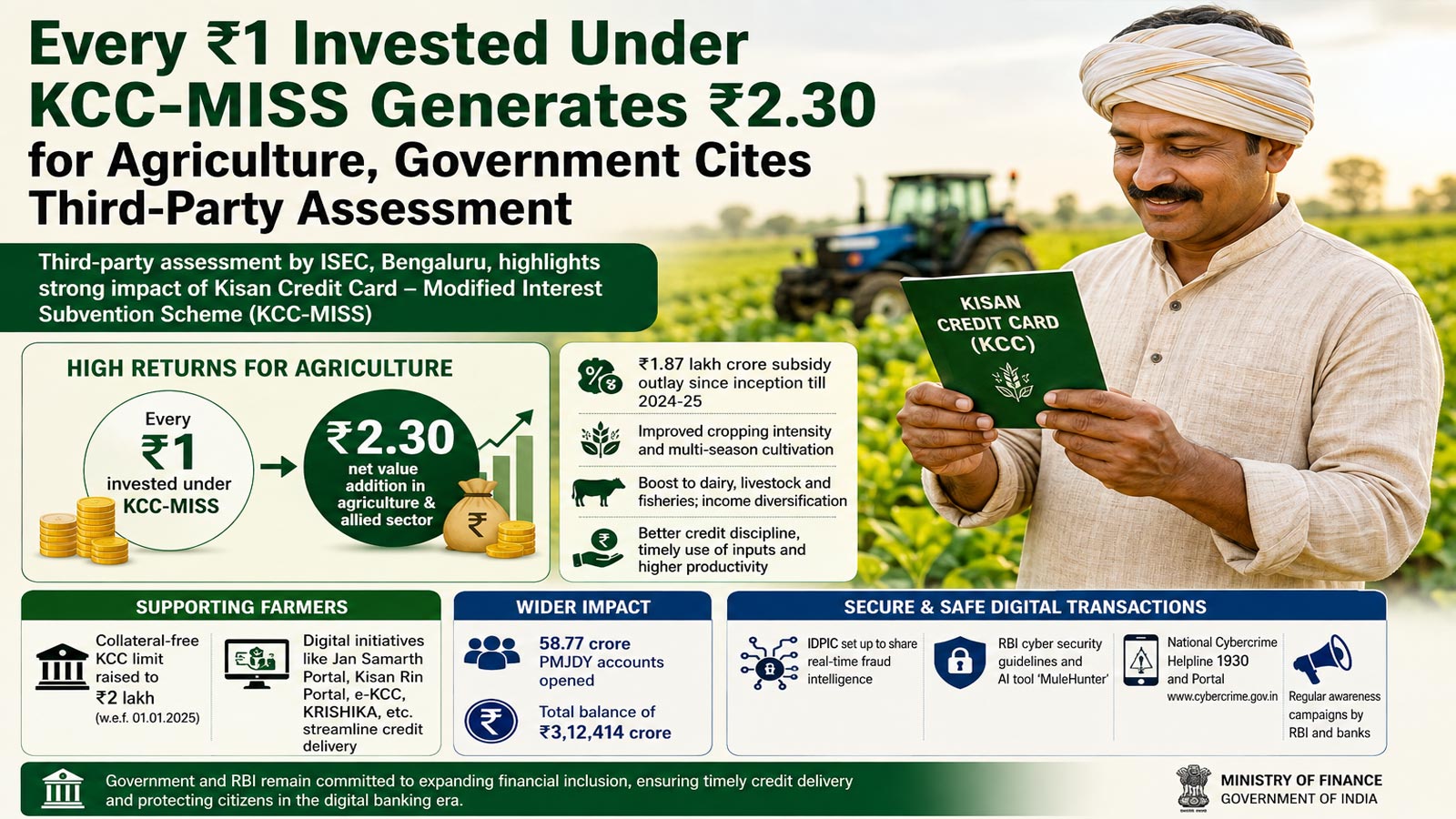
Every ₹1 invested under the Kisan Credit Card-Modified Interest Subvention Scheme (KCC-MISS) generates ₹2.30 in net value addition for the agriculture and allied sector, according to a third-party assessment conducted by the Institute for Social and Economic Change (ISEC), Bengaluru.
The findings underline the scheme’s contribution to improving farm productivity, expanding allied activities and strengthening access to affordable institutional credit.
According to the assessment, the KCC-MISS has significantly reduced the interest burden on farmers through an estimated subsidy outlay of ₹1.87 lakh crore since the scheme’s inception up to 2024-25.
The report found that farmers covered under the scheme have achieved higher cropping intensity and increased multi-season cultivation by gaining access to reliable irrigation and concessional credit. Beneficiaries have also diversified their crop portfolios and cultivated larger areas, supported by timely availability of working capital.
The study noted that access to adequate credit has improved the timely purchase and use of agricultural inputs. Farmers receiving the Prompt Repayment Incentive (PRI) have demonstrated better credit discipline, enhancing banks’ confidence in extending further loans.
Beyond crop cultivation, the scheme has also encouraged diversification into dairy, livestock and fisheries. The assessment found that concessional credit has supported working capital requirements for inland fisheries, particularly benefiting diversification efforts in the North-Eastern region, while helping farmers supplement crop income and reduce dependence on seasonal agriculture.
The government said it has introduced several measures to improve the delivery of agricultural credit and expand the reach of the Kisan Credit Card scheme. These include annual agriculture credit targets under priority sector lending, increasing the collateral-free loan limit under KCC from ₹1.6 lakh to ₹2 lakh with effect from January 1, 2025, and deploying digital platforms such as the Kisan Rin Portal, Jan Samarth Portal, e-KCC and KRISHIKA to streamline credit delivery.
To improve awareness and coverage, the Centre, state governments, the Reserve Bank of India, NABARD, State Level Bankers’ Committees and banks continue to conduct information, education and communication campaigns along with KCC saturation drives across the country.
Official data presented in Parliament showed that there were 7.28 crore operative Kisan Credit Card accounts with an outstanding amount of ₹10.08 lakh crore during 2025-26. Rajasthan recorded the highest outstanding amount at ₹1.15 lakh crore, followed by Uttar Pradesh at ₹1.40 lakh crore, Gujarat at ₹81,322 crore, Maharashtra at ₹75,143 crore, and Andhra Pradesh at ₹70,906 crore.
The data also highlighted the expansion of KCC coverage for allied sectors. Animal Husbandry KCC accounts increased to 51.26 lakh in 2025-26, with outstanding loans of ₹60,997 crore, while Fisheries KCC accounts rose to 1.38 lakh, with outstanding credit of ₹5,355 crore.
The information was provided by Minister of State for Finance Pankaj Chaudhary on Monday in the Lok Sabha in response to a question on the implementation and impact of the Kisan Credit Card scheme.


