







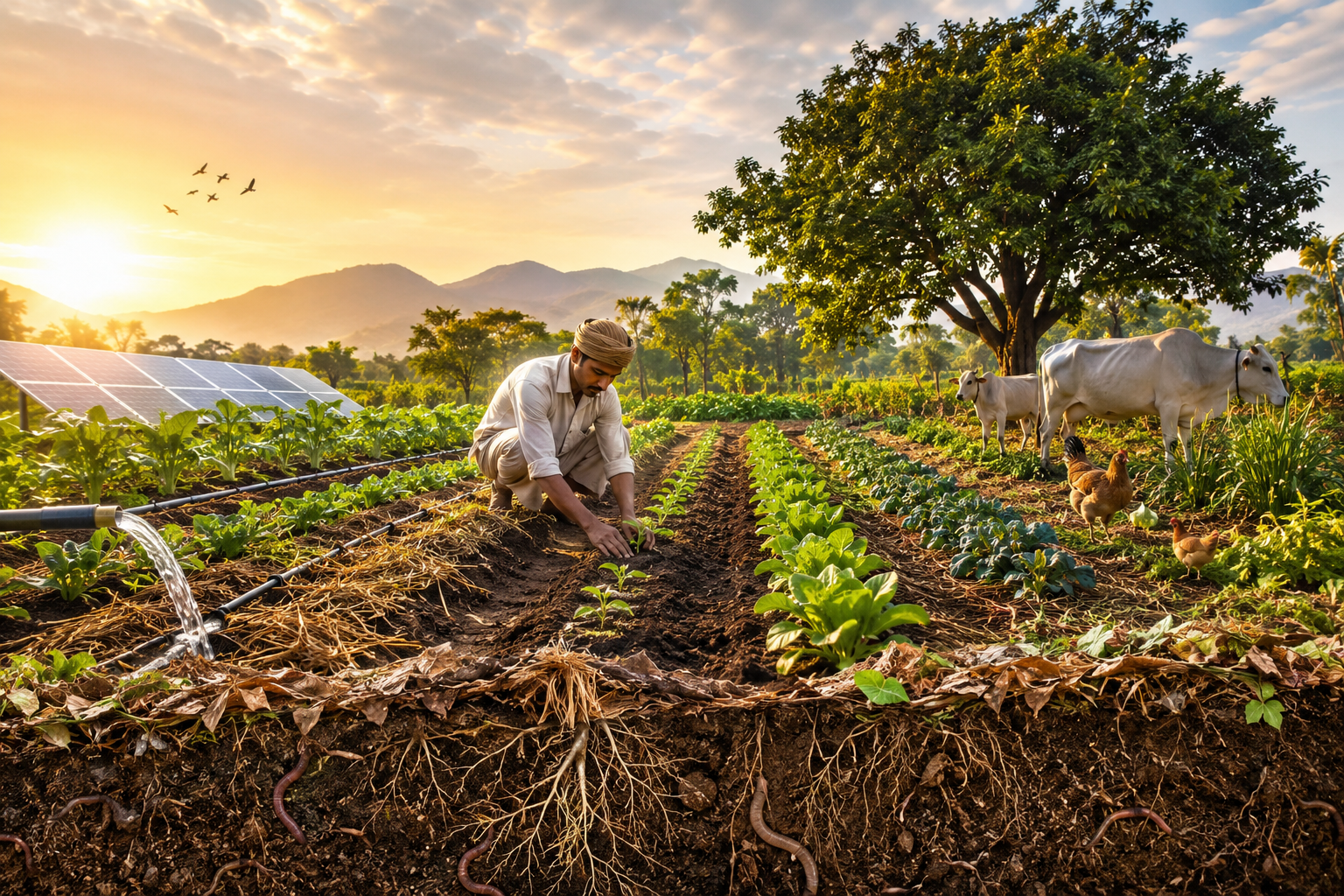
India’s agriculture sector has maintained strong growth over the years, but sustaining that momentum is increasingly linked to the health of the soil, availability of water and resilience of farming systems.
This is where regenerative agriculture comes in. It focuses not merely on sustaining existing farming conditions, but on actively restoring soil health, improving biodiversity and strengthening farms against climate-related stresses.
What is regenerative agriculture?
Regenerative agriculture is a holistic approach to farming that places soil health and biodiversity at its core.
The basic idea is simple: healthier soil can support more productive and resilient farms. The approach seeks to rebuild soil fertility, improve water retention, support biodiversity and strengthen the natural systems on which agriculture depends.
Unlike conventional sustainability approaches that primarily aim to maintain existing conditions, regenerative agriculture seeks to improve the condition of the land over time.
What are its key principles?
Regenerative agriculture broadly focuses on:
- Minimising disturbance to the soil
- Maintaining soil cover
- Protecting living roots of perennial crops
- Integrating livestock with farming
- Limiting chemical inputs
- Enhancing biodiversity
These principles are aimed at restoring the natural foundations of farming while maintaining productivity.
Why does India need regenerative agriculture?
India’s agriculture and allied sectors recorded 4.45 per cent decadal growth during FY16-FY25, the highest among previous decades.
However, intensive cultivation, heavy chemical use and erratic rainfall can put pressure on soil health and farm productivity. Heatwaves, dry spells and excessive rainfall can also increase the risks faced by farmers, particularly small and marginal farmers.
Regenerative agriculture seeks to address these challenges by making farming systems more resource-efficient and resilient.
What practices come under regenerative agriculture?
Regenerative agriculture is not a single farming technique. It brings together several approaches.
Micro-irrigation: Drip and sprinkler systems deliver water closer to plant roots, reducing wastage and improving water-use efficiency.
Natural farming: It uses on-farm biological inputs such as Beejamrut, Jeevamrut, GhanJeevamrut, Neemastra and Dashparni. It also encourages multi-cropping, mulching, cover cropping, minimal soil disturbance and livestock integration.
Soil health management: Green manuring, cover cropping and mulching can add organic matter, protect soil from erosion, conserve moisture and support nutrient cycling.
Integrated Farming Systems: Crops can be combined with livestock, fisheries, horticulture, agroforestry and apiculture. This diversification can reduce the risk of crop failure and create additional livelihood opportunities.
Agroforestry: Integrating trees with crops can provide additional income while improving soil moisture, regulating local temperatures and storing carbon.
How does it help farmers?
The benefits can be both environmental and economic.
Healthier soils can improve soil structure, fertility and water retention. Better soil cover can reduce erosion, while greater biodiversity can support pollinators, beneficial insects and soil microorganisms.
For farmers, reduced dependence on synthetic fertilisers, pesticides and irrigation can help lower input costs. More resilient farming systems can also help farmers cope better with climate variability and market fluctuations.
What is the government doing?
The government is supporting regenerative agricultural practices through several schemes covering natural farming, organic farming, micro-irrigation, integrated farming, agroforestry and soil health management.
Under the National Mission on Natural Farming, launched in 2024, farmers receive an output-based incentive of Rs 4,000 per acre per year for two years, covering up to one acre per farmer.
As of March 5, 2026, 18,786 natural farming clusters had been formed, covering 8.80 lakh hectares and enrolling 18.19 lakh farmers.
The Per Drop More Crop scheme promotes drip and sprinkler irrigation. As of May 2026, it had covered about 109 lakh hectares, with Rs 26,325 crore released as central assistance.
The Rainfed Area Development Programme promotes integrated farming systems. Since its inception, it has covered 9.53 lakh hectares and benefited 15.73 lakh farmers, with Rs 2,251.98 crore provided as central assistance to states as of December 2025.
The Soil Health Card Scheme, launched in 2015, provides farmers with plot-wise soil test reports and crop-specific recommendations. As of March 13, 2026, 25.89 crore Soil Health Cards had been generated since inception.
Can regenerative agriculture help fight climate change?
Yes, according to the approach outlined in the source material.
Regenerative practices can improve soil’s ability to retain water, reduce runoff and erosion, support biodiversity and increase carbon storage. They are also aligned with Sustainable Development Goal 13 on Climate Action, particularly its focus on strengthening resilience and adaptive capacity to climate-related risks.
The bigger picture
Regenerative agriculture is essentially about changing the question from “How much can the land produce this season?” to “How can we keep the land productive for generations?”
For India, the approach brings together soil health, water efficiency, biodiversity, diversified farming and climate resilience.
With natural farming, agroforestry, micro-irrigation, integrated farming systems and scientific soil management being promoted through government interventions, regenerative agriculture is being positioned as one pathway towards healthier soils, more resilient farms and more secure livelihoods.


